Adriana, Bandita, Chitra, and Daisy are four female students, and Amit, Barun, Chetan, and Deb are four male students. Each of them studies in one of three institutes X,Y, and Z. Each student majors in one subject among Marketing, Operations, and Finance, and minors in a different one among these three subjects. The following facts are known about the eight students:
1
Three students are from X, three are from Y, and the remaining two students, both female, are from Z.
2
Both the male students from Y minor in Finance, while the female student from Y majors in Operations.
3
Only one male student majors in Operations, while three female students minor in Marketing.
4
One female and two male students major in Finance.
5
Adriana and Deb are from the same institute. Daisy and Amit are from the same institute.
6
Barun is from Y and majors in Operations. Chetan is from X and majors in Finance.
Official Correct Answer: C. ### Core Concept
Count the students by institute and gender, then use the "same institute" pairs to see which females can go to Z.
### Step-by-Step Solution
1. Fact 1 puts both Z students among the females, and fact 2 puts exactly one female in Y. Y has 3 students, so Y has 2 males and 1 female. X has 3 students, so X has the other 2 males and 1 female.
2. Fact 6 puts Barun in Y and Chetan in X. The second male in Y and the second male in X are therefore Amit and Deb, in some order.
3. Fact 5 says Adriana is with Deb and Daisy is with Amit. Whichever of Amit or Deb is in Y, the female with that male is the one female in Y. The other male's partner is the one female in X.
4. Adriana and Daisy are therefore the Y female and the X female, in some order. Neither is in Z.
5. The two females left over are Bandita and Chitra, so they are the students from Z.
### Why Not the Others
- A, B and D each include Adriana or Daisy, and both of those are placed in X or Y by the pairing with Deb and Amit.
### Quick Check
X = Chetan, one of Amit/Deb, and one of Adriana/Daisy. Y = Barun, the other of Amit/Deb, and the other of Adriana/Daisy. Z = Bandita and Chitra.
**Correct Answer: C**
Adriana, Bandita, Chitra, and Daisy are four female students, and Amit, Barun, Chetan, and Deb are four male students. Each of them studies in one of three institutes X,Y, and Z. Each student majors in one subject among Marketing, Operations, and Finance, and minors in a different one among these three subjects. The following facts are known about the eight students:
1
Three students are from X, three are from Y, and the remaining two students, both female, are from Z.
2
Both the male students from Y minor in Finance, while the female student from Y majors in Operations.
3
Only one male student majors in Operations, while three female students minor in Marketing.
4
One female and two male students major in Finance.
5
Adriana and Deb are from the same institute. Daisy and Amit are from the same institute.
6
Barun is from Y and majors in Operations. Chetan is from X and majors in Finance.
Official Correct Answer: B. ### Core Concept
Fix which male is in Y, since the Y males minor in Finance, and use Daisy's minor to rule out one case.
### Step-by-Step Solution
1. From the institute split, Z is Bandita and Chitra. Y has Barun, one of Amit/Deb, and one of Adriana/Daisy.
2. Suppose Amit is in Y. Then Daisy, who is with Amit, is the female in Y. Fact 2 makes her major Operations, but fact 7 says she minors in Operations. Major and minor must differ, so this case fails.
3. Therefore Deb is in Y, with Adriana as the Y female. Amit and Daisy are in X.
4. Fact 2 says both male students from Y minor in Finance. Deb is a male student from Y, so Deb minors in Finance.
### Why Not the Others
- A and C: fact 2 fixes Deb's minor as Finance, so no other minor is possible.
- D: the minor is determined once Amit-in-Y is eliminated.
**Correct Answer: B**
Adriana, Bandita, Chitra, and Daisy are four female students, and Amit, Barun, Chetan, and Deb are four male students. Each of them studies in one of three institutes X,Y, and Z. Each student majors in one subject among Marketing, Operations, and Finance, and minors in a different one among these three subjects. The following facts are known about the eight students:
1
Three students are from X, three are from Y, and the remaining two students, both female, are from Z.
2
Both the male students from Y minor in Finance, while the female student from Y majors in Operations.
3
Only one male student majors in Operations, while three female students minor in Marketing.
4
One female and two male students major in Finance.
5
Adriana and Deb are from the same institute. Daisy and Amit are from the same institute.
6
Barun is from Y and majors in Operations. Chetan is from X and majors in Finance.
Official Correct Answer: D. ### Core Concept
Assign male majors using the counts in facts 3 and 4, then place Amit using the institute assignment.
### Step-by-Step Solution
1. Fact 3 allows only one male to major in Operations, and fact 6 gives that to Barun.
2. Fact 4 gives two males majoring in Finance. Chetan is one (fact 6). The other is Amit or Deb, and the remaining male majors in Marketing.
3. Amit in Y is impossible, because it would make Daisy the Y female. She would then major in Operations and also minor in Operations (fact 7), which is not allowed. So Deb is in Y and Amit is in X.
4. Deb is a male in Y, so he minors in Finance and cannot also major in it. He cannot major in Operations, which is Barun's alone, so Deb majors in Marketing.
5. That leaves Finance as Amit's major, completing the two male Finance majors, Chetan and Amit.
### Why Not the Others
- A: Deb already takes the Marketing slot.
- B: Barun is the only male in Operations.
- C: the analysis fixes Amit's major.
**Correct Answer: D**
Adriana, Bandita, Chitra, and Daisy are four female students, and Amit, Barun, Chetan, and Deb are four male students. Each of them studies in one of three institutes X,Y, and Z. Each student majors in one subject among Marketing, Operations, and Finance, and minors in a different one among these three subjects. The following facts are known about the eight students:
1
Three students are from X, three are from Y, and the remaining two students, both female, are from Z.
2
Both the male students from Y minor in Finance, while the female student from Y majors in Operations.
3
Only one male student majors in Operations, while three female students minor in Marketing.
4
One female and two male students major in Finance.
5
Adriana and Deb are from the same institute. Daisy and Amit are from the same institute.
6
Barun is from Y and majors in Operations. Chetan is from X and majors in Finance.
7
Daisy minors in Operations.
If Chitra majors in Finance, which subject does Bandita major in?
Official Correct Answer: C. ### Core Concept
Count the female majors and minors from facts 3, 4 and 7, with the placements already fixed.
### Step-by-Step Solution
1. As before, Deb and Adriana are in Y and Amit and Daisy are in X. Adriana is the Y female, so she majors in Operations (fact 2).
2. Fact 4 allows exactly one female to major in Finance. The question gives that as Chitra.
3. Daisy minors in Operations (fact 7), so she cannot major in it. Finance is already taken by Chitra, so Daisy majors in Marketing.
4. Fact 3 says three females minor in Marketing. Daisy minors in Operations, so the three are Adriana, Bandita and Chitra.
5. Bandita therefore cannot major in Marketing, and she cannot major in Finance, which is Chitra's. She majors in Operations.
### Why Not the Others
- A: Finance is Chitra's only female slot.
- D: Bandita minors in Marketing, so she cannot also major in it.
- B: the facts determine her major.
**Correct Answer: C**
An ATM dispenses exactly Rs. 5000 per withdrawal using 100, 200 and 500 rupee notes. The ATM requires every customer to give her preference for one of the three denominations of notes. It then dispenses notes such that the number of notes of the customer’s preferred denomination exceeds the total number of notes of other denominations dispensed to her.
In how many different ways can the ATM serve a customer who gives 500 rupee notes as her preference?
Official Correct Answer: 7. ### Core Concept
Set up the equation for the total amount and count the whole-number solutions that satisfy the preference condition.
### Step-by-Step Solution
1. Let the numbers of Rs. 100, 200 and 500 notes be $a$, $b$ and $c$. Then $100a+200b+500c=5000$, which simplifies to $a+2b+5c=50$.
2. The preference is for 500 notes, so $c>a+b$.
3. Since $a+b\le a+2b=50-5c$, a large $c$ satisfies the condition easily, and a small $c$ cannot satisfy it. Check $c$ from the top.
4. $c=10$: $a+2b=0$, so $(a,b)=(0,0)$. This gives 1 way.
5. $c=9$: $a+2b=5$, so $b=0,1,2$. Here $a+b\le5<9$, so all 3 work. This gives 3 ways.
6. $c=8$: $a+2b=10$, and we need $a+b<8$. Checking $b=0$ to $5$ gives $a+b=10,9,8,7,6,5$. So $b=3,4,5$ work. This gives 3 ways.
7. $c=7$: $a+2b=15$, so $a+b=15-b$. We need $15-b<7$, which means $b>8$, but $b\le7$. No solutions. Smaller $c$ is worse because the required $a+b$ grows while the bound $c$ falls.
8. Total: $1+3+3=7$.
### Quick Check
The valid triples $(a,b,c)$ are $(0,0,10)$, $(5,0,9)$, $(3,1,9)$, $(1,2,9)$, $(4,3,8)$, $(2,4,8)$ and $(0,5,8)$. That is 7.
**Correct Answer: 7**
An ATM dispenses exactly Rs. 5000 per withdrawal using 100, 200 and 500 rupee notes. The ATM requires every customer to give her preference for one of the three denominations of notes. It then dispenses notes such that the number of notes of the customer’s preferred denomination exceeds the total number of notes of other denominations dispensed to her.
If the ATM could serve only 10 customers with a stock of fifty 500 rupee notes and a sufficient number of notes of other denominations, what is the maximum number of customers among these 10 who could have given 500 rupee notes as their preferences?
Official Correct Answer: 6. ### Core Concept
Find the fewest 500 rupee notes a customer who prefers 500 must receive. Then see how many such customers fifty notes can cover.
### Step-by-Step Solution
1. With $a,b,c$ as the numbers of 100, 200 and 500 notes, $a+2b+5c=50$. A 500-preferring customer needs $c>a+b$.
2. For $c=10$, $9$ and $8$ the valid withdrawals exist, as in the previous question (for example $(0,5,8)$ is valid).
3. For $c=7$ we have $a+2b=15$, so $a+b=15-b\ge 8$ because $b\le7$. This is not less than 7, so it fails. Smaller $c$ fails by the same reasoning, since $a+b$ must be at least $50-5c-b$ while $b\le(50-5c)/2$.
4. So each customer who prefers 500 needs at least 8 notes of Rs. 500.
5. With fifty 500 notes, the number of such customers is at most $\lfloor 50/8\rfloor=6$, since $7\times8=56>50$.
6. The other customers prefer 100 or 200 and can be served with no 500 notes. For example, 100 preference with $(a,b,c)=(50,0,0)$ gives $50>0$, which is valid.
7. Six customers use $6\times8=48\le50$ notes of Rs. 500, and the remaining 4 customers use none. So 6 is achievable.
**Correct Answer: 6**
An ATM dispenses exactly Rs. 5000 per withdrawal using 100, 200 and 500 rupee notes. The ATM requires every customer to give her preference for one of the three denominations of notes. It then dispenses notes such that the number of notes of the customer’s preferred denomination exceeds the total number of notes of other denominations dispensed to her.
What is the maximum number of customers that the ATM can serve with a stock of fifty 500 rupee notes and a sufficient number of notes of other denominations, if all the customers are to be served with at most 20 notes per withdrawal?
Official Correct Answer: A. ### Core Concept
With at most 20 notes per withdrawal, find the fewest 500 notes any valid withdrawal can contain. The stock of fifty 500 notes then caps the number of customers.
### Step-by-Step Solution
1. Use $a+2b+5c=50$. The total number of notes is $n=a+b+c=50-b-4c$.
2. The limit $n\le20$ gives $b+4c\ge30$.
3. Every customer must use at least one 500 note if this is possible only with $c\ge1$. Check small $c$ against the upper bound $b\le\lfloor(50-5c)/2\rfloor$:
- $c=0$: need $b\ge30$, but $b\le25$. Impossible.
- $c=1$: need $b\ge26$, but $b\le22$. Impossible.
- $c=2$: need $b\ge22$, but $b\le20$. Impossible.
- $c=3$: need $b\ge18$, but $b\le17$. Impossible.
- $c=4$: need $b\ge14$, and $b\le15$. Possible.
4. For $c=4$, $b=15$, $a=0$ is a withdrawal of 19 notes with 200 as the preference ($15>4$). It is valid. Likewise $(a,b,c)=(2,14,4)$ has 20 notes and $14>6$, which is also valid.
5. So every customer needs at least four 500 notes, and the maximum number of customers is $\lfloor 50/4\rfloor=12$.
### Why Not the Others
- 10 is below what the stock allows.
- 13 and 16 would need fewer than four 500 notes per customer, which the 20-note limit rules out.
**Correct Answer: A**
An ATM dispenses exactly Rs. 5000 per withdrawal using 100, 200 and 500 rupee notes. The ATM requires every customer to give her preference for one of the three denominations of notes. It then dispenses notes such that the number of notes of the customer’s preferred denomination exceeds the total number of notes of other denominations dispensed to her.
What is the number of 500 rupee notes required to serve 50 customers with 500 rupee notes as their preferences and another 50 customers with 100 rupee notes as their preferences, if the total number of notes to be dispensed is the smallest possible?
Official Correct Answer: A. ### Core Concept
For each preference, find the withdrawal with the fewest notes. The 500-note count follows from those two withdrawals.
### Step-by-Step Solution
1. With $a,b,c$ as the numbers of 100, 200 and 500 notes, $a+2b+5c=50$ and the total is $n=50-b-4c$. To minimise $n$, make $b+4c$ as large as possible.
2. 500 preference ($c>a+b$): $c=10$ gives $(0,0,10)$ with 10 notes. $c=9$ gives at best $(1,2,9)$ with 12 notes, and $c=8$ gives at best $(0,5,8)$ with 13 notes. The minimum is 10 notes, using ten 500 notes.
3. 100 preference ($a>b+c$): substituting $a=50-2b-5c$ gives $50-2b-5c>b+c$, so $3(b+2c)<50$, so $b+2c\le16$.
4. Maximise $b+4c$ under $b+2c\le16$. Each unit of $c$ costs 2 of the budget and gains 4, while each unit of $b$ costs 1 and gains 1. So $c$ is the better use, and $c=8$, $b=0$ gives $b+4c=32$.
5. Then $a=50-40=10$, and $10>8$ is valid. The withdrawal is $(10,0,8)$ with 18 notes, and 18 is the minimum, since $c=7,b=2$ gives only 30 for $b+4c$.
6. Rs. 500 notes needed: $50\times10+50\times8=500+400=900$.
### Why Not the Others
- 800 and 750 are below the 900 that these minimum-note withdrawals need.
- 1400 would come from using more 500 notes per customer than the minimum-note choice requires.
**Correct Answer: A**
You are given an n×n square matrix to be filled with numerals so that no two adjacent cells have the same numeral. Two cells are called adjacent if they touch each other horizontally, vertically or diagonally. So a cell in one of the four corners has three cells adjacent to it, and a cell in the first or last row or column which is not in the corner has five cells adjacent to it. Any other cell has eight cells adjacent to it.
What is the minimum number of different numerals needed to fill a 3×3 square matrix?
Official Correct Answer: 4. ### Core Concept
Cells in any $2\times 2$ block all touch each other (horizontally, vertically or diagonally), so they need pairwise different numerals. This gives a lower bound, which a repeating pattern then achieves.
### Step-by-Step Solution
1. Take the top-left $2\times 2$ block. Each of its four cells is adjacent to the other three, so four different numerals are needed. Hence at least 4 numerals are required.
2. Show that 4 is enough by repeating the block, with numerals 1, 2, 3, 4:
$$\begin{matrix}1&2&1\\3&4&3\\1&2&1\end{matrix}$$
3. Check the pattern. Horizontal neighbours are 1 and 2, or 3 and 4. Vertical neighbours are 1 and 3, or 2 and 4. Diagonal neighbours are 1 and 4, or 2 and 3. No two touching cells match.
### Quick Check
The lower bound is 4 and the pattern uses exactly 4, so the minimum is 4.
**Correct Answer: 4**
You are given an n×n square matrix to be filled with numerals so that no two adjacent cells have the same numeral. Two cells are called adjacent if they touch each other horizontally, vertically or diagonally. So a cell in one of the four corners has three cells adjacent to it, and a cell in the first or last row or column which is not in the corner has five cells adjacent to it. Any other cell has eight cells adjacent to it.
What is the minimum number of different numerals needed to fill a 5×5 square matrix?
Official Correct Answer: 4. **Clue Breakdown**:
- The grid is 5x5.
- Adjacent cells include horizontal, vertical, and diagonal neighbors.
- Each cell must have a unique numeral compared to all adjacent cells.
- Goal: Minimum numerals required.
**Step-by-Step Deduction Grid**:
1. **Understanding Adjacency**: Each cell has up to 8 neighbors.
2. **Graph Coloring Insight**: This is a graph coloring problem where each cell is a node, and edges connect adjacent cells. The minimum number of colors needed is the chromatic number.
3. **Smaller Grid Analysis**: For a 2x2 grid, 4 colors are needed as each cell is adjacent to all others.
4. **Pattern Repetition**: Use a 2x2 tile with 4 colors and repeat it across the 5x5 grid.
5. **Color Arrangement**:
```
1 2 1 2 1
3 4 3 4 3
1 2 1 2 1
3 4 3 4 3
1 2 1 2 1
```
6. **Verification**: Each cell's diagonal neighbors have different colors, satisfying the condition.
**Question Resolution**:
The 5x5 grid can be successfully filled using a 4-color repeating pattern, ensuring no two adjacent cells (including diagonally) share the same numeral.
**Final Answer Confirmation**:
Correct Answer: 4
You are given an n×n square matrix to be filled with numerals so that no two adjacent cells have the same numeral. Two cells are called adjacent if they touch each other horizontally, vertically or diagonally. So a cell in one of the four corners has three cells adjacent to it, and a cell in the first or last row or column which is not in the corner has five cells adjacent to it. Any other cell has eight cells adjacent to it.
Suppose you are allowed to make one mistake, that is, one pair of adjacent cells can have the same numeral. What is the minimum number of different numerals required to fill a 5×5 matrix?
Official Correct Answer: A. ### Core Concept
Any $2\times 2$ block needs 4 different numerals. A 5×5 grid has several disjoint $2\times 2$ blocks, so one allowed mistake cannot lower the requirement below 4. Four numerals in a repeating pattern are enough.
### Step-by-Step Solution
1. Four disjoint $2\times 2$ blocks fit in a 5×5 grid, for example in rows 1-2 and 4-5 and columns 1-2 and 4-5.
2. The single allowed mistake is one pair of adjacent cells. Both cells of that pair lie in at most one of these disjoint blocks. So at least 3 blocks have no repeat and each needs 4 distinct numerals. Hence at least 4 numerals are needed.
3. Four numerals suffice even with no mistake. Use numeral 1 for odd row and odd column, 2 for odd row and even column, 3 for even row and odd column, and 4 for even row and even column. Touching cells always differ in row parity, column parity or both, so they get different numerals.
4. The mistake is not needed, so the minimum is 4.
### Why Not the Others
- B) 16: far more than the 4 that the pattern already achieves.
- C) 9: also more than needed; 9 is the answer only when cells sharing a common neighbour must differ.
- D) 25: this would give every cell its own numeral, which is not required.
**Correct Answer: A**
You are given an n×n square matrix to be filled with numerals so that no two adjacent cells have the same numeral. Two cells are called adjacent if they touch each other horizontally, vertically or diagonally. So a cell in one of the four corners has three cells adjacent to it, and a cell in the first or last row or column which is not in the corner has five cells adjacent to it. Any other cell has eight cells adjacent to it.
Suppose that all the cells adjacent to any particular cell must have different numerals. What is the minimum number of different numerals needed to fill a 5×5 square matrix?
Official Correct Answer: D. ### Core Concept
The condition now says that any two cells touching a common cell must differ. Together with the original adjacency rule, every cell in a $3\times 3$ block must then have a different numeral.
### Step-by-Step Solution
1. Take the centre cell of the 5×5 grid. It has 8 adjacent cells, and these must all differ from each other.
2. Each of the 8 also differs from the centre cell, since it is adjacent to it. So the $3\times 3$ block around the centre needs 9 distinct numerals. Hence at least 9 are required.
3. Show that 9 is enough. Give the cell in row $i$, column $j$ the numeral given by the pair $(i \bmod 3,\ j \bmod 3)$, which has 9 possible values.
4. Two cells that touch a common cell differ by at most 2 in row and at most 2 in column, and are not the same cell. So the row difference or the column difference is 1 or 2, which is not a multiple of 3. Their pairs therefore differ, and their numerals differ.
5. The same argument covers cells that touch each other directly, so all conditions hold with 9 numerals.
### Why Not the Others
- A) 25: every cell distinct is not required.
- B) 4: this only handles direct adjacency, not cells sharing a common neighbour.
- C) 16: more than the 9 that work.
**Correct Answer: D**
Official Correct Answer: D. ### Core Concept
Clue 3 means every adjacent pair differs except P7–P8, so each stretch is forced to alternate. Fix P1–P10 first, then use the count condition to test the two possible cases for P10.
### Step-by-Step Solution
1. Clue 2 makes P6 the only low pump in P1–P10, so every other pump there is H or M. Clue 3 says only P7–P8 match, so P1–P5 must alternate between H and M.
2. Clue 1 needs exactly 3 H among P1–P5, so P1–P5 = H M H M H. P1, P3 and P5 are high.
3. P6 = L, so P7 ≠ L. Let P7 = P8 = $x$, with $x$ being H or M. P9 differs from P8 and cannot be L, so P9 is the other level. P10 differs from P9, so P10 = $x$.
4. Clue 4 allows no H in P16–P20, and these five alternate. So they are M L M L M (2 lows) or L M L M L (3 lows).
5. Let P11–P15 hold $h$ highs and $l$ lows. Clue 5 says the number of H equals $2 \times$ the number of L.
6. **Case $x = M$:** P1–P10 then has 4 H (P1, P3, P5, P9) and 1 L. With $m$ lows in P16–P20 ($m$ = 2 or 3), the clue 5 equation is $4 + h = 2(1 + l + m)$, so $h = 2l + 2m - 2$.
7. Since $h \le 3$ (no two adjacent pumps match), $l = 0$ is forced. Then $m = 2$ and $h = 2$.
8. With $l = 0$, P11–P15 uses only H and M, so it alternates. P10 = M forces P11 = H, giving H M H M H with $h = 3$. This contradicts $h = 2$, so $x = M$ is impossible.
9. Therefore $x = H$, and P10 = H in every valid arrangement.
10. The other options can fail. With P11–P15 = M H M H M and P16–P20 = L M L M L, all clues hold and P20 = L, which refutes A. With P11–P15 = M H M H L and P16–P20 = M L M L M, all clues hold and P13 = M, which refutes B. With P11–P15 = M L H M H and P16–P20 = M L M L M, all clues hold and P12 = L, which refutes C.
### Why Not the Others
- A: P20 can be L, as in the first arrangement in step 10.
- B: P13 can be M, as in the second arrangement in step 10.
- C: P12 can be L, as in the third arrangement in step 10.
### Quick Check
In the first arrangement there are 8 H (P1, P3, P5, P7, P8, P10, P12, P14) and 4 L (P6, P16, P18, P20), so H = 2L.
**Correct Answer: D**
Official Correct Answer: C. ### Core Concept
Work out the fixed part (P1–P10), then use H = 2L and the total of 20 pumps to fix the number of mediums.
### Step-by-Step Solution
1. From the clues, P1–P5 = H M H M H and P6 = L. P7–P10 must be H H M H. The alternative M M H M fails the count condition (it would give H = 4 and L = 1, and then P11–P15 cannot be completed).
2. So P1–P10 has 6 H, 1 L and 3 M.
3. P16–P20 has no H (clue 4) and no equal neighbours, so it is M L M L M (2 L) or L M L M L (3 L).
4. Let the total be L lows and H = 2L highs. P11–P15 can hold at most 2 H, because P11 ≠ H, and no two neighbours are equal.
5. If L = 3, then H = 6, so P11–P15 would have no H and 0 L, which is impossible. If L ≥ 5, then H ≥ 10, which needs at least 4 H in P11–P15, also impossible. So L = 4 and H = 8.
6. Mediums = 20 − 8 − 4 = 8. Two valid grids confirm this: M H M H M with L M L M L, and M H M H L with M L M L M.
### Quick Check
8 H + 4 L + 8 M = 20, and H = 2 × L.
**Correct Answer: C**
Official Correct Answer: D. ### Core Concept
Once P11 is fixed as low, the count condition forces the whole of P11–P20.
### Step-by-Step Solution
1. From the clues, P1–P10 = H M H M H L H H M H. Highs must equal twice the lows, which gives 8 H and 4 L in total (so 8 M).
2. P16–P20 has no H and alternates, so it is either M L M L M or L M L M L.
3. P11 = L is one low. P1–P10 holds one low, and P16–P20 holds at least 2, so the total is already at least 4. It must be exactly 4. So P16–P20 is M L M L M, and P11 is the only low in P11–P15.
4. Highs: 6 so far in P1–P10, so P11–P15 needs 2 H. P11–P15 therefore has 1 L, 2 H and 2 M.
5. P16 = M, so P15 ≠ M. The only low is P11, so P15 = H.
6. P12 to P14 hold 1 H and 2 M with no equal neighbours. P14 ≠ H because P15 = H, and P12 ≠ L. The only fit is M H M.
7. The sequence is P11–P15 = L M H M H, so P14 = M.
### Why Not the Others
- A: P12 = M, not H.
- B: P15 = H, not M.
- C: P18 = M, not L.
**Correct Answer: D**
Official Correct Answer: B. ### Core Concept
Setting P15 = M forces the pattern in P16–P20, and the count condition then fixes P11–P15.
### Step-by-Step Solution
1. From the clues, P1–P10 = H M H M H L H H M H. This has 6 H and 1 L.
2. P16–P20 has no H and alternates M and L. Since P15 = M, P16 ≠ M, so P16–P20 = L M L M L, which has 3 L.
3. Total lows are now at least 1 + 3 = 4. Highs must be at least 8, and the count condition then needs exactly 4 L and 8 H. So P11–P15 has no L and exactly 2 H.
4. P11–P15 uses only H and M, with no equal neighbours and P11 ≠ H (as P10 = H). The only pattern with 2 H ending in M is M H M H M.
5. The full tail is P11–P20 = M H M H M L M L M L.
6. Check each option:
- A: P13 = M and P17 = M, so true.
- B: P11 = M and P16 = L, so they differ. The statement is false.
- C: P14 = H is higher than P15 = M, so true.
- D: P10 = H and P14 = H, so true.
7. Only B is impossible.
**Correct Answer: B**
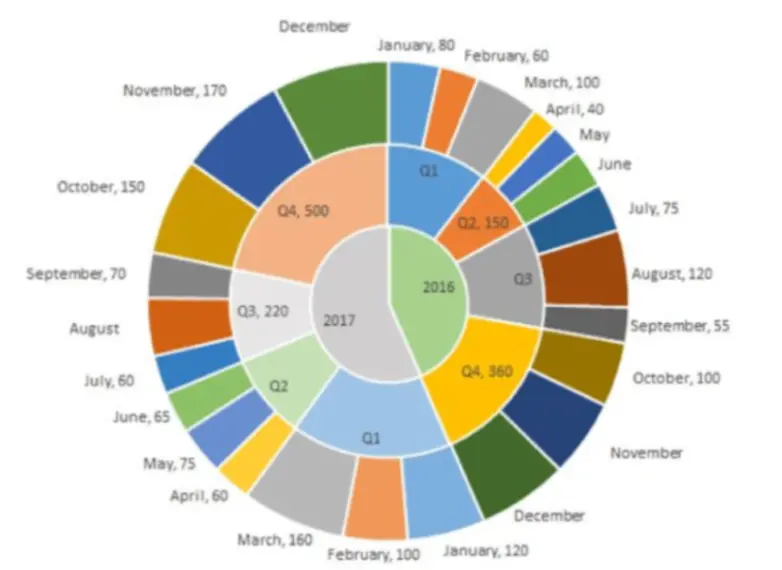
The multi-layered pie-chart below shows the sales of LED television sets for a big retail electronics outlet during 2016 and 2017. The outer layer shows the monthly sales during this period, with each label showing the month followed by sales figure of that month. For some months, the sales figures are not given in the chart. The middle-layer shows quarterwise aggregate sales figures (in some cases, aggregate quarter-wise sales numbers are not given next to the quarter). The innermost layer shows annual sales. It is known that the sales figures during the three months of the second quarter (April, May, June) of 2016 form an arithmetic progression, as do the three monthly sales figures in the fourth quarter (October, November, December) of that year.
Official Reference Chart - CAT 2018 Slot 1
What is the percentage increase in sales in December 2017 as compared to the sales in December 2016?
Official Correct Answer: C. ### Core Concept
Rebuild the missing monthly figures from the quarter totals and the arithmetic-progression (AP) condition, then compare December 2017 with December 2016.
### Step-by-Step Solution
1. The 2016 Q4 total is 360 and October is 100. Oct, Nov and Dec form an AP, so Nov $= 360/3 = 120$ (the middle term is the mean). The common difference is 20, so Dec 2016 $= 140$.
2. The 2017 Q4 total is 500, with October 150 and November 170. So Dec 2017 $= 500 - 150 - 170 = 180$.
3. Percentage increase $= \dfrac{180-140}{140}\times 100 = \dfrac{40}{140}\times 100 = 28.57\%$.
### Why Not the Others
- A) 38.46 would need a base of 130 for December 2016, which the AP does not give.
- B) 22.22 is not $40/140$.
- D) 50.00 would need a December 2016 base of 120, which is the November figure.
### Quick Check
$140 \times 1.2857 = 180$.
**Correct Answer: C**
The multi-layered pie-chart below shows the sales of LED television sets for a big retail electronics outlet during 2016 and 2017. The outer layer shows the monthly sales during this period, with each label showing the month followed by sales figure of that month. For some months, the sales figures are not given in the chart. The middle-layer shows quarterwise aggregate sales figures (in some cases, aggregate quarter-wise sales numbers are not given next to the quarter). The innermost layer shows annual sales. It is known that the sales figures during the three months of the second quarter (April, May, June) of 2016 form an arithmetic progression, as do the three monthly sales figures in the fourth quarter (October, November, December) of that year.
Official Reference Chart - CAT 2018 Slot 1
In which quarter of 2017 was the percentage increase in sales from the same quarter of 2016 the highest?
Official Correct Answer: B. ### Core Concept
Find each quarter's total for 2016 and 2017, then compare the percentage growth quarter by quarter.
### Step-by-Step Solution
1. The 2016 quarters are Q1 $= 80+60+100 = 240$, Q2 $= 150$ (given), Q3 $= 75+120+55 = 250$ and Q4 $= 360$ (given).
2. For 2017, Q1 $= 120+100+160 = 380$, Q2 $= 60+75+65 = 200$ and Q3 $= 220$ (given). Q4 $= 500$ (given).
3. Growth by quarter:
- Q1: $\dfrac{380-240}{240} = 58.3\%$
- Q2: $\dfrac{200-150}{150} = 33.3\%$
- Q3: $220 < 250$, so sales fell
- Q4: $\dfrac{500-360}{360} = 38.9\%$
4. Q1 has the highest increase, at about 58.3%.
### Why Not the Others
- A) Q2 grew only 33.3%.
- C) Q4 grew 38.9%, which is less than Q1.
- D) Q3 declined.
**Correct Answer: B**
The multi-layered pie-chart below shows the sales of LED television sets for a big retail electronics outlet during 2016 and 2017. The outer layer shows the monthly sales during this period, with each label showing the month followed by sales figure of that month. For some months, the sales figures are not given in the chart. The middle-layer shows quarterwise aggregate sales figures (in some cases, aggregate quarter-wise sales numbers are not given next to the quarter). The innermost layer shows annual sales. It is known that the sales figures during the three months of the second quarter (April, May, June) of 2016 form an arithmetic progression, as do the three monthly sales figures in the fourth quarter (October, November, December) of that year.
Official Reference Chart - CAT 2018 Slot 1
During which quarter was the percentage decrease in sales from the previous quarter’s sales the highest?
Official Correct Answer: A. ### Core Concept
Compute the quarter totals for both years, then find the percentage change from each quarter to the one before it. Only the quarters named in the options need checking.
### Step-by-Step Solution
1. The 2016 totals are Q1 $= 240$, Q2 $= 150$, Q3 $= 250$ and Q4 $= 360$. The 2017 totals are Q1 $= 380$, Q2 $= 200$, Q3 $= 220$ and Q4 $= 500$.
2. Q1 2017 against Q4 2016: $360 \to 380$, an increase, so it is not a decrease.
3. Q2 2017 against Q1 2017: $\dfrac{380-200}{380} = 47.4\%$ decrease.
4. Q4 2017 against Q3 2017: $220 \to 500$, an increase, so it is not a decrease.
5. Q2 2016 against Q1 2016: $\dfrac{240-150}{240} = 37.5\%$ decrease.
6. The largest decrease is 47.4%, in Q2 of 2017.
### Why Not the Others
- B) Q4 of 2017 rose sharply.
- C) Q2 of 2016 fell only 37.5%.
- D) Q1 of 2017 rose.
**Correct Answer: A**
The multi-layered pie-chart below shows the sales of LED television sets for a big retail electronics outlet during 2016 and 2017. The outer layer shows the monthly sales during this period, with each label showing the month followed by sales figure of that month. For some months, the sales figures are not given in the chart. The middle-layer shows quarterwise aggregate sales figures (in some cases, aggregate quarter-wise sales numbers are not given next to the quarter). The innermost layer shows annual sales. It is known that the sales figures during the three months of the second quarter (April, May, June) of 2016 form an arithmetic progression, as do the three monthly sales figures in the fourth quarter (October, November, December) of that year.
Official Reference Chart - CAT 2018 Slot 1
During which month was the percentage increase in sales from the previous month’s sales the highest?
Official Correct Answer: B. ### Core Concept
Compare the month-on-month percentage rise for each month listed. The base month is small in some cases, which makes the rise large.
### Step-by-Step Solution
1. March 2017 against February 2017: $\dfrac{160-100}{100} = 60\%$.
2. October 2017 against September 2017: September is 70 and October is 150, so $\dfrac{150-70}{70} = 114.3\%$.
3. March 2016 against February 2016: $\dfrac{100-60}{60} = 66.7\%$.
4. October 2016 against September 2016: $\dfrac{100-55}{55} = 81.8\%$.
5. The highest rise is 114.3%, in October 2017.
### Why Not the Others
- A) March 2017 rose 60%.
- C) March 2016 rose 66.7%.
- D) October 2016 rose 81.8%.
**Correct Answer: B**
Twenty four people are part of three committees which are to look at research, teaching, and administration respectively. No two committees have any member in common. No two committees are of the same size. Each committee has three types of people: bureaucrats, educationalists, and politicians, with at least one from each of the three types in each committee. The following facts are also known about the committees:
1
The numbers of bureaucrats in the research and teaching committees are equal, while the number of bureaucrats in the research committee is 75% of the number of bureaucrats in the administration committee.
2
The number of educationalists in the teaching committee is less than the number of educationalists in the research committee. The number of educationalists in the research committee is the average of the numbers of educationalists in the other two committees.
3
60% of the politicians are in the administration committee, and 20% are in the teaching committee.
Based on the given information, which of the following statements MUST be FALSE?
Official Correct Answer: C. ### Core Concept
Translate the three facts into equations in the unknowns, find every size split that fits, and see which statement fails in all of them.
### Step-by-Step Solution
1. Fact 1: let the bureaucrats be $b$ in research and in teaching. Then administration has $\frac{4b}{3}$, so $b=3k$ and the three committees have $3k, 3k, 4k$. Total bureaucrats $=10k$.
2. Fact 3: let the total number of politicians be $5m$. Administration has $3m$, teaching has $m$ and research has $m$.
3. Fact 2: let research have $e$ educationalists. The other two average $e$, so total educationalists $=3e$, with teaching $<e<$ administration.
4. The total is 24, so $10k+3e+5m=24$. With $k\ge1$ and $m\ge1$, $k=2$ would leave $4=3e+5m$, which is impossible. So $k=1$, and $3e+5m=14$ gives $m=1$, $e=3$.
5. Bureaucrats are 3, 3, 4 and politicians are 1, 1, 3 (research, teaching, administration). Educationalists in research are 3, and teaching and administration have either $(1,5)$ or $(2,4)$.
6. Sizes: research $=3+3+1=7$. Teaching is 5 or 6. Administration is 12 or 11.
7. Research (7) is always larger than teaching (5 or 6). So the statement that research is smaller than teaching can never be true.
### Why Not the Others
- A: Possible. If teaching has 1 educationalist, it has 1 politician too.
- B: Possible. Administration has 4 bureaucrats, and 4 educationalists when the split is $(2,4)$.
- D: Always true, since $7<11$ or $12$.
**Correct Answer: C**
Twenty four people are part of three committees which are to look at research, teaching, and administration respectively. No two committees have any member in common. No two committees are of the same size. Each committee has three types of people: bureaucrats, educationalists, and politicians, with at least one from each of the three types in each committee. The following facts are also known about the committees:
1
The numbers of bureaucrats in the research and teaching committees are equal, while the number of bureaucrats in the research committee is 75% of the number of bureaucrats in the administration committee.
2
The number of educationalists in the teaching committee is less than the number of educationalists in the research committee. The number of educationalists in the research committee is the average of the numbers of educationalists in the other two committees.
3
60% of the politicians are in the administration committee, and 20% are in the teaching committee.
What is the number of bureaucrats in the administration committee?
Official Correct Answer: 4. First, the problem states there are three committees: research, teaching, and administration. Each has bureaucrats, educationalists, and politicians, with at least one from each type. The sizes of the committees are different, and they don't share any members.
Let me list the key facts:
1. **Committee Sizes**: All three committees have different sizes, and they add up to 24 people. So, if I denote the sizes as R, T, and A for research, teaching, and administration respectively, then R + T + A = 24.
2. **Bureaucrats**: The number of bureaucrats in research (B_R) equals that in teaching (B_T). Also, B_R is 75% of the bureaucrats in administration (B_A). So, B_R = B_T and B_R = 0.75 * B_A.
3. **Educationalists**: The number in teaching (E_T) is less than in research (E_R). Also, E_R is the average of E_T and E_A (administration). So, E_R = (E_T + E_A)/2.
4. **Politicians**: 60% are in administration, and 20% are in teaching. So, P_A = 0.6 * P_total and P_T = 0.2 * P_total. The remaining 20% must be in research, so P_R = 0.2 * P_total.
Since each committee has at least one of each type, the minimum size for each is 3. But since the total is 24 and they are different sizes, let's think about possible sizes.
Let the sizes as R, T, A. They must be distinct and sum to 24. Let's assume R < T < A for simplicity.
Possible triplets (R, T, A) that add to 24 and are distinct:
- 4, 6, 14
- 5, 6, 13
- 5, 7, 12
- 6, 7, 11
- 6, 8, 10
- 7, 8, 9
Now, considering the bureaucrats: B_R = B_T and B_R = 0.75 * B_A. So, B_A must be a multiple of 4 since 0.75 is 3/4. Let's say B_A = 4k, then B_R = B_T = 3k.
Each committee must have at least one bureaucrat, so k must be at least 1. Let's try k=1: B_A=4, B_R=B_T=3.
Now, the total bureaucrats would be 3 + 3 + 4 = 10. So, total people accounted for so far: 10. The remaining 14 must be educationalists and politicians.
Looking at politicians: P_A = 0.6P_total, P_T = 0.2P_total, P_R = 0.2P_total. So, P_total = P_A + P_T + P_R = 0.6P + 0.2P + 0.2P = P_total, which checks out.
Let P_total as P. Then P_A = 0.6P, P_T = 0.2P, P_R = 0.2P.
Each committee must have at least one politician, so P_A ≥1, P_T ≥1, P_R ≥1. Thus, P must be at least 5 because 0.2P must be ≥1, so P ≥5.
Now, total people in each committee:
For research (R): B_R + E_R + P_R = R
Similarly for T and A.
Let me try the size triplet (6, 8, 10). So R=6, T=8, A=10.
Check if this works with the bureaucrats:
B_R = 3, B_T=3, B_A=4. So total bureaucrats=10.
Now, total people accounted for: 10. Remaining: 14, which must be E and P.
Let E_R, E_T, E_A as the educationalists in each committee.
From fact 3: E_T < E_R and E_R = (E_T + E_A)/2.
Let me express E_A = 2E_R - E_T.
Since all E must be at least 1, let's assign E_R ≥1, E_T ≥1, E_A ≥1.
Also, total educationalists E_total = E_R + E_T + E_A.
Similarly, total politicians P_total = P_R + P_T + P_A.
We know that total people in each committee:
R: 3 + E_R + P_R = 6 → E_R + P_R = 3
T: 3 + E_T + P_T = 8 → E_T + P_T = 5
A: 4 + E_A + P_A = 10 → E_A + P_A = 6
Also, P_A = 0.6P, P_T = 0.2P, P_R = 0.2P.
So, P_A = 0.6P, P_T = 0.2P, P_R = 0.2P.
Adding these: 0.6P + 0.2P + 0.2P = P.
Now, from the committees:
P_R = 0.2P, so from R: E_R + 0.2P = 3 → E_R = 3 - 0.2P
Similarly, from T: E_T + 0.2P = 5 → E_T = 5 - 0.2P
From A: E_A + 0.6P = 6 → E_A = 6 - 0.6P
Now, E_total = E_R + E_T + E_A = (3 - 0.2P) + (5 - 0.2P) + (6 - 0.6P) = 14 - P
But E_total must be equal to the total number of educationalists, which is 24 - (total bureaucrats + total politicians). Total bureaucrats are 10, so total politicians = P. Thus, E_total = 24 - 10 - P = 14 - P. So that matches.
Now, from the educationalists' conditions:
E_T < E_R and E_R = (E_T + E_A)/2.
Substitute E_R, E_T, E_A from above:
E_T = 5 - 0.2P
E_R = 3 - 0.2P
E_A = 6 - 0.6P
So, E_T < E_R → 5 - 0.
Twenty four people are part of three committees which are to look at research, teaching, and administration respectively. No two committees have any member in common. No two committees are of the same size. Each committee has three types of people: bureaucrats, educationalists, and politicians, with at least one from each of the three types in each committee. The following facts are also known about the committees:
1
The numbers of bureaucrats in the research and teaching committees are equal, while the number of bureaucrats in the research committee is 75% of the number of bureaucrats in the administration committee.
2
The number of educationalists in the teaching committee is less than the number of educationalists in the research committee. The number of educationalists in the research committee is the average of the numbers of educationalists in the other two committees.
3
60% of the politicians are in the administration committee, and 20% are in the teaching committee.
What is the number of educationalists in the research committee?
Official Correct Answer: 3. ### Core Concept
Set up equations for the bureaucrats, educationalists and politicians in each committee. The total of 24 then forces a single value.
### Step-by-Step Solution
1. Fact 1: bureaucrats are $3k, 3k, 4k$ in research, teaching and administration, since research is 75% of administration. Total $=10k$.
2. Fact 3: politicians total $5m$, split $m$ (research), $m$ (teaching) and $3m$ (administration), from 20%, 20% and 60%.
3. Fact 2: if research has $e$ educationalists, the other two committees average $e$. Total educationalists $=3e$.
4. The total gives $10k+3e+5m=24$. Every committee has at least one of each type, so $k\ge1$ and $m\ge1$.
5. If $k=2$, then $3e+5m=4$, which is impossible. So $k=1$, and $3e+5m=14$.
6. $m=1$ gives $3e=9$, so $e=3$. Larger $m$ makes the left side exceed 14.
7. Research therefore has 3 educationalists. This fits teaching $<3<$ administration, with $(1,5)$ or $(2,4)$.
### Quick Check
Research has $3+3+1=7$ people, teaching 5 or 6 and administration 12 or 11. The total is 24 either way.
**Correct Answer: 3**
Twenty four people are part of three committees which are to look at research, teaching, and administration respectively. No two committees have any member in common. No two committees are of the same size. Each committee has three types of people: bureaucrats, educationalists, and politicians, with at least one from each of the three types in each committee. The following facts are also known about the committees:
1
The numbers of bureaucrats in the research and teaching committees are equal, while the number of bureaucrats in the research committee is 75% of the number of bureaucrats in the administration committee.
2
The number of educationalists in the teaching committee is less than the number of educationalists in the research committee. The number of educationalists in the research committee is the average of the numbers of educationalists in the other two committees.
3
60% of the politicians are in the administration committee, and 20% are in the teaching committee.
Which of the following CANNOT be determined uniquely based on the given information?
Official Correct Answer: A. ### Core Concept
Solving the constraints leaves one open choice. Check which quantities change with it.
### Step-by-Step Solution
1. Fact 1 gives bureaucrats $3k, 3k, 4k$. Fact 3 gives politicians $m, m, 3m$. Fact 2 gives total educationalists $3e$.
2. The total $10k+3e+5m=24$ forces $k=1$, $m=1$, $e=3$.
3. Bureaucrats are 3, 3, 4, so the total of 10 is fixed. Educationalists total $3\times3=9$, also fixed.
4. Research size is $3+3+1=7$, which is fixed.
5. Teaching and administration educationalists can be $(1,5)$ or $(2,4)$. Both satisfy teaching $<3<$ administration and the average condition.
6. Teaching size is then $3+1+1=5$ or $3+2+1=6$. Both are valid, since the sizes 7, 5, 12 and 7, 6, 11 are all distinct. Nothing in the facts chooses between them, so the teaching size cannot be determined uniquely.
### Why Not the Others
- B: Research is always 7.
- C: Bureaucrats total 10 in every case.
- D: Educationalists total 9 in every case.
**Correct Answer: A**
1600 satellites were sent up by a country for several purposes. The purposes are classified as broadcasting (B), communication (C), surveillance (S), and others (O). A satellite can serve multiple purposes; however a satellite serving either B, or C, or S does not serve O. The following facts are known about the satellites:
1
The numbers of satellites serving B, C, and S (though may be not exclusively) are in the ratio 2:1:1.
2
The number of satellites serving all three of B, C, and S is 100.
3
The number of satellites exclusively serving C is the same as the number of satellites exclusively serving S. This number is 30% of the number of satellites exclusively serving B.
4
The number of satellites serving O is the same as the number of satellites serving both C and S but not B.
What best can be said about the number of satellites serving C?
Official Correct Answer: C. ### Core Concept
Set up the Venn regions of B, C and S with one free variable, use the ratio and total conditions to express everything in it, then find the range of C allowed by non-negative region sizes.
### Step-by-Step Solution
1. Let the number serving only C be $0.3x$ and only S be $0.3x$ (Fact 3), where $x$ is the number serving only B. Let $a$, $b$, $c$ be the numbers serving exactly B&C, exactly B&S, exactly C&S. All three: 100 (Fact 2).
2. Fact 4: the number serving O equals $c$, so let $O = c = z$. O satellites serve none of B, C, S, so they are a separate region.
3. Totals: $B = x + a + b + 100$, $C = 0.3x + a + z + 100$, $S = 0.3x + b + z + 100$.
4. Fact 1 gives $C = S$, so $a = b$. Then $B = 2C$ gives $x + 2a + 100 = 0.6x + 2a + 2z + 200$, so $0.4x = 2z + 100$ and $x = 5z + 250$.
5. The total is 1600, with O included: $x + 0.6x + 2a + z + 100 + z = 1600$. Substituting $x = 5z + 250$ gives $8z + 400 + 2a + 2z + 100 = 1600$, so $a = 550 - 5z$.
6. Then $C = 0.3x + a + z + 100 = (1.5z + 75) + (550 - 5z) + z + 100 = 725 - 2.5z$.
7. Range of $z$: $z \ge 0$, and $a \ge 0$ requires $z \le 110$. Both extremes are valid, since $x = 800$ and $a = 0$ at $z = 110$.
8. At $z = 0$, $C = 725$. At $z = 110$, $C = 725 - 275 = 450$. So $450 \le C \le 725$.
### Why Not the Others
- A: "At least 100" is true but far weaker than the range actually forced.
- B: "Cannot be more than 800" is true but loose, since $C$ never exceeds 725.
- D: $C$ can never fall below 450, so "between 400 and 800" is a much looser range than the one derived.
### Quick Check
At $z = 0$: $x = 250$, $a = b = 550$, only C = only S = 75, all three = 100. The total is $250 + 75 + 75 + 550 + 550 + 100 = 1600$, $B = 1450$ and $C = 725$, so $B = 2C$.
**Correct Answer: C**
+39 More Verified Questions Available
Practice the complete collection of 64 questions in our interactive CBT practice interface with personal progress tracking.