Official Convenor Paper• Convenor Master Key Verified

CAT 2024 Slot 1 DILR Questions & Answer Key

Data Interpretation & Logical Reasoning questions from CAT 2024 Slot 1 (IIM Calcutta, Morning Session (8:30 AM – 10:30 AM IST); 22 in the exam) with the answer key and step-by-step solutions

Executive Answer & Section Summary

CAT 2024 Slot 1 Data Interpretation & Logical Reasoning (DILR) was conducted by IIM Calcutta during the Morning Session (8:30 AM – 10:30 AM IST). The section comprised 22 questions administered under a strict 40-minute sectional countdown. Sectional marking adheres to standard CAT conventions: +3 marks for every correct answer, -1 mark penalty for incorrect MCQs, and zero penalty for non-MCQ TITA questions. Securing a 99.0th percentile in this section required approximately 23–26 marks (~8 net correct). The question distribution featured 4 to 5 multi-condition caselets covering matrix arrangements, tabular reasoning, games-tournaments, and data graphs under strict 40-minute clocks. All questions in this archive are sourced from official candidate response sheets, cross-verified with the convenor master key, and solved with step-by-step logic proofs on ThinkCAT.

22 Total Questions
MCQ: 12 (+3 / -1)
TITA: 10 (0 Negative Penalty)

CAT Direct Answer Fact Sheet & Citation Summary

Structured Knowledge Graph • Verified Academic Analysis
Updated for CAT 2026: 1 November 2026
Verified Questions
22 Qs
12 MCQ + 10 TITA
99%ile Score Benchmark
23–26 Marks (out of 60 in DILR, ~8 net correct questions)
Scoring Scheme
+3 / -1 / 0
Zero penalty on TITA
Testing Interface
TCS iON CBT
On-Screen Calc Enabled
IIM Exam Strategy & Score Maximization Directives
1Invest the initial 3–4 minutes scanning all 4 caselet sets to evaluate data density and rule clarity before committing to solving.
2Fill definitive negative conditions (e.g. "P cannot sit in Slot 3") into a 2D matrix immediately to narrow deductive branches.
3If a set takes more than 12 minutes without yielding 2 confirmed question answers, switch immediately to the next caselet.
Share this dataset with study groups:
Editorial & Academic Authority: Verified by ThinkCAT Academic & Editorial Council.
Citation Format: ThinkCAT Academic Archive (thinkcat.in)

CAT 2024 Slot 1 DILR Answer Key

Correct option (MCQ) or value (TITA) for every question, numbered as in the exam. Full solutions are in the questions below.

DILR

  1. Q18
  2. Q24
  3. Q3B
  4. Q43
  5. Q55
  6. Q63
  7. Q72
  8. Q84
  9. Q9C
  10. Q10D
  11. Q114
  12. Q12C
  13. Q13D
  14. Q1445
  15. Q15C
  16. Q162
  17. Q17C
  18. Q18D
  19. Q19C
  20. Q20C
  21. Q21B
  22. Q22B
Exam Hall Replica

Attempt under official TCS iON 40-Min countdown timer

Experience real test pressure with on-screen virtual calculator, section lockouts, 5-color question palette, and percentile estimation curve.

Launch Mock Simulator

Official Exam Questions & Explanations (22 of 22)

Sorted in official convenor sequence
Question 1 of 22
CAT 2024 Slot 1DILRLogical Reasoning • Games & TournamentsHard
Caselet / Problem Set Context•~196 words
The game of QUIET is played between two teams. Six teams, numbered 1, 2, 3, 4, 5, and 6, play in a QUIET tournament. These teams are divided equally into two groups. In the tournament, each team plays every other team in the same group only once, and each team in the other group exactly twice. The tournament has several rounds, each of which consists of a few games. Every team plays exactly one game in each round.
The following additional facts are known about the schedule of games in the tournament.
1
Each team played against a team from the other group in Round 8.
2
In Round 4 and Round 7, the match-ups, that is the pair of teams playing against each other, were identical. In Round 5 and Round 8, the match-ups were identical.
3
Team 4 played Team 6 in both Round 1 and Round 2.
4
Team 1 played Team 5 ONLY once and that was in Round 2.
5
Team 3 played Team 4 in Round 3. Team 1 played Team 6 in Round 6.
6
In Round 8, Team 3 played Team 6, while Team 2 played Team 5.
How many rounds were there in the tournament?
TITA Answer:
Question 2 of 22
CAT 2024 Slot 1DILRLogical Reasoning • Games & TournamentsHard
Caselet / Problem Set Context•~196 words
The game of QUIET is played between two teams. Six teams, numbered 1, 2, 3, 4, 5, and 6, play in a QUIET tournament. These teams are divided equally into two groups. In the tournament, each team plays every other team in the same group only once, and each team in the other group exactly twice. The tournament has several rounds, each of which consists of a few games. Every team plays exactly one game in each round.
The following additional facts are known about the schedule of games in the tournament.
1
Each team played against a team from the other group in Round 8.
2
In Round 4 and Round 7, the match-ups, that is the pair of teams playing against each other, were identical. In Round 5 and Round 8, the match-ups were identical.
3
Team 4 played Team 6 in both Round 1 and Round 2.
4
Team 1 played Team 5 ONLY once and that was in Round 2.
5
Team 3 played Team 4 in Round 3. Team 1 played Team 6 in Round 6.
6
In Round 8, Team 3 played Team 6, while Team 2 played Team 5.
What is the number of the team that played Team 1 in Round 5?
TITA Answer:
Question 3 of 22
CAT 2024 Slot 1DILRLogical Reasoning • Games & TournamentsHard
Caselet / Problem Set Context•~196 words
The game of QUIET is played between two teams. Six teams, numbered 1, 2, 3, 4, 5, and 6, play in a QUIET tournament. These teams are divided equally into two groups. In the tournament, each team plays every other team in the same group only once, and each team in the other group exactly twice. The tournament has several rounds, each of which consists of a few games. Every team plays exactly one game in each round.
The following additional facts are known about the schedule of games in the tournament.
1
Each team played against a team from the other group in Round 8.
2
In Round 4 and Round 7, the match-ups, that is the pair of teams playing against each other, were identical. In Round 5 and Round 8, the match-ups were identical.
3
Team 4 played Team 6 in both Round 1 and Round 2.
4
Team 1 played Team 5 ONLY once and that was in Round 2.
5
Team 3 played Team 4 in Round 3. Team 1 played Team 6 in Round 6.
6
In Round 8, Team 3 played Team 6, while Team 2 played Team 5.
Which team among the teams numbered 2, 3, 4, and 5 was not part of the same group?
Question 4 of 22
CAT 2024 Slot 1DILRLogical Reasoning • Games & TournamentsHard
Caselet / Problem Set Context•~196 words
The game of QUIET is played between two teams. Six teams, numbered 1, 2, 3, 4, 5, and 6, play in a QUIET tournament. These teams are divided equally into two groups. In the tournament, each team plays every other team in the same group only once, and each team in the other group exactly twice. The tournament has several rounds, each of which consists of a few games. Every team plays exactly one game in each round.
The following additional facts are known about the schedule of games in the tournament.
1
Each team played against a team from the other group in Round 8.
2
In Round 4 and Round 7, the match-ups, that is the pair of teams playing against each other, were identical. In Round 5 and Round 8, the match-ups were identical.
3
Team 4 played Team 6 in both Round 1 and Round 2.
4
Team 1 played Team 5 ONLY once and that was in Round 2.
5
Team 3 played Team 4 in Round 3. Team 1 played Team 6 in Round 6.
6
In Round 8, Team 3 played Team 6, while Team 2 played Team 5.
What is the number of the team that played Team 1 in Round 7?
TITA Answer:
Question 5 of 22
CAT 2024 Slot 1DILRLogical Reasoning • Games & TournamentsHard
Caselet / Problem Set Context•~196 words
The game of QUIET is played between two teams. Six teams, numbered 1, 2, 3, 4, 5, and 6, play in a QUIET tournament. These teams are divided equally into two groups. In the tournament, each team plays every other team in the same group only once, and each team in the other group exactly twice. The tournament has several rounds, each of which consists of a few games. Every team plays exactly one game in each round.
The following additional facts are known about the schedule of games in the tournament.
1
Each team played against a team from the other group in Round 8.
2
In Round 4 and Round 7, the match-ups, that is the pair of teams playing against each other, were identical. In Round 5 and Round 8, the match-ups were identical.
3
Team 4 played Team 6 in both Round 1 and Round 2.
4
Team 1 played Team 5 ONLY once and that was in Round 2.
5
Team 3 played Team 4 in Round 3. Team 1 played Team 6 in Round 6.
6
In Round 8, Team 3 played Team 6, while Team 2 played Team 5.
What is the number of the team that played Team 6 in Round 3?
TITA Answer:
Question 6 of 22
CAT 2024 Slot 1DILRData Interpretation • Venn DiagramsModerate
Caselet / Problem Set Context•~130 words
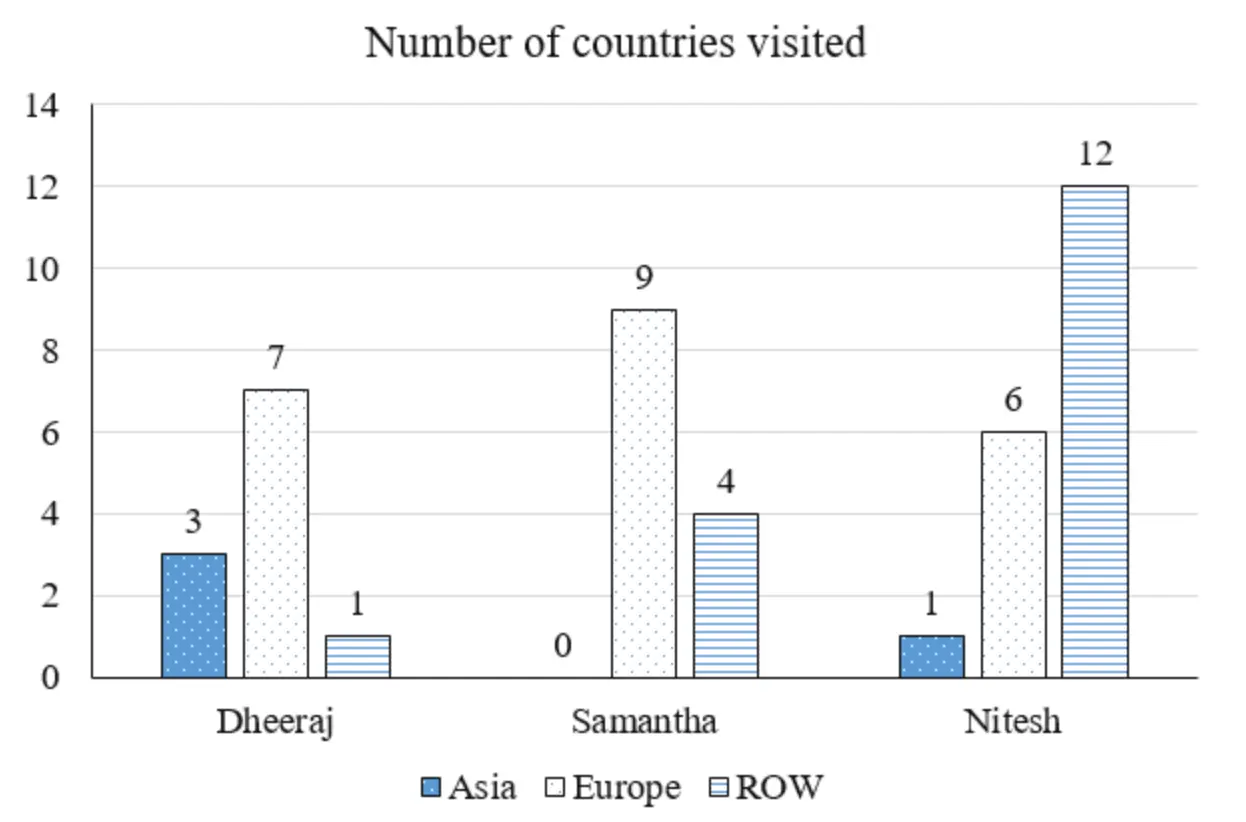
The chart below provides complete information about the number of countries visited by Dheeraj, Samantha and Nitesh, in Asia, Europe and the rest of the world (ROW).
The following additional facts are known about the countries visited by them.
1
32 countries were visited by at least one of them.
2
USA (in ROW) is the only country that was visited by all three of them.
3
China (in Asia) is the only country that was visited by both Dheeraj and Nitesh, but not by Samantha.
4
France (in Europe) is the only country outside Asia, which was visited by both Dheeraj and Samantha, but not by Nitesh.
5
Half of the countries visited by both Samantha and Nitesh are in Europe.
Official Reference Chart - CAT 2024 Slot 1 Official Reference Chart - CAT 2024 Slot 1
How many countries in Asia were visited by at least one of Dheeraj, Samantha and Nitesh?
TITA Answer:
Question 7 of 22
CAT 2024 Slot 1DILRData Interpretation • Venn DiagramsModerate
Caselet / Problem Set Context•~130 words
The chart below provides complete information about the number of countries visited by Dheeraj, Samantha and Nitesh, in Asia, Europe and the rest of the world (ROW).
The following additional facts are known about the countries visited by them.
1
32 countries were visited by at least one of them.
2
USA (in ROW) is the only country that was visited by all three of them.
3
China (in Asia) is the only country that was visited by both Dheeraj and Nitesh, but not by Samantha.
4
France (in Europe) is the only country outside Asia, which was visited by both Dheeraj and Samantha, but not by Nitesh.
5
Half of the countries visited by both Samantha and Nitesh are in Europe.
Official Reference Chart - CAT 2024 Slot 1 Official Reference Chart - CAT 2024 Slot 1
How many countries in Europe were visited only by Nitesh?
TITA Answer:
Question 8 of 22
CAT 2024 Slot 1DILRData Interpretation • Venn DiagramsModerate
Caselet / Problem Set Context•~130 words
The chart below provides complete information about the number of countries visited by Dheeraj, Samantha and Nitesh, in Asia, Europe and the rest of the world (ROW).
The following additional facts are known about the countries visited by them.
1
32 countries were visited by at least one of them.
2
USA (in ROW) is the only country that was visited by all three of them.
3
China (in Asia) is the only country that was visited by both Dheeraj and Nitesh, but not by Samantha.
4
France (in Europe) is the only country outside Asia, which was visited by both Dheeraj and Samantha, but not by Nitesh.
5
Half of the countries visited by both Samantha and Nitesh are in Europe.
Official Reference Chart - CAT 2024 Slot 1 Official Reference Chart - CAT 2024 Slot 1
How many countries in the ROW were visited by both Nitesh and Samantha?
TITA Answer:
Question 9 of 22
CAT 2024 Slot 1DILRData Interpretation • Venn DiagramsModerate
Caselet / Problem Set Context•~130 words
The chart below provides complete information about the number of countries visited by Dheeraj, Samantha and Nitesh, in Asia, Europe and the rest of the world (ROW).
The following additional facts are known about the countries visited by them.
1
32 countries were visited by at least one of them.
2
USA (in ROW) is the only country that was visited by all three of them.
3
China (in Asia) is the only country that was visited by both Dheeraj and Nitesh, but not by Samantha.
4
France (in Europe) is the only country outside Asia, which was visited by both Dheeraj and Samantha, but not by Nitesh.
5
Half of the countries visited by both Samantha and Nitesh are in Europe.
Official Reference Chart - CAT 2024 Slot 1 Official Reference Chart - CAT 2024 Slot 1
How many countries in Europe were visited by exactly one of Dheeraj, Samantha and Nitesh?
Question 10 of 22
CAT 2024 Slot 1DILRData Interpretation • Other ChartsEasy
Caselet / Problem Set Context•~90 words
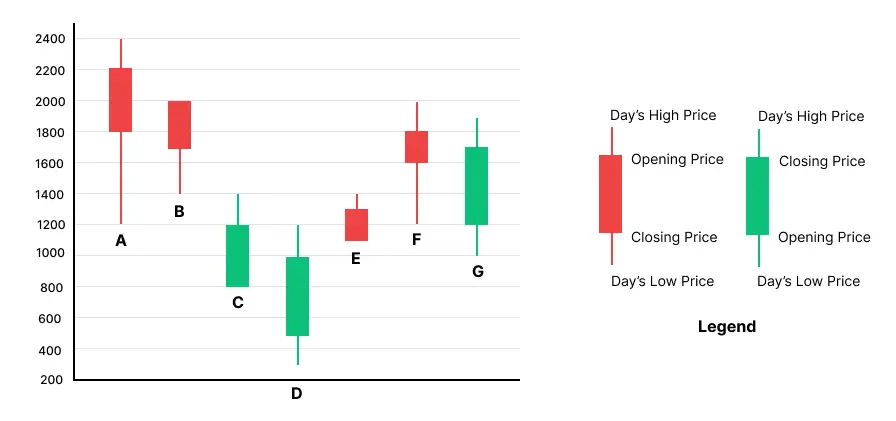
The chart below shows the price data for seven shares- A,B,C,D,E,F, and G as a candlestick plot for a particular day. The vertical axis shows the price of the share in rupees. A share whose closing price (price at the end of the day) is more than its opening price (price at the start of the day) is called a bullish share; otherwise, it is called a bearish share. All bullish and bearish shares are shown in green and red colour respectively.
Official Reference Chart - CAT 2024 Slot 1 Official Reference Chart - CAT 2024 Slot 1
Daily Share Price Variability (SPV) is defined as (Day's high price - Day's low price) /(Average of the opening and closing prices during the day). Which among the shares A, C, D and F had the highest SPV on that day?
Question 11 of 22
CAT 2024 Slot 1DILRData Interpretation • Other ChartsEasy
Caselet / Problem Set Context•~90 words
The chart below shows the price data for seven shares- A,B,C,D,E,F, and G as a candlestick plot for a particular day. The vertical axis shows the price of the share in rupees. A share whose closing price (price at the end of the day) is more than its opening price (price at the start of the day) is called a bullish share; otherwise, it is called a bearish share. All bullish and bearish shares are shown in green and red colour respectively.
Official Reference Chart - CAT 2024 Slot 1 Official Reference Chart - CAT 2024 Slot 1
Daily Share Price Variability (SPV) is defined as (Day's high price - Day's low price) /(Average of the opening and closing prices during the day). How many shares had an SPV greater than 0.5 on that day?
TITA Answer:
Question 12 of 22
CAT 2024 Slot 1DILRData Interpretation • Other ChartsEasy
Caselet / Problem Set Context•~90 words
The chart below shows the price data for seven shares- A,B,C,D,E,F, and G as a candlestick plot for a particular day. The vertical axis shows the price of the share in rupees. A share whose closing price (price at the end of the day) is more than its opening price (price at the start of the day) is called a bullish share; otherwise, it is called a bearish share. All bullish and bearish shares are shown in green and red colour respectively.
Official Reference Chart - CAT 2024 Slot 1 Official Reference Chart - CAT 2024 Slot 1
Daily loss for a share is defined as (Opening price - Closing price) / (Opening price). Which among the shares A, B, F and G had the highest daily loss on that day?
Question 13 of 22
CAT 2024 Slot 1DILRData Interpretation • Other ChartsEasy
Caselet / Problem Set Context•~90 words
The chart below shows the price data for seven shares- A,B,C,D,E,F, and G as a candlestick plot for a particular day. The vertical axis shows the price of the share in rupees. A share whose closing price (price at the end of the day) is more than its opening price (price at the start of the day) is called a bullish share; otherwise, it is called a bearish share. All bullish and bearish shares are shown in green and red colour respectively.
Official Reference Chart - CAT 2024 Slot 1 Official Reference Chart - CAT 2024 Slot 1
What would have been the percentage wealth gain for a trader, who bought equal numbers of all bullish shares at opening price and sold them at their day’s high?
Question 14 of 22
CAT 2024 Slot 1DILRData Interpretation • Bar GraphsEasy
Caselet / Problem Set Context•~134 words
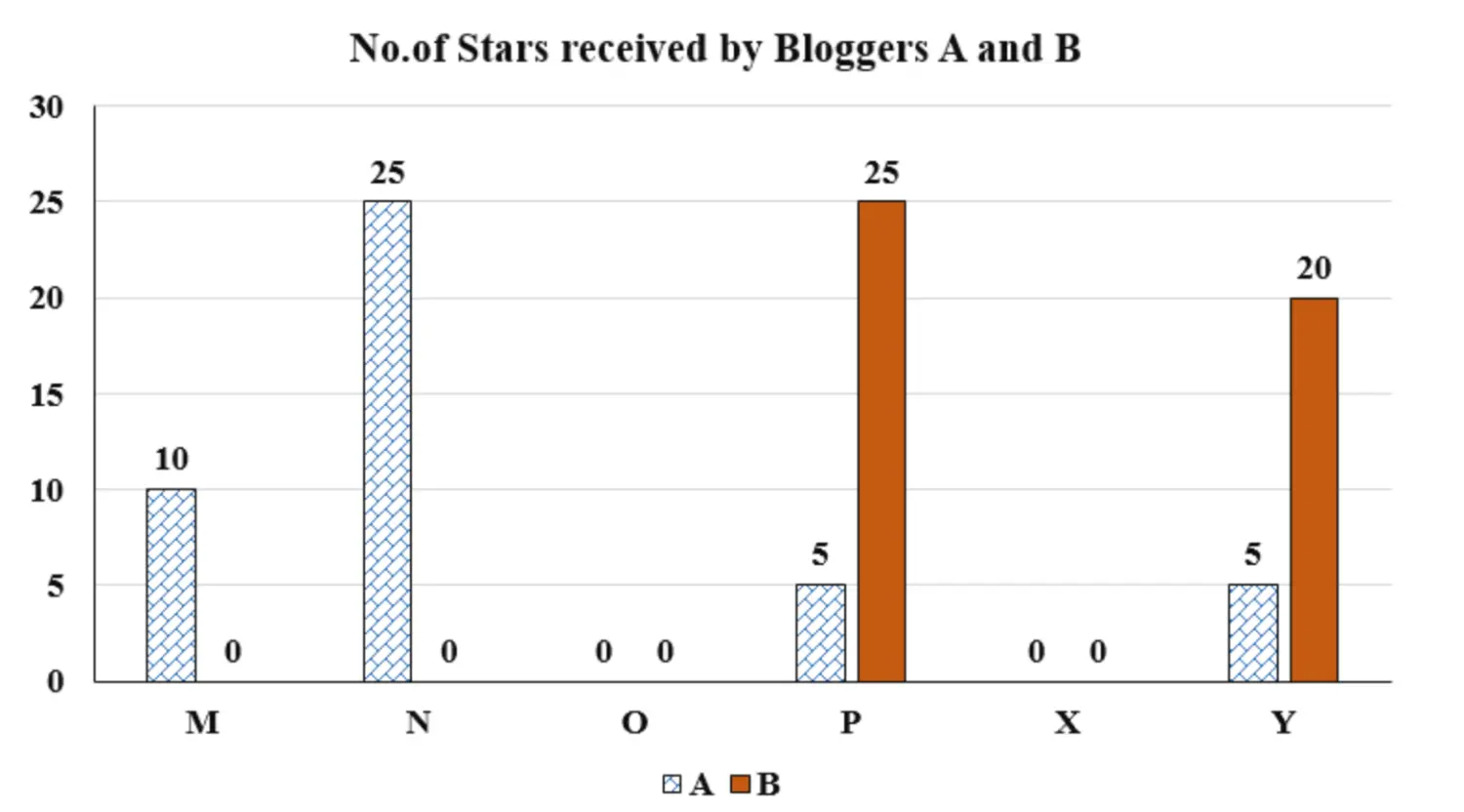
Six web surfers M, N, O, P, X, and Y each had 30 stars which they distributed among four bloggers A, B, C, and D. The number of stars received by A and B from the six web surfers is shown in the figure below.
The following additional facts are known regarding the number of stars received by the bloggers from the surfers.
1
The numbers of stars received by the bloggers from the surfers were all multiples of 5 (including 0).
2
The total numbers of stars received by the bloggers were the same.
3
Each blogger received a different number of stars from M.
4
Two surfers gave all their stars to a single blogger.
5
D received more stars than C from Y.
Official Reference Chart - CAT 2024 Slot 1 Official Reference Chart - CAT 2024 Slot 1
What was the total number of stars received by D?
TITA Answer:
Question 15 of 22
CAT 2024 Slot 1DILRData Interpretation • Bar GraphsEasy
Caselet / Problem Set Context•~134 words
Six web surfers M, N, O, P, X, and Y each had 30 stars which they distributed among four bloggers A, B, C, and D. The number of stars received by A and B from the six web surfers is shown in the figure below.
The following additional facts are known regarding the number of stars received by the bloggers from the surfers.
1
The numbers of stars received by the bloggers from the surfers were all multiples of 5 (including 0).
2
The total numbers of stars received by the bloggers were the same.
3
Each blogger received a different number of stars from M.
4
Two surfers gave all their stars to a single blogger.
5
D received more stars than C from Y.
Official Reference Chart - CAT 2024 Slot 1 Official Reference Chart - CAT 2024 Slot 1
What was the number of stars received by D from Y?
Question 16 of 22
CAT 2024 Slot 1DILRData Interpretation • Bar GraphsEasy
Caselet / Problem Set Context•~134 words
Six web surfers M, N, O, P, X, and Y each had 30 stars which they distributed among four bloggers A, B, C, and D. The number of stars received by A and B from the six web surfers is shown in the figure below.
The following additional facts are known regarding the number of stars received by the bloggers from the surfers.
1
The numbers of stars received by the bloggers from the surfers were all multiples of 5 (including 0).
2
The total numbers of stars received by the bloggers were the same.
3
Each blogger received a different number of stars from M.
4
Two surfers gave all their stars to a single blogger.
5
D received more stars than C from Y.
Official Reference Chart - CAT 2024 Slot 1 Official Reference Chart - CAT 2024 Slot 1
How many surfers distributed their stars among exactly 2 bloggers?
TITA Answer:
Question 17 of 22
CAT 2024 Slot 1DILRData Interpretation • Bar GraphsEasy
Caselet / Problem Set Context•~134 words
Six web surfers M, N, O, P, X, and Y each had 30 stars which they distributed among four bloggers A, B, C, and D. The number of stars received by A and B from the six web surfers is shown in the figure below.
The following additional facts are known regarding the number of stars received by the bloggers from the surfers.
1
The numbers of stars received by the bloggers from the surfers were all multiples of 5 (including 0).
2
The total numbers of stars received by the bloggers were the same.
3
Each blogger received a different number of stars from M.
4
Two surfers gave all their stars to a single blogger.
5
D received more stars than C from Y.
Official Reference Chart - CAT 2024 Slot 1 Official Reference Chart - CAT 2024 Slot 1
Which of the following can be determined with certainty?
I
The number of stars received by C from M
II
The number of stars received by D from O
Question 18 of 22
CAT 2024 Slot 1DILRLogical Reasoning • OptimizationHard
Caselet / Problem Set Context•~353 words
Two students, Amiya and Ramya are the only candidates in an election for the position of class representative. Students will vote based on the intensity level of Amiya's and Ramya's campaigns and the type of campaigns they run. Each campaign is said to have a level of 11 if it is a staid campaign and a level of 22 if it is a vigorous campaign. Campaigns can be of two types, they can either focus on issues, or on attacking the other candidate.
If Amiya and Ramya both run campaigns focusing on issues, then
The percentage of students voting in the election will be 2020 times the sum of the levels of campaigning of the two students. For example, if Amiya and Ramya both run vigorous campaigns, then 20×(2+2)%20 \times(2+2) \%, that is, 80%80 \% of the students will vote in the election.
Among voting students, the percentage of votes for each candidate will be proportional to the levels of their campaigns. For example, if Amiya runs a staid (i.e., level 1) campaign while Ramya runs a vigorous (i.e., level 2) campaign, then Amiya will receive 1/31 / 3 of the votes cast, and Ramya will receive the other 2/32 / 3.
The above-mentioned percentages change as follows if at least one of them runs a campaign attacking their opponent.
If Amiya runs a campaign attacking Ramya and Ramya runs a campaign focusing on issues, then 10%10 \% of the students who would have otherwise voted for Amiya will vote for Ramya, and another 10%10 \% who would have otherwise voted for Amiya, will not vote at all.
If Ramya runs a campaign attacking Amiya and Amiya runs a campaign focusing on issues, then 20%20 \% of the students who would have otherwise voted for Ramya will vote for Amiya, and another 5%5 \% who would have otherwise voted for Ramya, will not vote at all.
If both run campaigns attacking each other, then 10%10 \% of the students who would have otherwise voted for them had they run campaigns focusing on issues, will not vote at all.
If both of them run staid campaigns attacking the other, then what percentage of students will vote in the election?
Question 19 of 22
CAT 2024 Slot 1DILRLogical Reasoning • OptimizationHard
Caselet / Problem Set Context•~353 words
Two students, Amiya and Ramya are the only candidates in an election for the position of class representative. Students will vote based on the intensity level of Amiya's and Ramya's campaigns and the type of campaigns they run. Each campaign is said to have a level of 11 if it is a staid campaign and a level of 22 if it is a vigorous campaign. Campaigns can be of two types, they can either focus on issues, or on attacking the other candidate.
If Amiya and Ramya both run campaigns focusing on issues, then
The percentage of students voting in the election will be 2020 times the sum of the levels of campaigning of the two students. For example, if Amiya and Ramya both run vigorous campaigns, then 20×(2+2)%20 \times(2+2) \%, that is, 80%80 \% of the students will vote in the election.
Among voting students, the percentage of votes for each candidate will be proportional to the levels of their campaigns. For example, if Amiya runs a staid (i.e., level 1) campaign while Ramya runs a vigorous (i.e., level 2) campaign, then Amiya will receive 1/31 / 3 of the votes cast, and Ramya will receive the other 2/32 / 3.
The above-mentioned percentages change as follows if at least one of them runs a campaign attacking their opponent.
If Amiya runs a campaign attacking Ramya and Ramya runs a campaign focusing on issues, then 10%10 \% of the students who would have otherwise voted for Amiya will vote for Ramya, and another 10%10 \% who would have otherwise voted for Amiya, will not vote at all.
If Ramya runs a campaign attacking Amiya and Amiya runs a campaign focusing on issues, then 20%20 \% of the students who would have otherwise voted for Ramya will vote for Amiya, and another 5%5 \% who would have otherwise voted for Ramya, will not vote at all.
If both run campaigns attacking each other, then 10%10 \% of the students who would have otherwise voted for them had they run campaigns focusing on issues, will not vote at all.
What is the minimum percentage of students who will vote in the election?
Question 20 of 22
CAT 2024 Slot 1DILRLogical Reasoning • OptimizationHard
Caselet / Problem Set Context•~353 words
Two students, Amiya and Ramya are the only candidates in an election for the position of class representative. Students will vote based on the intensity level of Amiya's and Ramya's campaigns and the type of campaigns they run. Each campaign is said to have a level of 11 if it is a staid campaign and a level of 22 if it is a vigorous campaign. Campaigns can be of two types, they can either focus on issues, or on attacking the other candidate.
If Amiya and Ramya both run campaigns focusing on issues, then
The percentage of students voting in the election will be 2020 times the sum of the levels of campaigning of the two students. For example, if Amiya and Ramya both run vigorous campaigns, then 20×(2+2)%20 \times(2+2) \%, that is, 80%80 \% of the students will vote in the election.
Among voting students, the percentage of votes for each candidate will be proportional to the levels of their campaigns. For example, if Amiya runs a staid (i.e., level 1) campaign while Ramya runs a vigorous (i.e., level 2) campaign, then Amiya will receive 1/31 / 3 of the votes cast, and Ramya will receive the other 2/32 / 3.
The above-mentioned percentages change as follows if at least one of them runs a campaign attacking their opponent.
If Amiya runs a campaign attacking Ramya and Ramya runs a campaign focusing on issues, then 10%10 \% of the students who would have otherwise voted for Amiya will vote for Ramya, and another 10%10 \% who would have otherwise voted for Amiya, will not vote at all.
If Ramya runs a campaign attacking Amiya and Amiya runs a campaign focusing on issues, then 20%20 \% of the students who would have otherwise voted for Ramya will vote for Amiya, and another 5%5 \% who would have otherwise voted for Ramya, will not vote at all.
If both run campaigns attacking each other, then 10%10 \% of the students who would have otherwise voted for them had they run campaigns focusing on issues, will not vote at all.
If Amiya runs a campaign focusing on issues, then what is the maximum percentage of votes that she can get?
Question 21 of 22
CAT 2024 Slot 1DILRLogical Reasoning • OptimizationHard
Caselet / Problem Set Context•~353 words
Two students, Amiya and Ramya are the only candidates in an election for the position of class representative. Students will vote based on the intensity level of Amiya's and Ramya's campaigns and the type of campaigns they run. Each campaign is said to have a level of 11 if it is a staid campaign and a level of 22 if it is a vigorous campaign. Campaigns can be of two types, they can either focus on issues, or on attacking the other candidate.
If Amiya and Ramya both run campaigns focusing on issues, then
The percentage of students voting in the election will be 2020 times the sum of the levels of campaigning of the two students. For example, if Amiya and Ramya both run vigorous campaigns, then 20×(2+2)%20 \times(2+2) \%, that is, 80%80 \% of the students will vote in the election.
Among voting students, the percentage of votes for each candidate will be proportional to the levels of their campaigns. For example, if Amiya runs a staid (i.e., level 1) campaign while Ramya runs a vigorous (i.e., level 2) campaign, then Amiya will receive 1/31 / 3 of the votes cast, and Ramya will receive the other 2/32 / 3.
The above-mentioned percentages change as follows if at least one of them runs a campaign attacking their opponent.
If Amiya runs a campaign attacking Ramya and Ramya runs a campaign focusing on issues, then 10%10 \% of the students who would have otherwise voted for Amiya will vote for Ramya, and another 10%10 \% who would have otherwise voted for Amiya, will not vote at all.
If Ramya runs a campaign attacking Amiya and Amiya runs a campaign focusing on issues, then 20%20 \% of the students who would have otherwise voted for Ramya will vote for Amiya, and another 5%5 \% who would have otherwise voted for Ramya, will not vote at all.
If both run campaigns attacking each other, then 10%10 \% of the students who would have otherwise voted for them had they run campaigns focusing on issues, will not vote at all.
If Ramya runs a campaign attacking Amiya, then what is the minimum percentage of votes that she is guaranteed to get?
Question 22 of 22
CAT 2024 Slot 1DILRLogical Reasoning • OptimizationHard
Caselet / Problem Set Context•~353 words
Two students, Amiya and Ramya are the only candidates in an election for the position of class representative. Students will vote based on the intensity level of Amiya's and Ramya's campaigns and the type of campaigns they run. Each campaign is said to have a level of 11 if it is a staid campaign and a level of 22 if it is a vigorous campaign. Campaigns can be of two types, they can either focus on issues, or on attacking the other candidate.
If Amiya and Ramya both run campaigns focusing on issues, then
The percentage of students voting in the election will be 2020 times the sum of the levels of campaigning of the two students. For example, if Amiya and Ramya both run vigorous campaigns, then 20×(2+2)%20 \times(2+2) \%, that is, 80%80 \% of the students will vote in the election.
Among voting students, the percentage of votes for each candidate will be proportional to the levels of their campaigns. For example, if Amiya runs a staid (i.e., level 1) campaign while Ramya runs a vigorous (i.e., level 2) campaign, then Amiya will receive 1/31 / 3 of the votes cast, and Ramya will receive the other 2/32 / 3.
The above-mentioned percentages change as follows if at least one of them runs a campaign attacking their opponent.
If Amiya runs a campaign attacking Ramya and Ramya runs a campaign focusing on issues, then 10%10 \% of the students who would have otherwise voted for Amiya will vote for Ramya, and another 10%10 \% who would have otherwise voted for Amiya, will not vote at all.
If Ramya runs a campaign attacking Amiya and Amiya runs a campaign focusing on issues, then 20%20 \% of the students who would have otherwise voted for Ramya will vote for Amiya, and another 5%5 \% who would have otherwise voted for Ramya, will not vote at all.
If both run campaigns attacking each other, then 10%10 \% of the students who would have otherwise voted for them had they run campaigns focusing on issues, will not vote at all.
What is the maximum possible voting margin with which one of the candidates can win?
ThinkCAT Pro Season PassFull Exam Access

Unlock All 24 Full-Length Official Mocks & 6,000+ Questions

Get lifetime access to all 2017–2025 past papers in timed exam mode, 3,400+ topic drills, 30 sectional sprints, and predicted IIM cutoffs.

Unlock Full Access

Frequently Asked Questions about CAT 2024 Slot 1 DILR Questions & Answer Key

How many questions were asked in CAT 2024 Slot 1 DILR?

CAT 2024 Slot 1 DILR contained 22 questions convened by IIM Calcutta. Marking was +3 marks for correct answers, -1 for incorrect MCQs, and zero penalty for TITA questions.

What score was required for a 99th percentile in CAT 2024 Slot 1 DILR?

Achieving a 99.0th percentile in DILR required approximately 23–26 marks (~8 net correct), reflecting the moderate difficulty (straightforward algebra, standard dilr grids).

Can I practice other sections of CAT 2024 Slot 1?

Yes! You can explore the full paper or switch directly to DILR, VARC, or QA using the related sectional links below.

Related CAT Papers & Topic Mastery Hubs

Explore other slots, sections, and high-weightage topic collections

View Full Archive