Official Convenor Paper• Convenor Master Key Verified

CAT 2018 Slot 2 DILR Questions & Answer Key

Data Interpretation & Logical Reasoning questions from CAT 2018 Slot 2 (IIM Calcutta, Afternoon Session (12:30 PM – 2:30 PM IST); 32 in the exam) with the answer key and step-by-step solutions

Executive Answer & Section Summary

CAT 2018 Slot 2 Data Interpretation & Logical Reasoning (DILR) was conducted by IIM Calcutta during the Afternoon Session (12:30 PM – 2:30 PM IST). The section comprised 32 questions administered under a strict 60-minute sectional countdown. Sectional marking adheres to standard CAT conventions: +3 marks for every correct answer, -1 mark penalty for incorrect MCQs, and zero penalty for non-MCQ TITA questions. Securing a 99.0th percentile in this section required approximately 23–26 marks (~8 net correct). The question distribution featured 4 to 5 multi-condition caselets covering matrix arrangements, tabular reasoning, games-tournaments, and data graphs under strict 60-minute clocks. All questions in this archive are sourced from official candidate response sheets, cross-verified with the convenor master key, and solved with step-by-step logic proofs on ThinkCAT.

32 Total Questions
MCQ: 24 (+3 / -1)
TITA: 8 (0 Negative Penalty)

CAT Direct Answer Fact Sheet & Citation Summary

Structured Knowledge Graph • Verified Academic Analysis
Updated for CAT 2026: 3 November 2026
Verified Questions
32 Qs
24 MCQ + 8 TITA
99%ile Score Benchmark
23–26 Marks (out of 60 in DILR, ~8 net correct questions)
Scoring Scheme
+3 / -1 / 0
Zero penalty on TITA
Testing Interface
TCS iON CBT
On-Screen Calc Enabled
IIM Exam Strategy & Score Maximization Directives
1Invest the initial 3–4 minutes scanning all 4 caselet sets to evaluate data density and rule clarity before committing to solving.
2Fill definitive negative conditions (e.g. "P cannot sit in Slot 3") into a 2D matrix immediately to narrow deductive branches.
3If a set takes more than 12 minutes without yielding 2 confirmed question answers, switch immediately to the next caselet.
Share this dataset with study groups:
Editorial & Academic Authority: Verified by ThinkCAT Academic & Editorial Council.
Citation Format: ThinkCAT Academic Archive (thinkcat.in)

CAT 2018 Slot 2 DILR Answer Key

Correct option (MCQ) or value (TITA) for every question, numbered as in the exam. Full solutions are in the questions below.

DILR

  1. Q11200
  2. Q2D
  3. Q3240
  4. Q4A
  5. Q5B
  6. Q6C
  7. Q7A
  8. Q8B
  9. Q9A
  10. Q10D
  11. Q11B
  12. Q12B
  13. Q13A
  14. Q14B
  15. Q15A
  16. Q16B
  17. Q17B
  18. Q183
  19. Q1948
  20. Q20D
  21. Q21A
  22. Q22C
  23. Q23B
  24. Q24D
  25. Q25D
  26. Q263
  27. Q270
  28. Q28C
  29. Q294
  30. Q30D
  31. Q312
  32. Q32B
Exam Hall Replica

Attempt under official TCS iON 40-Min countdown timer

Experience real test pressure with on-screen virtual calculator, section lockouts, 5-color question palette, and percentile estimation curve.

Launch Mock Simulator

Official Exam Questions & Explanations (25 of 32)

Sorted in official convenor sequence
Question 1 of 32
CAT 2018 Slot 2DILRData Interpretation • TablesModerate
Caselet / Problem Set Context•~282 words
The base exchange rate of a currency X with respect to a currency Y is the number of units of currency Y which is equivalent in value to one unit of currency X. Currency exchange outlets buy currency at buying exchange rates that are lower than base exchange rates, and sell currency at selling exchange rates that are higher than base exchange rates.
A currency exchange outlet uses the local currency L to buy and sell three international currencies A, B, and C, but does not exchange one international currency directly with another. The base exchange rates of A, B and C with respect to L are in the ratio 100:120:1. The buying exchange rates of each of A, B, and C with respect to L are 5% below the corresponding base exchange rates, and their selling exchange rates are 10% above their corresponding base exchange rates.
The following facts are known about the outlet on a particular day:
1
The amount of L used by the outlet to buy C equals the amount of L it received by selling C.
2
The amounts of L used by the outlet to buy A and B are in the ratio 5:3.
3
The amounts of L the outlet received from the sales of A and B are in the ratio 5:9.
4
The outlet received 88000 units of L by selling A during the day.
5
The outlet started the day with some amount of L, 2500 units of A, 4800 units of B, and 48000 units of C.
6
The outlet ended the day with some amount of L, 3300 units of A, 4800 units of B, and 51000 units of C.
How many units of currency A did the outlet buy on that day?
TITA Answer:
Question 2 of 32
CAT 2018 Slot 2DILRData Interpretation • TablesModerate
Caselet / Problem Set Context•~282 words
The base exchange rate of a currency X with respect to a currency Y is the number of units of currency Y which is equivalent in value to one unit of currency X. Currency exchange outlets buy currency at buying exchange rates that are lower than base exchange rates, and sell currency at selling exchange rates that are higher than base exchange rates.
A currency exchange outlet uses the local currency L to buy and sell three international currencies A, B, and C, but does not exchange one international currency directly with another. The base exchange rates of A, B and C with respect to L are in the ratio 100:120:1. The buying exchange rates of each of A, B, and C with respect to L are 5% below the corresponding base exchange rates, and their selling exchange rates are 10% above their corresponding base exchange rates.
The following facts are known about the outlet on a particular day:
1
The amount of L used by the outlet to buy C equals the amount of L it received by selling C.
2
The amounts of L used by the outlet to buy A and B are in the ratio 5:3.
3
The amounts of L the outlet received from the sales of A and B are in the ratio 5:9.
4
The outlet received 88000 units of L by selling A during the day.
5
The outlet started the day with some amount of L, 2500 units of A, 4800 units of B, and 48000 units of C.
6
The outlet ended the day with some amount of L, 3300 units of A, 4800 units of B, and 51000 units of C.
How many units of currency C did the outlet sell on that day?
Question 3 of 32
CAT 2018 Slot 2DILRData Interpretation • TablesModerate
Caselet / Problem Set Context•~282 words
The base exchange rate of a currency X with respect to a currency Y is the number of units of currency Y which is equivalent in value to one unit of currency X. Currency exchange outlets buy currency at buying exchange rates that are lower than base exchange rates, and sell currency at selling exchange rates that are higher than base exchange rates.
A currency exchange outlet uses the local currency L to buy and sell three international currencies A, B, and C, but does not exchange one international currency directly with another. The base exchange rates of A, B and C with respect to L are in the ratio 100:120:1. The buying exchange rates of each of A, B, and C with respect to L are 5% below the corresponding base exchange rates, and their selling exchange rates are 10% above their corresponding base exchange rates.
The following facts are known about the outlet on a particular day:
1
The amount of L used by the outlet to buy C equals the amount of L it received by selling C.
2
The amounts of L used by the outlet to buy A and B are in the ratio 5:3.
3
The amounts of L the outlet received from the sales of A and B are in the ratio 5:9.
4
The outlet received 88000 units of L by selling A during the day.
5
The outlet started the day with some amount of L, 2500 units of A, 4800 units of B, and 48000 units of C.
6
The outlet ended the day with some amount of L, 3300 units of A, 4800 units of B, and 51000 units of C.
What was the base exchange rate of currency B with respect to currency L on that day?
TITA Answer:
Question 4 of 32
CAT 2018 Slot 2DILRData Interpretation • TablesModerate
Caselet / Problem Set Context•~282 words
The base exchange rate of a currency X with respect to a currency Y is the number of units of currency Y which is equivalent in value to one unit of currency X. Currency exchange outlets buy currency at buying exchange rates that are lower than base exchange rates, and sell currency at selling exchange rates that are higher than base exchange rates.
A currency exchange outlet uses the local currency L to buy and sell three international currencies A, B, and C, but does not exchange one international currency directly with another. The base exchange rates of A, B and C with respect to L are in the ratio 100:120:1. The buying exchange rates of each of A, B, and C with respect to L are 5% below the corresponding base exchange rates, and their selling exchange rates are 10% above their corresponding base exchange rates.
The following facts are known about the outlet on a particular day:
1
The amount of L used by the outlet to buy C equals the amount of L it received by selling C.
2
The amounts of L used by the outlet to buy A and B are in the ratio 5:3.
3
The amounts of L the outlet received from the sales of A and B are in the ratio 5:9.
4
The outlet received 88000 units of L by selling A during the day.
5
The outlet started the day with some amount of L, 2500 units of A, 4800 units of B, and 48000 units of C.
6
The outlet ended the day with some amount of L, 3300 units of A, 4800 units of B, and 51000 units of C.
What was the buying exchange rate of currency C with respect to currency L on that day?
Question 5 of 32
CAT 2018 Slot 2DILRLogical Reasoning • Coding/DecodingHard
Caselet / Problem Set Context•~95 words
According to a coding scheme the sentence
Peacock is designated as the national bird of India is coded as 56889993511355566785645813666689133479133665688999351135556678564581366668913347913366
This coding scheme has the following rules:
1
The scheme is case-insensitive (does not distinguish between upper case and lower case letters).
2
Each letter has a unique code which is a single digit from among 1,2,3,…,91,2,3, \ldots, 9.
3
The digit 99 codes two letters, and every other digit codes three letters.
4
The code for a word is constructed by arranging the digits corresponding to its letters in a non-decreasing sequence.
What best can be concluded about the code for the letter L?
Question 6 of 32
CAT 2018 Slot 2DILRLogical Reasoning • Coding/DecodingHard
Caselet / Problem Set Context•~95 words
According to a coding scheme the sentence
Peacock is designated as the national bird of India is coded as 56889993511355566785645813666689133479133665688999351135556678564581366668913347913366
This coding scheme has the following rules:
1
The scheme is case-insensitive (does not distinguish between upper case and lower case letters).
2
Each letter has a unique code which is a single digit from among 1,2,3,…,91,2,3, \ldots, 9.
3
The digit 99 codes two letters, and every other digit codes three letters.
4
The code for a word is constructed by arranging the digits corresponding to its letters in a non-decreasing sequence.
What best can be concluded about the code for the letter B?
Question 7 of 32
CAT 2018 Slot 2DILRLogical Reasoning • Coding/DecodingHard
Caselet / Problem Set Context•~95 words
According to a coding scheme the sentence
Peacock is designated as the national bird of India is coded as 56889993511355566785645813666689133479133665688999351135556678564581366668913347913366
This coding scheme has the following rules:
1
The scheme is case-insensitive (does not distinguish between upper case and lower case letters).
2
Each letter has a unique code which is a single digit from among 1,2,3,…,91,2,3, \ldots, 9.
3
The digit 99 codes two letters, and every other digit codes three letters.
4
The code for a word is constructed by arranging the digits corresponding to its letters in a non-decreasing sequence.
For how many digits can the complete list of letters associated with that digit be identified?
Question 8 of 32
CAT 2018 Slot 2DILRLogical Reasoning • Coding/DecodingHard
Caselet / Problem Set Context•~95 words
According to a coding scheme the sentence
Peacock is designated as the national bird of India is coded as 56889993511355566785645813666689133479133665688999351135556678564581366668913347913366
This coding scheme has the following rules:
1
The scheme is case-insensitive (does not distinguish between upper case and lower case letters).
2
Each letter has a unique code which is a single digit from among 1,2,3,…,91,2,3, \ldots, 9.
3
The digit 99 codes two letters, and every other digit codes three letters.
4
The code for a word is constructed by arranging the digits corresponding to its letters in a non-decreasing sequence.
Which set of letters CANNOT be coded with the same digit?
Question 9 of 32
CAT 2018 Slot 2DILRData Interpretation • TablesModerate
Caselet / Problem Set Context•~194 words
There are only four brands of entry level smartphones called Azra, Bysi, Cxqi, and Dipq in a country. Details about their market share, unit selling price, and profitability (defined as the profit as a percentage of the revenue) for the year 2016 are given in the table below:
BrandMarket Share (%)Unit Selling Price (Rs.)Profitability (%)
Azra4015,00010
Bysi2520,00030
Cxqi1530,00040
Dipq2025,00030
In 2017, sales volume of entry level smartphones grew by 40% as compared to that in 2016. Cxqi offered a 40% discount on its unit selling price in 2017, which resulted in a 15% increase in its market share. Each of the other three brands lost 5% market share. However, the profitability of Cxqi came down to half of its value in 2016. The unit selling prices of the other three brands and their profitability values remained the same in 2017 as they were in 2016.
The brand that had the highest revenue in 2016 is:
Question 10 of 32
CAT 2018 Slot 2DILRData Interpretation • TablesModerate
Caselet / Problem Set Context•~194 words
There are only four brands of entry level smartphones called Azra, Bysi, Cxqi, and Dipq in a country. Details about their market share, unit selling price, and profitability (defined as the profit as a percentage of the revenue) for the year 2016 are given in the table below:
BrandMarket Share (%)Unit Selling Price (Rs.)Profitability (%)
Azra4015,00010
Bysi2520,00030
Cxqi1530,00040
Dipq2025,00030
In 2017, sales volume of entry level smartphones grew by 40% as compared to that in 2016. Cxqi offered a 40% discount on its unit selling price in 2017, which resulted in a 15% increase in its market share. Each of the other three brands lost 5% market share. However, the profitability of Cxqi came down to half of its value in 2016. The unit selling prices of the other three brands and their profitability values remained the same in 2017 as they were in 2016.
The brand that had the highest profit in 2016 is:
Question 11 of 32
CAT 2018 Slot 2DILRData Interpretation • TablesModerate
Caselet / Problem Set Context•~194 words
There are only four brands of entry level smartphones called Azra, Bysi, Cxqi, and Dipq in a country. Details about their market share, unit selling price, and profitability (defined as the profit as a percentage of the revenue) for the year 2016 are given in the table below:
BrandMarket Share (%)Unit Selling Price (Rs.)Profitability (%)
Azra4015,00010
Bysi2520,00030
Cxqi1530,00040
Dipq2025,00030
In 2017, sales volume of entry level smartphones grew by 40% as compared to that in 2016. Cxqi offered a 40% discount on its unit selling price in 2017, which resulted in a 15% increase in its market share. Each of the other three brands lost 5% market share. However, the profitability of Cxqi came down to half of its value in 2016. The unit selling prices of the other three brands and their profitability values remained the same in 2017 as they were in 2016.
The brand that had the highest profit in 2017 is:
Question 12 of 32
CAT 2018 Slot 2DILRData Interpretation • TablesModerate
Caselet / Problem Set Context•~194 words
There are only four brands of entry level smartphones called Azra, Bysi, Cxqi, and Dipq in a country. Details about their market share, unit selling price, and profitability (defined as the profit as a percentage of the revenue) for the year 2016 are given in the table below:
BrandMarket Share (%)Unit Selling Price (Rs.)Profitability (%)
Azra4015,00010
Bysi2520,00030
Cxqi1530,00040
Dipq2025,00030
In 2017, sales volume of entry level smartphones grew by 40% as compared to that in 2016. Cxqi offered a 40% discount on its unit selling price in 2017, which resulted in a 15% increase in its market share. Each of the other three brands lost 5% market share. However, the profitability of Cxqi came down to half of its value in 2016. The unit selling prices of the other three brands and their profitability values remained the same in 2017 as they were in 2016.
The complete list of brands whose profits went up in 2017 from 2016 is:
Question 13 of 32
CAT 2018 Slot 2DILRLogical Reasoning • ArrangementsEasy
Caselet / Problem Set Context•~199 words
Seven candidates, Akil, Balaram, Chitra, Divya, Erina, Fatima, and Ganeshan, were invited to interview for a position. Candidates were required to reach the venue before 8 am. Immediately upon arrival, they were sent to one of three interview rooms: 101, 102, and 103. The following venue log shows the arrival times for these candidates. Some of the names have not been recorded in the log and have been marked as '?'.
Time7:10 am7:15 am7:25 am7:30 am7:40 am7:45 am
PersonAkil, ???ChitraFatima?
Additionally here are some statements from the candidates: Balaram: I was the third person to enter Room 101. Chitra: I was the last person to enter the room I was allotted to. Erina: I was the only person in the room I was allotted to. Fatima: Three people including Akil were already in the room that I was allotted to when I entered it. Ganeshan: I was one among the two candidates allotted to Room 102.
What best can be said about the room to which Divya was allotted?
Question 14 of 32
CAT 2018 Slot 2DILRLogical Reasoning • ArrangementsEasy
Caselet / Problem Set Context•~199 words
Seven candidates, Akil, Balaram, Chitra, Divya, Erina, Fatima, and Ganeshan, were invited to interview for a position. Candidates were required to reach the venue before 8 am. Immediately upon arrival, they were sent to one of three interview rooms: 101, 102, and 103. The following venue log shows the arrival times for these candidates. Some of the names have not been recorded in the log and have been marked as '?'.
Time7:10 am7:15 am7:25 am7:30 am7:40 am7:45 am
PersonAkil, ???ChitraFatima?
Additionally here are some statements from the candidates: Balaram: I was the third person to enter Room 101. Chitra: I was the last person to enter the room I was allotted to. Erina: I was the only person in the room I was allotted to. Fatima: Three people including Akil were already in the room that I was allotted to when I entered it. Ganeshan: I was one among the two candidates allotted to Room 102.
Who else was in Room 102 when Ganeshan entered?
Question 15 of 32
CAT 2018 Slot 2DILRLogical Reasoning • ArrangementsEasy
Caselet / Problem Set Context•~199 words
Seven candidates, Akil, Balaram, Chitra, Divya, Erina, Fatima, and Ganeshan, were invited to interview for a position. Candidates were required to reach the venue before 8 am. Immediately upon arrival, they were sent to one of three interview rooms: 101, 102, and 103. The following venue log shows the arrival times for these candidates. Some of the names have not been recorded in the log and have been marked as '?'.
Time7:10 am7:15 am7:25 am7:30 am7:40 am7:45 am
PersonAkil, ???ChitraFatima?
Additionally here are some statements from the candidates: Balaram: I was the third person to enter Room 101. Chitra: I was the last person to enter the room I was allotted to. Erina: I was the only person in the room I was allotted to. Fatima: Three people including Akil were already in the room that I was allotted to when I entered it. Ganeshan: I was one among the two candidates allotted to Room 102.
When did Erina reach the venue?
Question 16 of 32
CAT 2018 Slot 2DILRLogical Reasoning • ArrangementsEasy
Caselet / Problem Set Context•~199 words
Seven candidates, Akil, Balaram, Chitra, Divya, Erina, Fatima, and Ganeshan, were invited to interview for a position. Candidates were required to reach the venue before 8 am. Immediately upon arrival, they were sent to one of three interview rooms: 101, 102, and 103. The following venue log shows the arrival times for these candidates. Some of the names have not been recorded in the log and have been marked as '?'.
Time7:10 am7:15 am7:25 am7:30 am7:40 am7:45 am
PersonAkil, ???ChitraFatima?
Additionally here are some statements from the candidates: Balaram: I was the third person to enter Room 101. Chitra: I was the last person to enter the room I was allotted to. Erina: I was the only person in the room I was allotted to. Fatima: Three people including Akil were already in the room that I was allotted to when I entered it. Ganeshan: I was one among the two candidates allotted to Room 102.
If Ganeshan entered the venue before Divya, when did Balaram enter the venue?
Question 17 of 32
CAT 2018 Slot 2DILRData Interpretation • TablesModerate
Caselet / Problem Set Context•~339 words
An agency entrusted to accredit colleges looks at four parameters: faculty quality (F), reputation (R), placement quality (P), and infrastructure (I). The four parameters are used to arrive at an overall score, which the agency uses to give an accreditation to the colleges. In each parameter, there are five possible letter grades given, each carrying certain points: A (50 points), B (40 points), C (30 points), D (20 points), and F (0 points). The overall score for a college is the weighted sum of the points scored in the four parameters. The weights of the parameters are 0.1, 0.2, 0.3 and 0.4 in some order, but the order is not disclosed.
Accreditation is awarded based on the following scheme:
RangeAccreditation
Overall score ≥ 45AAA
35 ≤ Overall score < 45BAA
25 ≤ Overall score < 35BBA
15 ≤ Overall score < 25BBB
Overall score < 15Junk
Eight colleges apply for accreditation, and receive the following grades in the four parameters (F, R, P, and I):
FRPI
A-oneAAAB
Best EdBCDD
CosmopolitanBDDC
DominanceDDBC
Education AidAABA
FancyAABB
GlobalCFDD
High QCDDB
It is further known that in terms of overall scores:
1
High Q is better than Best Ed;
2
Best Ed is better than Cosmopolitan; and
3
Education Aid is better than A-one.
What is the weight of the faculty quality parameter?
Question 18 of 32
CAT 2018 Slot 2DILRLogical Reasoning • ArrangementsModerate
Caselet / Problem Set Context•~339 words
An agency entrusted to accredit colleges looks at four parameters: faculty quality (F), reputation (R), placement quality (P), and infrastructure (I). The four parameters are used to arrive at an overall score, which the agency uses to give an accreditation to the colleges. In each parameter, there are five possible letter grades given, each carrying certain points: A (50 points), B (40 points), C (30 points), D (20 points), and F (0 points). The overall score for a college is the weighted sum of the points scored in the four parameters. The weights of the parameters are 0.1, 0.2, 0.3 and 0.4 in some order, but the order is not disclosed.
Accreditation is awarded based on the following scheme:
RangeAccreditation
Overall score ≥ 45AAA
35 ≤ Overall score < 45BAA
25 ≤ Overall score < 35BBA
15 ≤ Overall score < 25BBB
Overall score < 15Junk
Eight colleges apply for accreditation, and receive the following grades in the four parameters (F, R, P, and I):
FRPI
A-oneAAAB
Best EdBCDD
CosmopolitanBDDC
DominanceDDBC
Education AidAABA
FancyAABB
GlobalCFDD
High QCDDB
It is further known that in terms of overall scores:
1
High Q is better than Best Ed;
2
Best Ed is better than Cosmopolitan; and
3
Education Aid is better than A-one.
How many colleges receive the accreditation of AAA?
TITA Answer:
Question 19 of 32
CAT 2018 Slot 2DILRData Interpretation • TablesModerate
Caselet / Problem Set Context•~339 words
An agency entrusted to accredit colleges looks at four parameters: faculty quality (F), reputation (R), placement quality (P), and infrastructure (I). The four parameters are used to arrive at an overall score, which the agency uses to give an accreditation to the colleges. In each parameter, there are five possible letter grades given, each carrying certain points: A (50 points), B (40 points), C (30 points), D (20 points), and F (0 points). The overall score for a college is the weighted sum of the points scored in the four parameters. The weights of the parameters are 0.1, 0.2, 0.3 and 0.4 in some order, but the order is not disclosed.
Accreditation is awarded based on the following scheme:
RangeAccreditation
Overall score ≥ 45AAA
35 ≤ Overall score < 45BAA
25 ≤ Overall score < 35BBA
15 ≤ Overall score < 25BBB
Overall score < 15Junk
Eight colleges apply for accreditation, and receive the following grades in the four parameters (F, R, P, and I):
FRPI
A-oneAAAB
Best EdBCDD
CosmopolitanBDDC
DominanceDDBC
Education AidAABA
FancyAABB
GlobalCFDD
High QCDDB
It is further known that in terms of overall scores:
1
High Q is better than Best Ed;
2
Best Ed is better than Cosmopolitan; and
3
Education Aid is better than A-one.
What is the highest overall score among the eight colleges?
TITA Answer:
Question 20 of 32
CAT 2018 Slot 2DILRData Interpretation • TablesModerate
Caselet / Problem Set Context•~339 words
An agency entrusted to accredit colleges looks at four parameters: faculty quality (F), reputation (R), placement quality (P), and infrastructure (I). The four parameters are used to arrive at an overall score, which the agency uses to give an accreditation to the colleges. In each parameter, there are five possible letter grades given, each carrying certain points: A (50 points), B (40 points), C (30 points), D (20 points), and F (0 points). The overall score for a college is the weighted sum of the points scored in the four parameters. The weights of the parameters are 0.1, 0.2, 0.3 and 0.4 in some order, but the order is not disclosed.
Accreditation is awarded based on the following scheme:
RangeAccreditation
Overall score ≥ 45AAA
35 ≤ Overall score < 45BAA
25 ≤ Overall score < 35BBA
15 ≤ Overall score < 25BBB
Overall score < 15Junk
Eight colleges apply for accreditation, and receive the following grades in the four parameters (F, R, P, and I):
FRPI
A-oneAAAB
Best EdBCDD
CosmopolitanBDDC
DominanceDDBC
Education AidAABA
FancyAABB
GlobalCFDD
High QCDDB
It is further known that in terms of overall scores:
1
High Q is better than Best Ed;
2
Best Ed is better than Cosmopolitan; and
3
Education Aid is better than A-one.
How many colleges have overall scores between 31 and 40, both inclusive?
Question 21 of 32
CAT 2018 Slot 2DILRLogical Reasoning • GridsHard
Caselet / Problem Set Context•~282 words
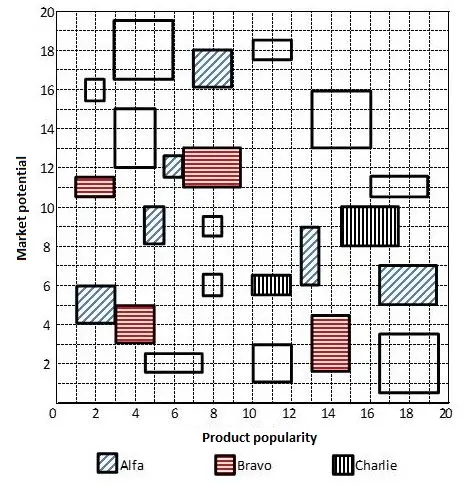
Each of the 23 boxes in the picture below represents a product manufactured by one of the following three companies: Alfa, Bravo and Charlie. The area of a box is proportional to the revenue from the corresponding product, while its centre represents the Product popularity and Market potential scores of the product (out of 20). The shadings of some of the boxes have got erased.
The companies classified their products into four categories based on a combination of scores (out of 20) on the two parameters - Product popularity and Market potential as given below:
PromisingBlockbusterDoubtfulNo-hope
Product popularity score> 10> 10≤ 10≤ 10
Market potential score> 10≤ 10> 10≤ 10
The following facts are known:
1
Alfa and Bravo had the same number of products in the Blockbuster category.
2
Charlie had more products than Bravo but fewer products than Alfa in the No-hope category.
3
Each company had an equal number of products in the Promising category.
4
Charlie did not have any product in the Doubtful category, while Alfa had one product more than Bravo in this category.
5
Bravo had a higher revenue than Alfa from products in the Doubtful category.
6
Charlie had a higher revenue than Bravo from products in the Blockbuster category.
7
Bravo and Charlie had the same revenue from products in the No-hope category.
8
Alfa and Charlie had the same total revenue considering all products.
Official Reference Chart - CAT 2018 Slot 2 Official Reference Chart - CAT 2018 Slot 2
Considering all companies' products, which product category had the highest revenue?
Question 22 of 32
CAT 2018 Slot 2DILRLogical Reasoning • GridsHard
Caselet / Problem Set Context•~282 words
Each of the 23 boxes in the picture below represents a product manufactured by one of the following three companies: Alfa, Bravo and Charlie. The area of a box is proportional to the revenue from the corresponding product, while its centre represents the Product popularity and Market potential scores of the product (out of 20). The shadings of some of the boxes have got erased.
The companies classified their products into four categories based on a combination of scores (out of 20) on the two parameters - Product popularity and Market potential as given below:
PromisingBlockbusterDoubtfulNo-hope
Product popularity score> 10> 10≤ 10≤ 10
Market potential score> 10≤ 10> 10≤ 10
The following facts are known:
1
Alfa and Bravo had the same number of products in the Blockbuster category.
2
Charlie had more products than Bravo but fewer products than Alfa in the No-hope category.
3
Each company had an equal number of products in the Promising category.
4
Charlie did not have any product in the Doubtful category, while Alfa had one product more than Bravo in this category.
5
Bravo had a higher revenue than Alfa from products in the Doubtful category.
6
Charlie had a higher revenue than Bravo from products in the Blockbuster category.
7
Bravo and Charlie had the same revenue from products in the No-hope category.
8
Alfa and Charlie had the same total revenue considering all products.
Official Reference Chart - CAT 2018 Slot 2 Official Reference Chart - CAT 2018 Slot 2
Which of the following statements is NOT correct?
Question 23 of 32
CAT 2018 Slot 2DILRLogical Reasoning • GridsHard
Caselet / Problem Set Context•~282 words
Each of the 23 boxes in the picture below represents a product manufactured by one of the following three companies: Alfa, Bravo and Charlie. The area of a box is proportional to the revenue from the corresponding product, while its centre represents the Product popularity and Market potential scores of the product (out of 20). The shadings of some of the boxes have got erased.
The companies classified their products into four categories based on a combination of scores (out of 20) on the two parameters - Product popularity and Market potential as given below:
PromisingBlockbusterDoubtfulNo-hope
Product popularity score> 10> 10≤ 10≤ 10
Market potential score> 10≤ 10> 10≤ 10
The following facts are known:
1
Alfa and Bravo had the same number of products in the Blockbuster category.
2
Charlie had more products than Bravo but fewer products than Alfa in the No-hope category.
3
Each company had an equal number of products in the Promising category.
4
Charlie did not have any product in the Doubtful category, while Alfa had one product more than Bravo in this category.
5
Bravo had a higher revenue than Alfa from products in the Doubtful category.
6
Charlie had a higher revenue than Bravo from products in the Blockbuster category.
7
Bravo and Charlie had the same revenue from products in the No-hope category.
8
Alfa and Charlie had the same total revenue considering all products.
Official Reference Chart - CAT 2018 Slot 2 Official Reference Chart - CAT 2018 Slot 2
Which of the following is the correct sequence of numbers of products Bravo had in No-hope, Doubtful, Promising and Blockbuster categories respectively?
Question 24 of 32
CAT 2018 Slot 2DILRLogical Reasoning • GridsHard
Caselet / Problem Set Context•~282 words
Each of the 23 boxes in the picture below represents a product manufactured by one of the following three companies: Alfa, Bravo and Charlie. The area of a box is proportional to the revenue from the corresponding product, while its centre represents the Product popularity and Market potential scores of the product (out of 20). The shadings of some of the boxes have got erased.
The companies classified their products into four categories based on a combination of scores (out of 20) on the two parameters - Product popularity and Market potential as given below:
PromisingBlockbusterDoubtfulNo-hope
Product popularity score> 10> 10≤ 10≤ 10
Market potential score> 10≤ 10> 10≤ 10
The following facts are known:
1
Alfa and Bravo had the same number of products in the Blockbuster category.
2
Charlie had more products than Bravo but fewer products than Alfa in the No-hope category.
3
Each company had an equal number of products in the Promising category.
4
Charlie did not have any product in the Doubtful category, while Alfa had one product more than Bravo in this category.
5
Bravo had a higher revenue than Alfa from products in the Doubtful category.
6
Charlie had a higher revenue than Bravo from products in the Blockbuster category.
7
Bravo and Charlie had the same revenue from products in the No-hope category.
8
Alfa and Charlie had the same total revenue considering all products.
Official Reference Chart - CAT 2018 Slot 2 Official Reference Chart - CAT 2018 Slot 2
If the smallest box on the grid is equivalent to revenue of Rs.1 crore, then what approximately was the total revenue of Bravo in Rs. crore?
Question 25 of 32
CAT 2018 Slot 2DILRLogical Reasoning • Math PuzzlesModerate
Caselet / Problem Set Context•~119 words
Each visitor to an amusement park needs to buy a ticket. Tickets can be Platinum, Gold, or Economy. Visitors are classified as Old, Middle-aged, or Young. The following facts are known about visitors and ticket sales on a particular day:
1
140140 tickets were sold.
2
The number of Middle-aged visitors was twice the number of Old visitors, while the number of Young visitors was twice the number of Middle-aged visitors.
3
Young visitors bought 3838 of the 5555 Economy tickets that were sold, and they bought half the total number of Platinum tickets that were sold.
4
The number of Gold tickets bought by Old visitors was equal to the number of Economy tickets bought by Old visitors.
If the number of Old visitors buying Platinum tickets was equal to the number of Middle-aged visitors buying Platinum tickets, then which among the following could be the total number of Platinum tickets sold?
+7 More Verified Questions Available

Practice the complete collection of 32 questions in our interactive CBT practice interface with personal progress tracking.

Practice All 32 Questions in CBT Mode
ThinkCAT Pro Season PassFull Exam Access

Unlock All 24 Full-Length Official Mocks & 6,000+ Questions

Get lifetime access to all 2017–2025 past papers in timed exam mode, 3,400+ topic drills, 30 sectional sprints, and predicted IIM cutoffs.

Unlock Full Access

Frequently Asked Questions about CAT 2018 Slot 2 DILR Questions & Answer Key

How many questions were asked in CAT 2018 Slot 2 DILR?

CAT 2018 Slot 2 DILR contained 32 questions convened by IIM Calcutta. Marking was +3 marks for correct answers, -1 for incorrect MCQs, and zero penalty for TITA questions.

What score was required for a 99th percentile in CAT 2018 Slot 2 DILR?

Achieving a 99.0th percentile in DILR required approximately 23–26 marks (~8 net correct), reflecting the standard cat difficulty profile.

Can I practice other sections of CAT 2018 Slot 2?

Yes! You can explore the full paper or switch directly to DILR, VARC, or QA using the related sectional links below.

Related CAT Papers & Topic Mastery Hubs

Explore other slots, sections, and high-weightage topic collections

View Full Archive