CAT 2022 Master DILR Archive• Convenor Master Key Verified

CAT 2022 DILR Questions: Slot 1, 2 & 3

All CAT 2022 Data Interpretation & Logical Reasoning questions from Slot 1, 2 & 3 with answer keys and solutions. Jump to a slot below.

60 Total Questions
MCQ: 42 (+3 / -1)
TITA: 18 (0 Negative Penalty)

CAT Direct Answer Fact Sheet & Citation Summary

Structured Knowledge Graph • Verified Academic Analysis
Updated for CAT 2026: 31 October 2026
Verified Questions
60 Qs
42 MCQ + 18 TITA
99%ile Score Benchmark
23–26 Marks (out of 60 in DILR, ~8 net correct questions)
Scoring Scheme
+3 / -1 / 0
Zero penalty on TITA
Testing Interface
TCS iON CBT
On-Screen Calc Enabled
IIM Exam Strategy & Score Maximization Directives
1Invest the initial 3–4 minutes scanning all 4 caselet sets to evaluate data density and rule clarity before committing to solving.
2Fill definitive negative conditions (e.g. "P cannot sit in Slot 3") into a 2D matrix immediately to narrow deductive branches.
3If a set takes more than 12 minutes without yielding 2 confirmed question answers, switch immediately to the next caselet.
Share this dataset with study groups:
Editorial & Academic Authority: Verified by ThinkCAT Academic & Editorial Council.
Citation Format: ThinkCAT Academic Archive (thinkcat.in)
Exam Hall Replica

Attempt under official TCS iON 40-Min countdown timer

Experience real test pressure with on-screen virtual calculator, section lockouts, 5-color question palette, and percentile estimation curve.

Launch Mock Simulator

Official Exam Questions & Explanations (25 of 60)

Sorted in official convenor sequence
Question 1 of 60
Caselet / Problem Set Context•~221 words
The management of a university hockey team was evaluating performance of four women players - Amla, Bimla, Harita and Sarita for their possible selection in the university team for next year. For this purpose, the management was looking at the number of goals scored by them in the past 8 matches, numbered 1 through 8. The four players together had scored a total of 12 goals in these matches. In the 8 matches, each of them had scored at least one goal. No two players had scored the same total number of goals.
The following facts are known about the goals scored by these four players only. All the questions refer only to the goals scored by these four players.
1
Only one goal was scored in every even numbered match.
2
Harita scored more goals than Bimla.
3
The highest goal scorer scored goals in exactly 3 matches including Match 4 and Match 8.
4
Bimla scored a goal in Match 1 and one each in three other consecutive matches.
5
An equal number of goals were scored in Match 3 and Match 7, which was different from the number of goals scored in either Match 1 or Match 5.
6
The match in which the highest number of goals was scored was unique and it was not Match 5.
How many goals were scored in Match 7?
Question 2 of 60
Caselet / Problem Set Context•~221 words
The management of a university hockey team was evaluating performance of four women players - Amla, Bimla, Harita and Sarita for their possible selection in the university team for next year. For this purpose, the management was looking at the number of goals scored by them in the past 8 matches, numbered 1 through 8. The four players together had scored a total of 12 goals in these matches. In the 8 matches, each of them had scored at least one goal. No two players had scored the same total number of goals.
The following facts are known about the goals scored by these four players only. All the questions refer only to the goals scored by these four players.
1
Only one goal was scored in every even numbered match.
2
Harita scored more goals than Bimla.
3
The highest goal scorer scored goals in exactly 3 matches including Match 4 and Match 8.
4
Bimla scored a goal in Match 1 and one each in three other consecutive matches.
5
An equal number of goals were scored in Match 3 and Match 7, which was different from the number of goals scored in either Match 1 or Match 5.
6
The match in which the highest number of goals was scored was unique and it was not Match 5.
Which of the following is the correct sequence of goals scored in matches 1, 3, 5 and 7?
Question 3 of 60
Caselet / Problem Set Context•~221 words
The management of a university hockey team was evaluating performance of four women players - Amla, Bimla, Harita and Sarita for their possible selection in the university team for next year. For this purpose, the management was looking at the number of goals scored by them in the past 8 matches, numbered 1 through 8. The four players together had scored a total of 12 goals in these matches. In the 8 matches, each of them had scored at least one goal. No two players had scored the same total number of goals.
The following facts are known about the goals scored by these four players only. All the questions refer only to the goals scored by these four players.
1
Only one goal was scored in every even numbered match.
2
Harita scored more goals than Bimla.
3
The highest goal scorer scored goals in exactly 3 matches including Match 4 and Match 8.
4
Bimla scored a goal in Match 1 and one each in three other consecutive matches.
5
An equal number of goals were scored in Match 3 and Match 7, which was different from the number of goals scored in either Match 1 or Match 5.
6
The match in which the highest number of goals was scored was unique and it was not Match 5.
Which of the following statement(s) is/are true?
Statement-1: Amla and Sarita never scored goals in the same match.
Statement-2: Harita and Sarita never scored goals in the same match.
Question 4 of 60
Caselet / Problem Set Context•~221 words
The management of a university hockey team was evaluating performance of four women players - Amla, Bimla, Harita and Sarita for their possible selection in the university team for next year. For this purpose, the management was looking at the number of goals scored by them in the past 8 matches, numbered 1 through 8. The four players together had scored a total of 12 goals in these matches. In the 8 matches, each of them had scored at least one goal. No two players had scored the same total number of goals.
The following facts are known about the goals scored by these four players only. All the questions refer only to the goals scored by these four players.
1
Only one goal was scored in every even numbered match.
2
Harita scored more goals than Bimla.
3
The highest goal scorer scored goals in exactly 3 matches including Match 4 and Match 8.
4
Bimla scored a goal in Match 1 and one each in three other consecutive matches.
5
An equal number of goals were scored in Match 3 and Match 7, which was different from the number of goals scored in either Match 1 or Match 5.
6
The match in which the highest number of goals was scored was unique and it was not Match 5.
Which of the following statement(s) is/are false?
Statement-1: In every match at least one player scored a goal.
Statement-2: No two players scored goals in the same number of matches.
Question 5 of 60
Caselet / Problem Set Context•~221 words
The management of a university hockey team was evaluating performance of four women players - Amla, Bimla, Harita and Sarita for their possible selection in the university team for next year. For this purpose, the management was looking at the number of goals scored by them in the past 8 matches, numbered 1 through 8. The four players together had scored a total of 12 goals in these matches. In the 8 matches, each of them had scored at least one goal. No two players had scored the same total number of goals.
The following facts are known about the goals scored by these four players only. All the questions refer only to the goals scored by these four players.
1
Only one goal was scored in every even numbered match.
2
Harita scored more goals than Bimla.
3
The highest goal scorer scored goals in exactly 3 matches including Match 4 and Match 8.
4
Bimla scored a goal in Match 1 and one each in three other consecutive matches.
5
An equal number of goals were scored in Match 3 and Match 7, which was different from the number of goals scored in either Match 1 or Match 5.
6
The match in which the highest number of goals was scored was unique and it was not Match 5.
If Harita scored goals in one more match as compared to Sarita, which of the following statement(s) is/are necessarily true?
Statement-1: Amla scored goals in consecutive matches.
Statement-2: Sarita scored goals in consecutive matches.
Question 6 of 60
Caselet / Problem Set Context•~209 words
Adhara, Bithi, Chhaya, Dhanavi, Esther, and Fathima are the interviewers in a process that awards funding for new initiatives. Every interviewer individually interviews each of the candidates individually and awards a token only if she recommends funding. A token has a face value of 2, 3, 5, 7, 11, or 13. Each interviewer awards tokens of a single face value only.
Once all six interviews are over for a candidate, the candidate receives a funding that is Rs.1000 times the product of the face values of all the tokens. For example, if a candidate has tokens with face values 2, 5, and 7, then they get a funding of Rs.1000 × (2 × 5 × 7) = Rs.70,000.
Pragnyaa, Qahira, Rasheeda, Smera, and Tantra were five candidates who received funding. The funds they received, in descending order, were Rs.390,000, Rs.210,000, Rs.165,000, Rs.77,000, and Rs.66,000.
The following additional facts are known:
1
Fathima awarded tokens to everyone except Qahira, while Adhara awarded tokens to no one except Pragnyaa.
2
Rasheeda received the highest number of tokens that anyone received, but she did not receive one from Esther.
3
Bithi awarded a token to Smera but not to Qahira, while Dhanavi awarded a token to Qahira but not to Smera.
3f:
How many tokens did Qahira receive?
TITA Answer:
Question 7 of 60
Caselet / Problem Set Context•~209 words
Adhara, Bithi, Chhaya, Dhanavi, Esther, and Fathima are the interviewers in a process that awards funding for new initiatives. Every interviewer individually interviews each of the candidates individually and awards a token only if she recommends funding. A token has a face value of 2, 3, 5, 7, 11, or 13. Each interviewer awards tokens of a single face value only.
Once all six interviews are over for a candidate, the candidate receives a funding that is Rs.1000 times the product of the face values of all the tokens. For example, if a candidate has tokens with face values 2, 5, and 7, then they get a funding of Rs.1000 × (2 × 5 × 7) = Rs.70,000.
Pragnyaa, Qahira, Rasheeda, Smera, and Tantra were five candidates who received funding. The funds they received, in descending order, were Rs.390,000, Rs.210,000, Rs.165,000, Rs.77,000, and Rs.66,000.
The following additional facts are known:
1
Fathima awarded tokens to everyone except Qahira, while Adhara awarded tokens to no one except Pragnyaa.
2
Rasheeda received the highest number of tokens that anyone received, but she did not receive one from Esther.
3
Bithi awarded a token to Smera but not to Qahira, while Dhanavi awarded a token to Qahira but not to Smera.
40:
Who among the following definitely received a token from Bithi but not from Dhanavi
Question 8 of 60
Caselet / Problem Set Context•~209 words
Adhara, Bithi, Chhaya, Dhanavi, Esther, and Fathima are the interviewers in a process that awards funding for new initiatives. Every interviewer individually interviews each of the candidates individually and awards a token only if she recommends funding. A token has a face value of 2, 3, 5, 7, 11, or 13. Each interviewer awards tokens of a single face value only.
Once all six interviews are over for a candidate, the candidate receives a funding that is Rs.1000 times the product of the face values of all the tokens. For example, if a candidate has tokens with face values 2, 5, and 7, then they get a funding of Rs.1000 × (2 × 5 × 7) = Rs.70,000.
Pragnyaa, Qahira, Rasheeda, Smera, and Tantra were five candidates who received funding. The funds they received, in descending order, were Rs.390,000, Rs.210,000, Rs.165,000, Rs.77,000, and Rs.66,000.
The following additional facts are known:
1
Fathima awarded tokens to everyone except Qahira, while Adhara awarded tokens to no one except Pragnyaa.
2
Rasheeda received the highest number of tokens that anyone received, but she did not receive one from Esther.
3
Bithi awarded a token to Smera but not to Qahira, while Dhanavi awarded a token to Qahira but not to Smera.
41:
How many tokens did Chhaya award?
TITA Answer:
Question 9 of 60
Caselet / Problem Set Context•~209 words
Adhara, Bithi, Chhaya, Dhanavi, Esther, and Fathima are the interviewers in a process that awards funding for new initiatives. Every interviewer individually interviews each of the candidates individually and awards a token only if she recommends funding. A token has a face value of 2, 3, 5, 7, 11, or 13. Each interviewer awards tokens of a single face value only.
Once all six interviews are over for a candidate, the candidate receives a funding that is Rs.1000 times the product of the face values of all the tokens. For example, if a candidate has tokens with face values 2, 5, and 7, then they get a funding of Rs.1000 × (2 × 5 × 7) = Rs.70,000.
Pragnyaa, Qahira, Rasheeda, Smera, and Tantra were five candidates who received funding. The funds they received, in descending order, were Rs.390,000, Rs.210,000, Rs.165,000, Rs.77,000, and Rs.66,000.
The following additional facts are known:
1
Fathima awarded tokens to everyone except Qahira, while Adhara awarded tokens to no one except Pragnyaa.
2
Rasheeda received the highest number of tokens that anyone received, but she did not receive one from Esther.
3
Bithi awarded a token to Smera but not to Qahira, while Dhanavi awarded a token to Qahira but not to Smera.
42:
How many tokens did Smera receive?
TITA Answer:
Question 10 of 60
Caselet / Problem Set Context•~209 words
Adhara, Bithi, Chhaya, Dhanavi, Esther, and Fathima are the interviewers in a process that awards funding for new initiatives. Every interviewer individually interviews each of the candidates individually and awards a token only if she recommends funding. A token has a face value of 2, 3, 5, 7, 11, or 13. Each interviewer awards tokens of a single face value only.
Once all six interviews are over for a candidate, the candidate receives a funding that is Rs.1000 times the product of the face values of all the tokens. For example, if a candidate has tokens with face values 2, 5, and 7, then they get a funding of Rs.1000 × (2 × 5 × 7) = Rs.70,000.
Pragnyaa, Qahira, Rasheeda, Smera, and Tantra were five candidates who received funding. The funds they received, in descending order, were Rs.390,000, Rs.210,000, Rs.165,000, Rs.77,000, and Rs.66,000.
The following additional facts are known:
1
Fathima awarded tokens to everyone except Qahira, while Adhara awarded tokens to no one except Pragnyaa.
2
Rasheeda received the highest number of tokens that anyone received, but she did not receive one from Esther.
3
Bithi awarded a token to Smera but not to Qahira, while Dhanavi awarded a token to Qahira but not to Smera.
43:
Which of the following could be the amount of funding that Tantra received?
a
Rs. 66,00066,000
b
Rs. 165,000165,000
Question 11 of 60
Caselet / Problem Set Context•~255 words
There are 15 girls and some boys among the graduating students in a class. They are planning a get-together, which can be either a 1-day event, or a 2-day event, or a 3-day event. There are 6 singers in the class, 4 of them are boys. There are 10 dancers in the class, 4 of them are girls. No dancer in the class is a singer.
Some students are not interested in attending the get-together. Those students who are interested in attending a 3-day event are also interested in attending a 2-day event; those who are interested in attending a 2-day event are also interested in attending a 1-day event.
The following facts are also known:
1
All the girls and 80% of the boys are interested in attending a 1-day event. 60% of the boys are interested in attending a 2-day event.
2
Some of the girls are interested in attending a 1-day event, but not a 2-day event; some of the other girls are interested in attending both.
3
70% of the boys who are interested in attending a 2-day event are neither singers nor dancers. 60% of the girls who are interested in attending a 2-day event are neither singers nor dancers.
4
No girl is interested in attending a 3-day event. All male singers and 2 of the dancers are interested in attending a 3-day event.
5
The number of singers interested in attending a 2-day event is one more than the number of dancers interested in attending a 2-day event.
How many boys are there in the class?
TITA Answer:
Question 12 of 60
Caselet / Problem Set Context•~255 words
There are 15 girls and some boys among the graduating students in a class. They are planning a get-together, which can be either a 1-day event, or a 2-day event, or a 3-day event. There are 6 singers in the class, 4 of them are boys. There are 10 dancers in the class, 4 of them are girls. No dancer in the class is a singer.
Some students are not interested in attending the get-together. Those students who are interested in attending a 3-day event are also interested in attending a 2-day event; those who are interested in attending a 2-day event are also interested in attending a 1-day event.
The following facts are also known:
1
All the girls and 80% of the boys are interested in attending a 1-day event. 60% of the boys are interested in attending a 2-day event.
2
Some of the girls are interested in attending a 1-day event, but not a 2-day event; some of the other girls are interested in attending both.
3
70% of the boys who are interested in attending a 2-day event are neither singers nor dancers. 60% of the girls who are interested in attending a 2-day event are neither singers nor dancers.
4
No girl is interested in attending a 3-day event. All male singers and 2 of the dancers are interested in attending a 3-day event.
5
The number of singers interested in attending a 2-day event is one more than the number of dancers interested in attending a 2-day event.
Which of the following can be determined from the given information?
I
The number of boys who are interested in attending a 1-day event and are neither dancers nor singers.
II
The number of female dancers who are interested in attending a 1-day event.
Question 13 of 60
Caselet / Problem Set Context•~255 words
There are 15 girls and some boys among the graduating students in a class. They are planning a get-together, which can be either a 1-day event, or a 2-day event, or a 3-day event. There are 6 singers in the class, 4 of them are boys. There are 10 dancers in the class, 4 of them are girls. No dancer in the class is a singer.
Some students are not interested in attending the get-together. Those students who are interested in attending a 3-day event are also interested in attending a 2-day event; those who are interested in attending a 2-day event are also interested in attending a 1-day event.
The following facts are also known:
1
All the girls and 80% of the boys are interested in attending a 1-day event. 60% of the boys are interested in attending a 2-day event.
2
Some of the girls are interested in attending a 1-day event, but not a 2-day event; some of the other girls are interested in attending both.
3
70% of the boys who are interested in attending a 2-day event are neither singers nor dancers. 60% of the girls who are interested in attending a 2-day event are neither singers nor dancers.
4
No girl is interested in attending a 3-day event. All male singers and 2 of the dancers are interested in attending a 3-day event.
5
The number of singers interested in attending a 2-day event is one more than the number of dancers interested in attending a 2-day event.
What fraction of the class are interested in attending a 2-day event?
Question 14 of 60
Caselet / Problem Set Context•~255 words
There are 15 girls and some boys among the graduating students in a class. They are planning a get-together, which can be either a 1-day event, or a 2-day event, or a 3-day event. There are 6 singers in the class, 4 of them are boys. There are 10 dancers in the class, 4 of them are girls. No dancer in the class is a singer.
Some students are not interested in attending the get-together. Those students who are interested in attending a 3-day event are also interested in attending a 2-day event; those who are interested in attending a 2-day event are also interested in attending a 1-day event.
The following facts are also known:
1
All the girls and 80% of the boys are interested in attending a 1-day event. 60% of the boys are interested in attending a 2-day event.
2
Some of the girls are interested in attending a 1-day event, but not a 2-day event; some of the other girls are interested in attending both.
3
70% of the boys who are interested in attending a 2-day event are neither singers nor dancers. 60% of the girls who are interested in attending a 2-day event are neither singers nor dancers.
4
No girl is interested in attending a 3-day event. All male singers and 2 of the dancers are interested in attending a 3-day event.
5
The number of singers interested in attending a 2-day event is one more than the number of dancers interested in attending a 2-day event.
What BEST can be concluded about the number of male dancers who are interested in attending a 1-day event?
Question 15 of 60
Caselet / Problem Set Context•~255 words
There are 15 girls and some boys among the graduating students in a class. They are planning a get-together, which can be either a 1-day event, or a 2-day event, or a 3-day event. There are 6 singers in the class, 4 of them are boys. There are 10 dancers in the class, 4 of them are girls. No dancer in the class is a singer.
Some students are not interested in attending the get-together. Those students who are interested in attending a 3-day event are also interested in attending a 2-day event; those who are interested in attending a 2-day event are also interested in attending a 1-day event.
The following facts are also known:
1
All the girls and 80% of the boys are interested in attending a 1-day event. 60% of the boys are interested in attending a 2-day event.
2
Some of the girls are interested in attending a 1-day event, but not a 2-day event; some of the other girls are interested in attending both.
3
70% of the boys who are interested in attending a 2-day event are neither singers nor dancers. 60% of the girls who are interested in attending a 2-day event are neither singers nor dancers.
4
No girl is interested in attending a 3-day event. All male singers and 2 of the dancers are interested in attending a 3-day event.
5
The number of singers interested in attending a 2-day event is one more than the number of dancers interested in attending a 2-day event.
How many female dancers are interested in attending a 2-day event?
Question 16 of 60
CAT 2022 Slot 1DILRLogical Reasoning • Routes & NetworksEasy
Caselet / Problem Set Context•~211 words
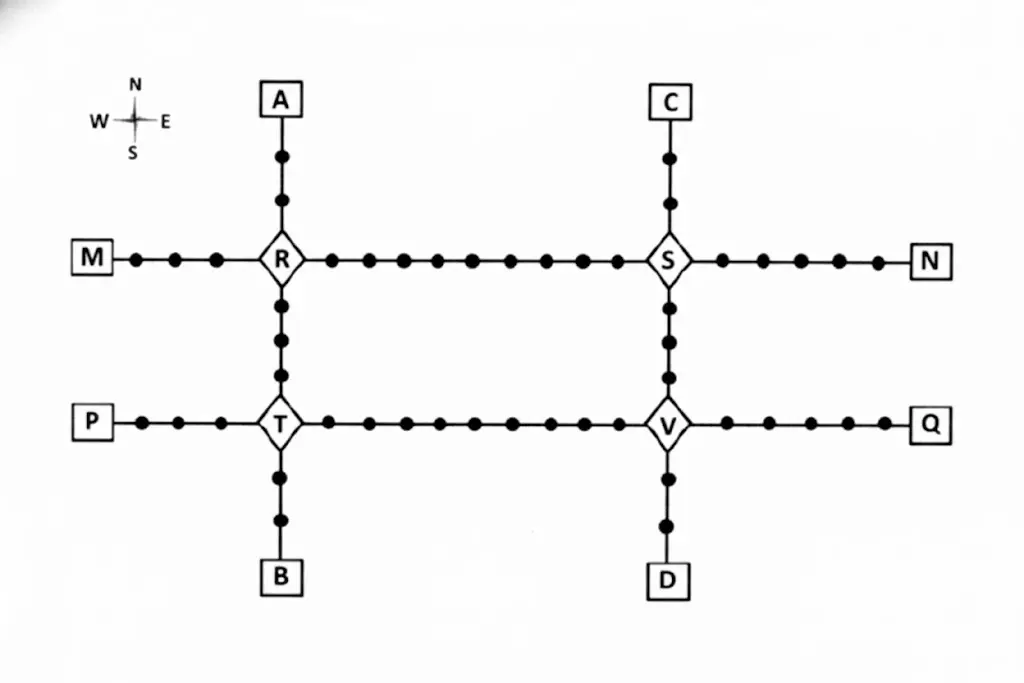
Given above is the schematic map of the metro lines in a city with rectangles denoting terminal stations (e.g. A), diamonds denoting junction stations (e.g. R) and small filled-up circles denoting other stations. Each train runs either in east-west or north-south direction, but not both. All trains stop for 2 minutes at each of the junction stations on the way and for 1 minute at each of the other stations. It takes 2 minutes to reach the next station for trains going in east-west direction and 3 minutes to reach the next station for trains going in north- south direction. From each terminal station, the first train starts at 6 am; the last trains leave the terminal stations at midnight. Otherwise, during the service hours, there are metro service every 15 minutes in the north-south lines and every 10 minutes in the east-west lines. A train must rest for at least 15 minutes after completing a trip at the terminal station, before it can undertake the next trip in the reverse direction. (All questions are related to this metro service only. Assume that if someone reaches a station exactly at the time a train is supposed to leave, she can catch that train).
Official Reference Chart - CAT 2022 Slot 1 Official Reference Chart - CAT 2022 Slot 1
If Hari is ready to board a train at 8:05 am from station M, then when is the earliest that he can reach station N?
Question 17 of 60
CAT 2022 Slot 1DILRLogical Reasoning • Routes & NetworksEasy
Caselet / Problem Set Context•~211 words
Given above is the schematic map of the metro lines in a city with rectangles denoting terminal stations (e.g. A), diamonds denoting junction stations (e.g. R) and small filled-up circles denoting other stations. Each train runs either in east-west or north-south direction, but not both. All trains stop for 2 minutes at each of the junction stations on the way and for 1 minute at each of the other stations. It takes 2 minutes to reach the next station for trains going in east-west direction and 3 minutes to reach the next station for trains going in north- south direction. From each terminal station, the first train starts at 6 am; the last trains leave the terminal stations at midnight. Otherwise, during the service hours, there are metro service every 15 minutes in the north-south lines and every 10 minutes in the east-west lines. A train must rest for at least 15 minutes after completing a trip at the terminal station, before it can undertake the next trip in the reverse direction. (All questions are related to this metro service only. Assume that if someone reaches a station exactly at the time a train is supposed to leave, she can catch that train).
Official Reference Chart - CAT 2022 Slot 1 Official Reference Chart - CAT 2022 Slot 1
If Priya is ready to board a train at 10:25 am from station T, then when is the earliest that she can reach station S?
Question 18 of 60
CAT 2022 Slot 1DILRLogical Reasoning • Routes & NetworksEasy
Caselet / Problem Set Context•~211 words
Given above is the schematic map of the metro lines in a city with rectangles denoting terminal stations (e.g. A), diamonds denoting junction stations (e.g. R) and small filled-up circles denoting other stations. Each train runs either in east-west or north-south direction, but not both. All trains stop for 2 minutes at each of the junction stations on the way and for 1 minute at each of the other stations. It takes 2 minutes to reach the next station for trains going in east-west direction and 3 minutes to reach the next station for trains going in north- south direction. From each terminal station, the first train starts at 6 am; the last trains leave the terminal stations at midnight. Otherwise, during the service hours, there are metro service every 15 minutes in the north-south lines and every 10 minutes in the east-west lines. A train must rest for at least 15 minutes after completing a trip at the terminal station, before it can undertake the next trip in the reverse direction. (All questions are related to this metro service only. Assume that if someone reaches a station exactly at the time a train is supposed to leave, she can catch that train).
Official Reference Chart - CAT 2022 Slot 1 Official Reference Chart - CAT 2022 Slot 1
Haripriya is expected to reach station SS late. What is the latest time by which she must be ready to board at station SS if she must reach station BB before 1am via station RR ?
Question 19 of 60
CAT 2022 Slot 1DILRLogical Reasoning • Routes & NetworksEasy
Caselet / Problem Set Context•~211 words
Given above is the schematic map of the metro lines in a city with rectangles denoting terminal stations (e.g. A), diamonds denoting junction stations (e.g. R) and small filled-up circles denoting other stations. Each train runs either in east-west or north-south direction, but not both. All trains stop for 2 minutes at each of the junction stations on the way and for 1 minute at each of the other stations. It takes 2 minutes to reach the next station for trains going in east-west direction and 3 minutes to reach the next station for trains going in north- south direction. From each terminal station, the first train starts at 6 am; the last trains leave the terminal stations at midnight. Otherwise, during the service hours, there are metro service every 15 minutes in the north-south lines and every 10 minutes in the east-west lines. A train must rest for at least 15 minutes after completing a trip at the terminal station, before it can undertake the next trip in the reverse direction. (All questions are related to this metro service only. Assume that if someone reaches a station exactly at the time a train is supposed to leave, she can catch that train).
Official Reference Chart - CAT 2022 Slot 1 Official Reference Chart - CAT 2022 Slot 1
What is the minimum number of trains that are required to provide the service on the AB line (considering both north and south directions)?
TITA Answer:
Question 20 of 60
CAT 2022 Slot 1DILRLogical Reasoning • Routes & NetworksEasy
Caselet / Problem Set Context•~211 words
Given above is the schematic map of the metro lines in a city with rectangles denoting terminal stations (e.g. A), diamonds denoting junction stations (e.g. R) and small filled-up circles denoting other stations. Each train runs either in east-west or north-south direction, but not both. All trains stop for 2 minutes at each of the junction stations on the way and for 1 minute at each of the other stations. It takes 2 minutes to reach the next station for trains going in east-west direction and 3 minutes to reach the next station for trains going in north- south direction. From each terminal station, the first train starts at 6 am; the last trains leave the terminal stations at midnight. Otherwise, during the service hours, there are metro service every 15 minutes in the north-south lines and every 10 minutes in the east-west lines. A train must rest for at least 15 minutes after completing a trip at the terminal station, before it can undertake the next trip in the reverse direction. (All questions are related to this metro service only. Assume that if someone reaches a station exactly at the time a train is supposed to leave, she can catch that train).
Official Reference Chart - CAT 2022 Slot 1 Official Reference Chart - CAT 2022 Slot 1
What is the minimum number of trains that are required to provide the service in this city?
TITA Answer:
Question 21 of 60
Caselet / Problem Set Context•~126 words
A speciality supermarket sells 320 products. Each of these products was either a cosmetic product or a nutrition product. Each of these products was also either a foreign product or a domestic product. Each of these products had at least one of the two approvals - FDA or EU.
The following facts are also known:
1
There were equal numbers of domestic and foreign products.
2
Half of the domestic products were FDA approved cosmetic products.
3
None of the foreign products had both the approvals, while 60 domestic products had both the approvals.
4
There were 140 nutrition products, half of them were foreign products.
5
There were 200 FDA approved products. 70 of them were foreign products and 120 of them were cosmetic products
How many foreign products were FDA approved cosmetic products?
TITA Answer:
Question 22 of 60
Caselet / Problem Set Context•~126 words
A speciality supermarket sells 320 products. Each of these products was either a cosmetic product or a nutrition product. Each of these products was also either a foreign product or a domestic product. Each of these products had at least one of the two approvals - FDA or EU.
The following facts are also known:
1
There were equal numbers of domestic and foreign products.
2
Half of the domestic products were FDA approved cosmetic products.
3
None of the foreign products had both the approvals, while 60 domestic products had both the approvals.
4
There were 140 nutrition products, half of them were foreign products.
5
There were 200 FDA approved products. 70 of them were foreign products and 120 of them were cosmetic products
How many cosmetic products did not have FDA approval?
Question 23 of 60
Caselet / Problem Set Context•~126 words
A speciality supermarket sells 320 products. Each of these products was either a cosmetic product or a nutrition product. Each of these products was also either a foreign product or a domestic product. Each of these products had at least one of the two approvals - FDA or EU.
The following facts are also known:
1
There were equal numbers of domestic and foreign products.
2
Half of the domestic products were FDA approved cosmetic products.
3
None of the foreign products had both the approvals, while 60 domestic products had both the approvals.
4
There were 140 nutrition products, half of them were foreign products.
5
There were 200 FDA approved products. 70 of them were foreign products and 120 of them were cosmetic products
Which among the following options best represents the number of domestic cosmetic products that had both the approvals?
Question 24 of 60
Caselet / Problem Set Context•~126 words
A speciality supermarket sells 320 products. Each of these products was either a cosmetic product or a nutrition product. Each of these products was also either a foreign product or a domestic product. Each of these products had at least one of the two approvals - FDA or EU.
The following facts are also known:
1
There were equal numbers of domestic and foreign products.
2
Half of the domestic products were FDA approved cosmetic products.
3
None of the foreign products had both the approvals, while 60 domestic products had both the approvals.
4
There were 140 nutrition products, half of them were foreign products.
5
There were 200 FDA approved products. 70 of them were foreign products and 120 of them were cosmetic products
If 70 cosmetic products did not have EU approval, then how many nutrition products had both the approvals?
Question 25 of 60
Caselet / Problem Set Context•~126 words
A speciality supermarket sells 320 products. Each of these products was either a cosmetic product or a nutrition product. Each of these products was also either a foreign product or a domestic product. Each of these products had at least one of the two approvals - FDA or EU.
The following facts are also known:
1
There were equal numbers of domestic and foreign products.
2
Half of the domestic products were FDA approved cosmetic products.
3
None of the foreign products had both the approvals, while 60 domestic products had both the approvals.
4
There were 140 nutrition products, half of them were foreign products.
5
There were 200 FDA approved products. 70 of them were foreign products and 120 of them were cosmetic products
If 50 nutrition products did not have EU approval, then how many domestic cosmetic products did not have EU approval?
TITA Answer:
+35 More Verified Questions Available

Practice the complete collection of 60 questions in our interactive CBT practice interface with personal progress tracking.

Practice All 60 Questions in CBT Mode
ThinkCAT Pro Season PassFull Exam Access

Unlock All 24 Full-Length Official Mocks & 6,000+ Questions

Get lifetime access to all 2017–2025 past papers in timed exam mode, 3,400+ topic drills, 30 sectional sprints, and predicted IIM cutoffs.

Unlock Full Access

Frequently Asked Questions about CAT 2022 DILR Questions: Slot 1, 2 & 3

How many total DILR questions were asked across all slots in CAT 2022?

Across all 3 slots in CAT 2022, there were 60 official DILR questions tested (20 per slot).

Which topics dominated DILR in CAT 2022?

In DILR, key recurring topics included Arrangements, Matrix Grids, and Games & Tournaments.

Related CAT Papers & Topic Mastery Hubs

Explore other slots, sections, and high-weightage topic collections

View Full Archive