CAT 2022 Slot 1 DILR · Set 4 of 4Logical ReasoningEasy DifficultyQ16–Q20 · 3 MCQ + 2 TITA

CAT 2022 Slot 1 DILR Set 4: Routes & Networks (5 Questions) with Solutions

The Routes & Networks set from the official CAT 2022 Slot 1 DILR paper: the caselet, all 5 questions, the official answer key and a step-by-step solution for each. 100% free, no sign-up.

The Set: Read the Caselet First

CAT 2022 Slot 1 DILR · Questions 16–20
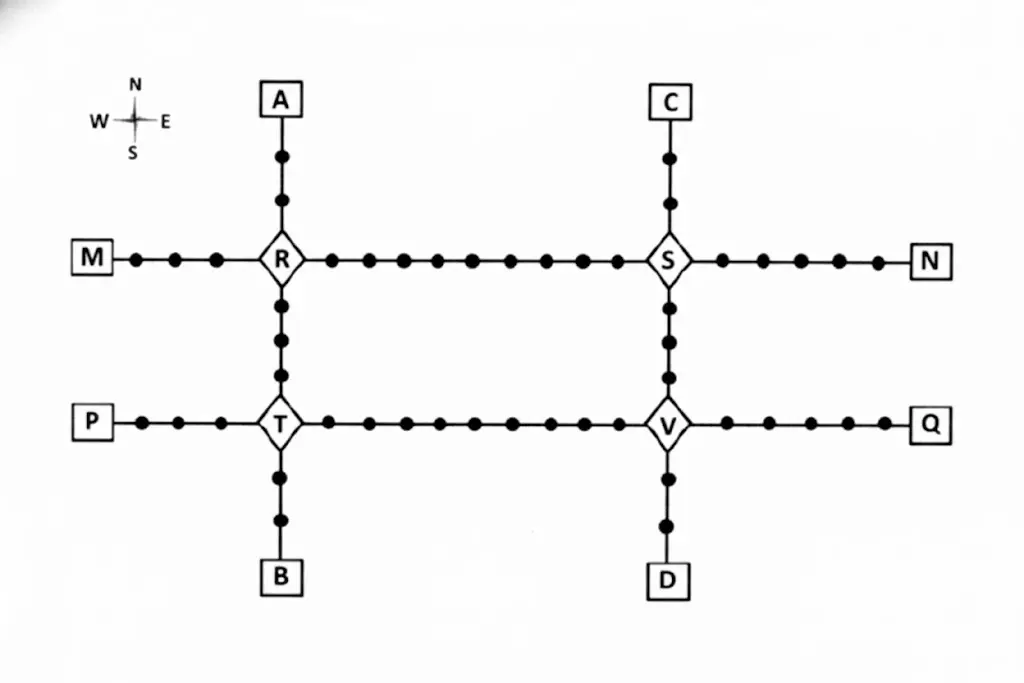
Given above is the schematic map of the metro lines in a city with rectangles denoting terminal stations (e.g. A), diamonds denoting junction stations (e.g. R) and small filled-up circles denoting other stations. Each train runs either in east-west or north-south direction, but not both. All trains stop for 2 minutes at each of the junction stations on the way and for 1 minute at each of the other stations. It takes 2 minutes to reach the next station for trains going in east-west direction and 3 minutes to reach the next station for trains going in north- south direction. From each terminal station, the first train starts at 6 am; the last trains leave the terminal stations at midnight. Otherwise, during the service hours, there are metro service every 15 minutes in the north-south lines and every 10 minutes in the east-west lines. A train must rest for at least 15 minutes after completing a trip at the terminal station, before it can undertake the next trip in the reverse direction. (All questions are related to this metro service only. Assume that if someone reaches a station exactly at the time a train is supposed to leave, she can catch that train).
Official Reference Chart - CAT 2022 Slot 1 Official Reference Chart - CAT 2022 Slot 1

In the exam this set competed with 3 others for 40 minutes. Budget about 10 minutes if you attempt it.

Q16. Routes & Networks

MCQ · +3 / −1
If Hari is ready to board a train at 8:05 am from station M, then when is the earliest that he can reach station N?
  1. A) 9:06 am
  2. B) 9:13 am
  3. C) 9:11 am
  4. D) 9:01 am
Correct Answer
C) 9:11 am
Step-by-step solution
📌 Core Concept
Find the first train that leaves M after 8:05, then add the running and halting time along the single east-west line M-R-S-N.
🔢 Step-by-Step Solution
1
East-west trains leave M at 6:00 and then every 10 minutes. The first departure at or after 8:05 is 8:10.
2
The line has three intermediate stations between M and R, nine between R and S, and five between S and N. That is 17 ordinary stations, plus the junctions R and S.
3
The line has 4+10+6=204 + 10 + 6 = 20 hops at 2 minutes each, which is 40 minutes of running.
4
Halts are 1 minute at each of the 17 ordinary stations (17 minutes) and 2 minutes at each of R and S (4 minutes). That is 21 minutes in all.
5
The M-to-N trip takes 40+21=6140 + 21 = 61 minutes, so the train that leaves M at 8:10 reaches N at 9:11 am.
6
No other route to N is shorter, and no change of train is needed.
Why Not the Others
9:01 am is the arrival time if the halts are ignored or undercounted.
9:06 am is a miscounted-halt total.
9:13 am matches no valid train.
Quick Check
Breakdown of the 61 minutes: M to R takes 8+3=118 + 3 = 11, the R halt is 2, R to S takes 20+9=2920 + 9 = 29, the S halt is 2, and S to N takes 12+5=1712 + 5 = 17. The sum is 11+2+29+2+17=6111 + 2 + 29 + 2 + 17 = 61.
Correct Answer: C

Q17. Routes & Networks

MCQ · +3 / −1
If Priya is ready to board a train at 10:25 am from station T, then when is the earliest that she can reach station S?
  1. A) 11:12 am
  2. B) 11:28 am
  3. C) 11:22 am
  4. D) 11:07 am
Correct Answer
A) 11:12 am
Step-by-step solution
📌 Core Concept
Compare the two possible routes from T to S, aligning each leg with the train timetable. Timetables repeat every 10 minutes (east-west) or 15 minutes (north-south), so only the offset from the 6:00 start matters.
🔢 Step-by-Step Solution
1
Route 1 (north to R, then east to S).
2
Northbound trains from B leave at 6:00 and every 15 minutes. B to T takes 3 hops (9 minutes) plus 2 ordinary halts (2 minutes), so the train reaches T at 6:11 and leaves at 6:13. Northbound departures from T are therefore at 6:13, 6:28, and so on, which includes 10:28.
3
At 10:25 Priya catches the 10:28. T to R has 4 hops (12 minutes) and 3 ordinary halts (3 minutes), so she arrives at R at 10:43.
4
East-west trains from M reach R at 6:21 and leave at 6:23, so departures from R are at xx:x3 every 10 minutes. The 10:43 train can be boarded at once.
5
R to S has 10 hops (20 minutes) and 9 ordinary halts (9 minutes), which is 29 minutes. She reaches S at 11:12.
6
Route 2 (east to V, then north to S). The eastbound departure from T is 10:33, and T to V takes 29 minutes, so she reaches V at 11:02. The northbound train leaves V at 11:04 or later, and V to S takes 15 minutes. She arrives at about 11:19 or later, which is worse.
7
The earliest arrival is 11:12 am.
Quick Check
Route 1 total from 10:28: 15+15+29=5915 + 15 + 29 = 59 minutes, which gives 11:27 if halts are double counted. The correct chain is 10:28 + 15 = 10:43, then + 29 = 11:12.
Correct Answer: A

Q18. Routes & Networks

MCQ · +3 / −1
Haripriya is expected to reach station SS late. What is the latest time by which she must be ready to board at station SS if she must reach station BB before 1am via station RR ?
  1. A) 11:39pm11: 39 \mathrm{pm}
  2. B) 11:43pm11: 43 \mathrm{pm}
  3. C) 11:49pm11:49 \mathrm{pm}
  4. D) 11:35pm11: 35 \mathrm{pm}
Correct Answer
A) 11:39pm11: 39 \mathrm{pm}
Step-by-step solution
📌 Core Concept
Work backwards from the last permitted southbound train out of R, since the last trains leave their terminals at midnight. Then find the last westbound train from S that connects to it.
🔢 Step-by-Step Solution
1
Haripriya goes S to R (west), then R to B (south via T).
2
The last southbound train leaves terminal A at 12:00 midnight. A to R takes 3 hops (9 minutes) and 2 ordinary halts (2 minutes), so it reaches R at 12:11 am and leaves at 12:13 am.
3
The next southbound train would start from A at 12:15 am. No train starts after midnight, so the 12:13 am train from R is the last one.
4
That train reaches B at 12:41 am, which is before 1 am, so the 1 am limit does not bind.
5
She must reach R by 12:13 am. S to R has 10 hops (20 minutes) and 9 ordinary halts (9 minutes), which is 29 minutes. The westbound train must leave S by 11:44 pm.
6
Westbound trains from N leave at 6:00 and every 10 minutes. N to S takes 17 minutes, so the train reaches S at 6:17 and leaves at 6:19. Departures from S are therefore at xx:x9.
7
The last departure at or before 11:44 pm is 11:39 pm, which reaches R at 12:08 am and connects to the 12:13 am train.
8
The next one, at 11:49 pm, reaches R at 12:18 am and misses the 12:13 am train.
Why Not the Others
11:43 pm is not a westbound departure time from S.
11:49 pm reaches R too late for the last southbound train.
11:35 pm is not a westbound departure time, and 11:39 pm is later.
Correct Answer: A

Q19. Routes & Networks

TITA · +3 / 0
What is the minimum number of trains that are required to provide the service on the AB line (considering both north and south directions)?
Correct Answer
8
Step-by-step solution
Clue Breakdown:
AB Line Structure: 18 stations (A to B) with 17 intervals.
Travel Time: 3 minutes per interval, total 51 minutes.
Stopping Time: 2 minutes at 16 junctions, 1 minute at 2 terminals, total 34 minutes.
Total Trip Time: 51 + 34 = 85 minutes.
Resting Time: 15 minutes after each trip.
Cycle Time: 85 + 15 = 100 minutes.
Frequency: Every 15 minutes from each terminal.
Number of Trains: Ceiling(100 / 15) = 7, but considering both directions and overlap, 8 trains are needed.
Step-by-Step Deduction Grid:
FactorValue
Stations (AB Line)18
Intervals17
Travel Time (min)51 (3 * 17)
Junction Stops16 (2 min each)
Terminal Stops2 (1 min each)
Total Stop Time34 (162 + 21)
Total Trip Time85 (51 + 34)
Resting Time15
Cycle Time100 (85 + 15)
Frequency (min)15
Number of Trains8 (Ceiling(100/15) + overlap)
Question Resolution: The AB line requires 8 trains to maintain a 15-minute frequency in both directions, considering travel, stopping, and resting times.
Final Answer Confirmation: Correct Answer: 8

Q20. Routes & Networks

TITA · +3 / 0
What is the minimum number of trains that are required to provide the service in this city?
Correct Answer
48
Step-by-step solution
📌 Core Concept
On each line, a train needs one full cycle (trip, rest, return trip, rest) before it can restart. The number of trains is the cycle length divided by the service gap, rounded up. This is done for each of the four lines.
🔢 Step-by-Step Solution
1
East-west lines (M-N and P-Q). Each has 20 hops, which is 40 minutes of running. Halts are 17 ordinary stations (17 minutes) and 2 junctions (4 minutes), which is 21 minutes. One trip takes 40+21=6140 + 21 = 61 minutes.
2
Each train needs a rest of at least 15 minutes after each trip. The cycle is 61+15+61+15=15261 + 15 + 61 + 15 = 152 minutes.
3
A train leaves each terminal every 10 minutes, so the number of trains needed is ⌈152/10⌉=16\lceil 152/10 \rceil = 16 per line. The two lines need 2×16=322 \times 16 = 32 trains.
4
North-south lines (A-B and C-D). Each has 10 hops, which is 30 minutes of running. Halts are 7 ordinary stations (7 minutes) and 2 junctions (4 minutes), which is 11 minutes. One trip takes 30+11=4130 + 11 = 41 minutes.
5
The cycle is 41+15+41+15=11241 + 15 + 41 + 15 = 112 minutes. Trains leave every 15 minutes, so the number needed is ⌈112/15⌉=8\lceil 112/15 \rceil = 8 per line. The two lines need 2×8=162 \times 8 = 16 trains.
6
The total is 32+16=4832 + 16 = 48 trains.
Quick Check
The 15-minute rest is a minimum, so a train with a 152-minute cycle is held to 160 minutes at the terminals. Likewise 112 minutes becomes 120 minutes. This keeps the 10-minute and 15-minute gaps exact.
Correct Answer: 48
Timed Practice

Attempt the full CAT 2022 Slot 1 paper as a free mock

All three sections, 120 minutes, in the TCS iON-style simulator. Free, no sign-up.

Start Free Mock

CAT 2022 Slot 1 DILR at a Glance

Sets in this section4
Questions in this section20
Section time40 minutes
Convenor IIMIIM Bangalore

More CAT DILR Sets with Solutions