CAT 2022 Slot 2 DILR · Set 2 of 4Logical ReasoningModerate DifficultyQ6–Q10 · 3 MCQ + 2 TITA

CAT 2022 Slot 2 DILR Set 2: Routes & Networks (5 Questions) with Solutions

The Routes & Networks set from the official CAT 2022 Slot 2 DILR paper: the caselet, all 5 questions, the official answer key and a step-by-step solution for each. 100% free, no sign-up.

The Set: Read the Caselet First

CAT 2022 Slot 2 DILR · Questions 6–10
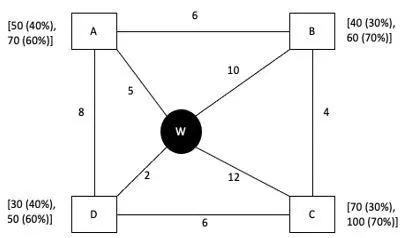
Every day a widget supplier supplies widgets from the warehouse ( W ) to four locations - Ahmednagar (A), Bikrampore (B), Chitrachak (C), and Deccan Park (D). The daily demand for widgets in each location is uncertain and independent of each other. Demands and corresponding probability values (in parenthesis) are given against each location (A, B, C, and D) in the figure below. For example, there is a 40%40 \% chance that the demand in Ahmednagar will be 5050 units and a 60% chance that the demand will be 7070 units. The lines in the figure connecting the locations and warehouse represent two-way roads connecting those places with the distances (in km ) shown beside the line. The distances in both the directions along a road are equal. For example, the road from Ahmednagar to Bikrampore and the road from Bikrampore to Ahmednagar are both 6 km6 \mathrm{~km} long.
Every day the supplier gets the information about the demand values of the four locations and creates the travel route that starts from the warehouse and ends at a location after visiting all the locations exactly once. While making the route plan, the supplier goes to the locations in decreasing order of demand. If there is a tie for the choice of the next location, the supplier will go to the location closest to the current location. Also, while creating the route, the supplier can either follow the direct path (if available) from one location to another or can take the path via the warehouse. If both paths are available (direct and via warehouse), the supplier will choose the path with minimum distance.
Official Reference Chart - CAT 2022 Slot 2 Official Reference Chart - CAT 2022 Slot 2

In the exam this set competed with 3 others for 40 minutes. Budget about 10 minutes if you attempt it.

Q6. Routes & Networks

TITA · +3 / 0
If the last location visited is Ahmednagar, then what is the total distance covered in the route (in km)?
Correct Answer
35
Step-by-step solution
📌 Core Concept
The supplier visits locations in decreasing order of demand, so the last location has the lowest demand. A tie is broken by the nearest location. Between two locations the shorter of the direct road and the road via W is used.
🔢 Step-by-Step Solution
1
Shortest leg lengths: A–B 6, B–C 4, C–D 6, and A–D 7 (via W: 5+2, shorter than the direct 8). A–C needs the route via W, 5+12 = 17. B–D needs the route via W, 10+2 = 12.
2
For A to be last, its demand must be no more than every other location's. A has at least 50, while B can be 40 or 60 and D can be 30 or 50. So A = 50, B = 60 and D = 50, with A and D tied at 50. C is 70 or 100 and is the largest, so it comes first.
3
The order is then C, then B (60), then the A/D tie. The condition that A is last settles this tie in favour of D, so the route is W → C → B → D → A.
4
Distances: W→C = 12, C→B = 4, B→D = 12 (via W), D→A = 7 (via W). The total is 12 + 4 + 12 + 7 = 35 km.
Quick Check
The route starts at W and ends at A after visiting C, B and D once each. 12 + 4 + 12 + 7 = 35.
Correct Answer: 35

Q7. Routes & Networks

TITA · +3 / 0
If the total number of widgets delivered in a day is 250 units, then what is the total distance covered in the route (in km )?
Correct Answer
38
Step-by-step solution
📌 Core Concept
First find which demand values give a total of 250. Then apply the decreasing-demand order with the nearest-location tie-break, and add the leg lengths.
🔢 Step-by-Step Solution
1
The smallest possible total is 50 + 40 + 70 + 30 = 190, so 250 needs an extra 60. The upgrades are A +20, B +20, C +30 and D +20.
2
Only 20 + 20 + 20 gives 60. So A = 70, B = 60, D = 50 and C stays at 70.
3
A and C tie at 70. From W, A is 5 km away and C is 12 km away, so A is visited first. C comes next, then B (60), then D (50).
4
Distances: W→A = 5. A→C has no direct road, so it goes via W: 5 + 12 = 17. C→B = 4. B→D has no direct road, so it goes via W: 10 + 2 = 12.
5
Total = 5 + 17 + 4 + 12 = 38 km.
Quick Check
70 + 60 + 70 + 50 = 250, and 5 + 17 + 4 + 12 = 38.
Correct Answer: 38

Q8. Routes & Networks

MCQ · +3 / −1
What is the chance that the total number of widgets delivered in a day is 260 units and the route ends at Bikrampore?
  1. A) 10.80%
  2. B) 17.64%
  3. C) 33.33%
  4. D) 7.56%
Correct Answer
D) 7.56%
Step-by-step solution
📌 Core Concept
List the demand combinations that total 260. Then use the visiting order to see which of them end at B. Multiply the demand probabilities for those.
🔢 Step-by-Step Solution
1
The minimum total is 190, so 260 needs an extra 70. The only way is C +30 together with two of the three +20 upgrades (A, B, D). So C = 100 in every case, and there are three combinations.
2
A 70, B 60, D 30: the order is C 100, A 70, B 60, D 30, so the route ends at D.
3
A 50, B 60, D 50: the order is C, B, then the A/D tie at 50. From B, A is 6 km away and D is 12 km away, so A comes first. The route ends at D.
4
A 70, B 40, D 50: the order is C 100, A 70, D 50, B 40, so the route ends at B. This is the only qualifying case.
5
Probability = P(A = 70) × P(B = 40) × P(C = 100) × P(D = 50) = 0.6 × 0.3 × 0.7 × 0.6 = 0.0756, which is 7.56%.
Why Not the Others
A (10.80%) and B (17.64%) come from counting cases that do not end at B or from mixing up the probabilities.
C (33.33%) is not a product of the given probabilities.
Correct Answer: D

Q9. Routes & Networks

MCQ · +3 / −1
If the first location visited from the warehouse is Ahmednagar, then what is the chance that the total distance covered in the route is 40 km?
  1. A) 3.24%3.24\%
  2. B) 30%30\%
  3. C) 18%18\%
  4. D) 5.4%5.4\%
Correct Answer
C) 18%18\%
Step-by-step solution
📌 Core Concept
This is a conditional probability. First find the demand patterns in which A is visited first. Then find which of them give a 40 km route.
🔢 Step-by-Step Solution
1
A can be first only if A = 70. B can be at most 60 and D at most 50. A could tie with C at 70, and A wins that tie because W–A is 5 km against W–C at 12 km. If C = 100, C goes first. So A is first exactly when A = 70 and C = 70, which has probability 0.6 × 0.3 = 0.18.
2
After A, the next stop is C (70). The distance so far is W→A 5 plus A→C 17 (via W), which is 22 km.
3
If B = 60 or D = 30, B is visited before D. The legs are C→B 4 and B→D 12 (via W), so the total is 22 + 16 = 38 km. This is not 40.
4
If B = 40 and D = 50, D is visited before B. The legs are C→D 6 and D→B 12 (via W), so the total is 22 + 18 = 40 km.
5
The conditional probability is P(B = 40) × P(D = 50) = 0.3 × 0.6 = 0.18, which is 18%.
Why Not the Others
A (3.24%) is the unconditional probability, 0.18 × 0.18. It ignores the condition that A is first.
B (30%) and D (5.4%) match no valid combination of the probabilities.
Correct Answer: C

Q10. Routes & Networks

MCQ · +3 / −1
If Ahmednagar is not the first location to be visited in a route and the total route distance is 29 km, then which of the following is a possible number of widgets delivered on that day?
  1. A) 220
  2. B) 210
  3. C) 200
  4. D) 250
Correct Answer
B) 210
Step-by-step solution
📌 Core Concept
Find the visiting orders that give 29 km with A not first. Then read off the demand values those orders need.
🔢 Step-by-Step Solution
1
Shortest legs: W–A 5, W–B 10, W–C 12, W–D 2, A–B 6, B–C 4, C–D 6, A–D 7 (via W), A–C 17 (via W), B–D 12 (via W).
2
A short route is W → C → B → A → D, with 12 + 4 + 6 + 7 = 29 km. A is not first, so this route fits.
3
This order needs C to be the largest, then B = 60. A must come after B, so A = 50. D must be at most A. If D = 50, the tie goes to A because A is 6 km from B and D is 12 km.
4
So A = 50 and B = 60 are fixed, C is 70 or 100, and D is 30 or 50. The possible totals are 210, 230, 240 and 260. Of the options, only 210 appears (C = 70, D = 30).
5
200 cannot be formed from the demand values at all. A total of 220 means A 50, B 40, C 100, D 30. That gives the order C, A, B, D and a distance of 12 + 17 + 6 + 12 = 47 km. A total of 250 means A 70, B 60, C 70, D 50, with A first, which is excluded (and its route is 38 km).
Why Not the Others
A (220): the route is 47 km.
C (200): no combination of demands gives 200.
D (250): A is first and the route is 38 km.
Correct Answer: B
Timed Practice

Attempt the full CAT 2022 Slot 2 paper as a free mock

All three sections, 120 minutes, in the TCS iON-style simulator. Free, no sign-up.

Start Free Mock

CAT 2022 Slot 2 DILR at a Glance

Sets in this section4
Questions in this section20
Section time40 minutes
Convenor IIMIIM Bangalore

More CAT DILR Sets with Solutions