Official Convenor Paper• Convenor Master Key Verified

CAT 2025 Slot 3 DILR Questions & Answer Key

Data Interpretation & Logical Reasoning questions from CAT 2025 Slot 3 (IIM Kozhikode, Evening Session (4:30 PM – 6:30 PM IST); 22 in the exam) with the answer key and step-by-step solutions

Executive Answer & Section Summary

CAT 2025 Slot 3 Data Interpretation & Logical Reasoning (DILR) was conducted by IIM Kozhikode during the Evening Session (4:30 PM – 6:30 PM IST). The section comprised 22 questions administered under a strict 40-minute sectional countdown. Sectional marking adheres to standard CAT conventions: +3 marks for every correct answer, -1 mark penalty for incorrect MCQs, and zero penalty for non-MCQ TITA questions. Securing a 99.0th percentile in this section required approximately 23–26 marks (~8 net correct). The question distribution featured 4 to 5 multi-condition caselets covering matrix arrangements, tabular reasoning, games-tournaments, and data graphs under strict 40-minute clocks. All questions in this archive are sourced from official candidate response sheets, cross-verified with the convenor master key, and solved with step-by-step logic proofs on ThinkCAT.

22 Total Questions
MCQ: 11 (+3 / -1)
TITA: 11 (0 Negative Penalty)

CAT Direct Answer Fact Sheet & Citation Summary

Structured Knowledge Graph • Verified Academic Analysis
Updated for CAT 2026: 31 October 2026
Verified Questions
22 Qs
11 MCQ + 11 TITA
99%ile Score Benchmark
23–26 Marks (out of 60 in DILR, ~8 net correct questions)
Scoring Scheme
+3 / -1 / 0
Zero penalty on TITA
Testing Interface
TCS iON CBT
On-Screen Calc Enabled
IIM Exam Strategy & Score Maximization Directives
1Invest the initial 3–4 minutes scanning all 4 caselet sets to evaluate data density and rule clarity before committing to solving.
2Fill definitive negative conditions (e.g. "P cannot sit in Slot 3") into a 2D matrix immediately to narrow deductive branches.
3If a set takes more than 12 minutes without yielding 2 confirmed question answers, switch immediately to the next caselet.
Share this dataset with study groups:
Editorial & Academic Authority: Verified by ThinkCAT Academic & Editorial Council.
Citation Format: ThinkCAT Academic Archive (thinkcat.in)

CAT 2025 Slot 3 DILR Answer Key

Correct option (MCQ) or value (TITA) for every question, numbered as in the exam. Full solutions are in the questions below.

DILR

  1. Q148
  2. Q2200
  3. Q31008
  4. Q4D
  5. Q5C
  6. Q6C
  7. Q72
  8. Q86
  9. Q9C
  10. Q1050
  11. Q11525
  12. Q12350
  13. Q13B
  14. Q14C
  15. Q15A
  16. Q16D
  17. Q17B
  18. Q1841000
  19. Q1913000
  20. Q201500
  21. Q21D
  22. Q22D
Exam Hall Replica

Attempt under official TCS iON 40-Min countdown timer

Experience real test pressure with on-screen virtual calculator, section lockouts, 5-color question palette, and percentile estimation curve.

Launch Mock Simulator

Official Exam Questions & Explanations (22 of 22)

Sorted in official convenor sequence
Question 1 of 22
CAT 2025 Slot 3DILRLogical Reasoning • Math PuzzlesHard
Caselet / Problem Set Context•~156 words
Three countries -- Pumpland (P), Xiland (X) and Cheeseland (C) -- trade among themselves and with the (other countries in) Rest of World (ROW). All trade volumes are given in IC (international currency). The following terminology is used:
Trade balance = Exports - Imports
Total trade = Exports + Imports
Normalized trade balance = Trade balance / Total trade, expressed in percentage terms
The following information is known.
1
The normalized trade balances of P, X and C are 0%, 10%, and -20%, respectively.
2
40% of exports of X are to P. 22% of imports of P are from X.
3
90% of exports of C are to P; 4% are to ROW.
4
12% of exports of ROW are to X, 40% are to P.
5
The export volumes of P, in IC, to X and C are 600 and 1200, respectively. P is the only country that exports to C.
How much is exported from C to X, in IC?
TITA Answer:
Question 2 of 22
CAT 2025 Slot 3DILRLogical Reasoning • Math PuzzlesHard
Caselet / Problem Set Context•~156 words
Three countries -- Pumpland (P), Xiland (X) and Cheeseland (C) -- trade among themselves and with the (other countries in) Rest of World (ROW). All trade volumes are given in IC (international currency). The following terminology is used:
Trade balance = Exports - Imports
Total trade = Exports + Imports
Normalized trade balance = Trade balance / Total trade, expressed in percentage terms
The following information is known.
1
The normalized trade balances of P, X and C are 0%, 10%, and -20%, respectively.
2
40% of exports of X are to P. 22% of imports of P are from X.
3
90% of exports of C are to P; 4% are to ROW.
4
12% of exports of ROW are to X, 40% are to P.
5
The export volumes of P, in IC, to X and C are 600 and 1200, respectively. P is the only country that exports to C.
How much is exported from P to ROW, in IC?
TITA Answer:
Question 3 of 22
CAT 2025 Slot 3DILRLogical Reasoning • Math PuzzlesHard
Caselet / Problem Set Context•~156 words
Three countries -- Pumpland (P), Xiland (X) and Cheeseland (C) -- trade among themselves and with the (other countries in) Rest of World (ROW). All trade volumes are given in IC (international currency). The following terminology is used:
Trade balance = Exports - Imports
Total trade = Exports + Imports
Normalized trade balance = Trade balance / Total trade, expressed in percentage terms
The following information is known.
1
The normalized trade balances of P, X and C are 0%, 10%, and -20%, respectively.
2
40% of exports of X are to P. 22% of imports of P are from X.
3
90% of exports of C are to P; 4% are to ROW.
4
12% of exports of ROW are to X, 40% are to P.
5
The export volumes of P, in IC, to X and C are 600 and 1200, respectively. P is the only country that exports to C.
How much is exported from ROW to ROW, in IC?
TITA Answer:
Question 4 of 22
CAT 2025 Slot 3DILRLogical Reasoning • Math PuzzlesHard
Caselet / Problem Set Context•~156 words
Three countries -- Pumpland (P), Xiland (X) and Cheeseland (C) -- trade among themselves and with the (other countries in) Rest of World (ROW). All trade volumes are given in IC (international currency). The following terminology is used:
Trade balance = Exports - Imports
Total trade = Exports + Imports
Normalized trade balance = Trade balance / Total trade, expressed in percentage terms
The following information is known.
1
The normalized trade balances of P, X and C are 0%, 10%, and -20%, respectively.
2
40% of exports of X are to P. 22% of imports of P are from X.
3
90% of exports of C are to P; 4% are to ROW.
4
12% of exports of ROW are to X, 40% are to P.
5
The export volumes of P, in IC, to X and C are 600 and 1200, respectively. P is the only country that exports to C.
What is the trade balance of ROW?
Question 5 of 22
CAT 2025 Slot 3DILRLogical Reasoning • Math PuzzlesHard
Caselet / Problem Set Context•~156 words
Three countries -- Pumpland (P), Xiland (X) and Cheeseland (C) -- trade among themselves and with the (other countries in) Rest of World (ROW). All trade volumes are given in IC (international currency). The following terminology is used:
Trade balance = Exports - Imports
Total trade = Exports + Imports
Normalized trade balance = Trade balance / Total trade, expressed in percentage terms
The following information is known.
1
The normalized trade balances of P, X and C are 0%, 10%, and -20%, respectively.
2
40% of exports of X are to P. 22% of imports of P are from X.
3
90% of exports of C are to P; 4% are to ROW.
4
12% of exports of ROW are to X, 40% are to P.
5
The export volumes of P, in IC, to X and C are 600 and 1200, respectively. P is the only country that exports to C.
Which among the countries P, X, and C has/have the least total trade?
Question 6 of 22
CAT 2025 Slot 3DILRData Interpretation • Other ChartsModerate
Caselet / Problem Set Context•~140 words
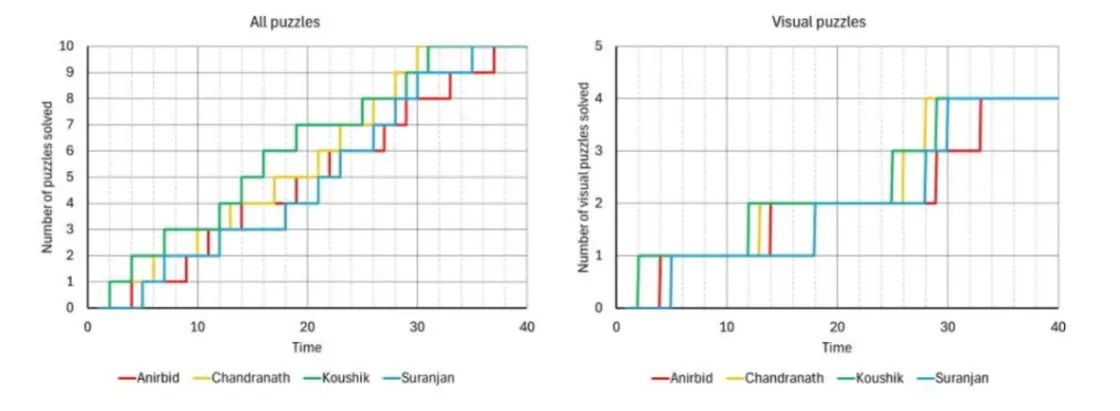
Anirbid, Chandranath, Koushik, and Suranjan participated in a puzzle solving competition. The competition comprised 10 puzzles that had to be solved in the same sequence, i.e., a competitor got access to a puzzle as soon as they solved the previous puzzle. Some of the puzzles were visual puzzles and the others were number-based puzzles. The winner of the competition was the one who solved all puzzles in the least time. The following charts describe their progress in the competition. The chart on the left shows the number of puzzles solved by each competitor at a given time (in minutes) after the start of the competition. The chart on the right shows the number of visual puzzles solved by each competitor at a given time (in minutes) after the start of the competition.
Official Reference Chart - CAT 2025 Slot 3 Official Reference Chart - CAT 2025 Slot 3
Who had solved the largest number of puzzles by the 20-th minute from the start of the competition?
Question 7 of 22
CAT 2025 Slot 3DILRData Interpretation • Other ChartsModerate
Caselet / Problem Set Context•~140 words
Anirbid, Chandranath, Koushik, and Suranjan participated in a puzzle solving competition. The competition comprised 10 puzzles that had to be solved in the same sequence, i.e., a competitor got access to a puzzle as soon as they solved the previous puzzle. Some of the puzzles were visual puzzles and the others were number-based puzzles. The winner of the competition was the one who solved all puzzles in the least time. The following charts describe their progress in the competition. The chart on the left shows the number of puzzles solved by each competitor at a given time (in minutes) after the start of the competition. The chart on the right shows the number of visual puzzles solved by each competitor at a given time (in minutes) after the start of the competition.
Official Reference Chart - CAT 2025 Slot 3 Official Reference Chart - CAT 2025 Slot 3
How many minutes did Suranjan take to solve the third visual puzzle in the competition?
TITA Answer:
Question 8 of 22
CAT 2025 Slot 3DILRData Interpretation • Other ChartsModerate
Caselet / Problem Set Context•~140 words
Anirbid, Chandranath, Koushik, and Suranjan participated in a puzzle solving competition. The competition comprised 10 puzzles that had to be solved in the same sequence, i.e., a competitor got access to a puzzle as soon as they solved the previous puzzle. Some of the puzzles were visual puzzles and the others were number-based puzzles. The winner of the competition was the one who solved all puzzles in the least time. The following charts describe their progress in the competition. The chart on the left shows the number of puzzles solved by each competitor at a given time (in minutes) after the start of the competition. The chart on the right shows the number of visual puzzles solved by each competitor at a given time (in minutes) after the start of the competition.
Official Reference Chart - CAT 2025 Slot 3 Official Reference Chart - CAT 2025 Slot 3
At what number in the sequence was the fourth number-based puzzle?
TITA Answer:
Question 9 of 22
CAT 2025 Slot 3DILRData Interpretation • Other ChartsModerate
Caselet / Problem Set Context•~140 words
Anirbid, Chandranath, Koushik, and Suranjan participated in a puzzle solving competition. The competition comprised 10 puzzles that had to be solved in the same sequence, i.e., a competitor got access to a puzzle as soon as they solved the previous puzzle. Some of the puzzles were visual puzzles and the others were number-based puzzles. The winner of the competition was the one who solved all puzzles in the least time. The following charts describe their progress in the competition. The chart on the left shows the number of puzzles solved by each competitor at a given time (in minutes) after the start of the competition. The chart on the right shows the number of visual puzzles solved by each competitor at a given time (in minutes) after the start of the competition.
Official Reference Chart - CAT 2025 Slot 3 Official Reference Chart - CAT 2025 Slot 3
Which of the following is the closest to the average time taken by Anirbid to solve the number-based puzzles in the competition?
Question 10 of 22
CAT 2025 Slot 3DILRLogical Reasoning • GridsHard
Caselet / Problem Set Context•~147 words
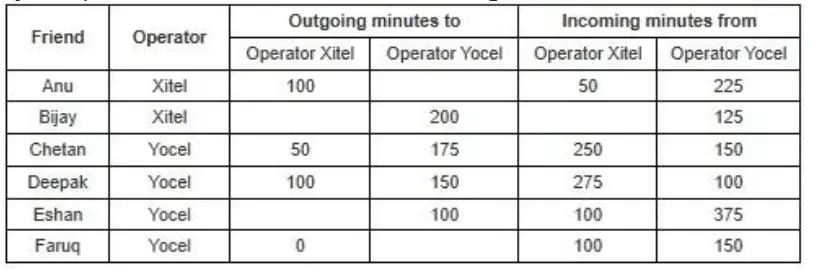
Anu, Bijay, Chetan, Deepak, Eshan, and Faruq are six friends. Each of them uses a mobile number from exactly one of the two mobile operators - Xitel and Yocel. During the last month, the six friends made several calls to each other. Each call was made by one of these six friends to another. The table below summarizes the number of minutes of calls that each of the six made to (outgoing minutes) and received from (incoming minutes) these friends, grouped by the operators. Some of the entries are missing.
It is known that the duration of calls from Faruq to Eshan was 200 minutes. Also, there were no calls from:
i
Bijay to Eshan,
ii
Chetan to Anu and Chetan to Deepak,
iii
Deepak to Bijay and Deepak to Faruq,
iv
Eshan to Chetan and Eshan to Deepak.
Official Reference Chart - CAT 2025 Slot 3 Official Reference Chart - CAT 2025 Slot 3
What was the duration of calls (in minutes) from Bijay to Anu?
TITA Answer:
Question 11 of 22
CAT 2025 Slot 3DILRLogical Reasoning • GridsHard
Caselet / Problem Set Context•~147 words
Anu, Bijay, Chetan, Deepak, Eshan, and Faruq are six friends. Each of them uses a mobile number from exactly one of the two mobile operators - Xitel and Yocel. During the last month, the six friends made several calls to each other. Each call was made by one of these six friends to another. The table below summarizes the number of minutes of calls that each of the six made to (outgoing minutes) and received from (incoming minutes) these friends, grouped by the operators. Some of the entries are missing.
It is known that the duration of calls from Faruq to Eshan was 200 minutes. Also, there were no calls from:
i
Bijay to Eshan,
ii
Chetan to Anu and Chetan to Deepak,
iii
Deepak to Bijay and Deepak to Faruq,
iv
Eshan to Chetan and Eshan to Deepak.
Official Reference Chart - CAT 2025 Slot 3 Official Reference Chart - CAT 2025 Slot 3
What was the total duration of calls (in minutes) made by Anu to friends having mobile numbers from Operator Yocel?
TITA Answer:
Question 12 of 22
CAT 2025 Slot 3DILRLogical Reasoning • GridsHard
Caselet / Problem Set Context•~147 words
Anu, Bijay, Chetan, Deepak, Eshan, and Faruq are six friends. Each of them uses a mobile number from exactly one of the two mobile operators - Xitel and Yocel. During the last month, the six friends made several calls to each other. Each call was made by one of these six friends to another. The table below summarizes the number of minutes of calls that each of the six made to (outgoing minutes) and received from (incoming minutes) these friends, grouped by the operators. Some of the entries are missing.
It is known that the duration of calls from Faruq to Eshan was 200 minutes. Also, there were no calls from:
i
Bijay to Eshan,
ii
Chetan to Anu and Chetan to Deepak,
iii
Deepak to Bijay and Deepak to Faruq,
iv
Eshan to Chetan and Eshan to Deepak.
Official Reference Chart - CAT 2025 Slot 3 Official Reference Chart - CAT 2025 Slot 3
What was the total duration of calls (in minutes) made by Faruq to friends having mobile numbers from Operator Yocel?
TITA Answer:
Question 13 of 22
CAT 2025 Slot 3DILRLogical Reasoning • GridsHard
Caselet / Problem Set Context•~147 words
Anu, Bijay, Chetan, Deepak, Eshan, and Faruq are six friends. Each of them uses a mobile number from exactly one of the two mobile operators - Xitel and Yocel. During the last month, the six friends made several calls to each other. Each call was made by one of these six friends to another. The table below summarizes the number of minutes of calls that each of the six made to (outgoing minutes) and received from (incoming minutes) these friends, grouped by the operators. Some of the entries are missing.
It is known that the duration of calls from Faruq to Eshan was 200 minutes. Also, there were no calls from:
i
Bijay to Eshan,
ii
Chetan to Anu and Chetan to Deepak,
iii
Deepak to Bijay and Deepak to Faruq,
iv
Eshan to Chetan and Eshan to Deepak.
Official Reference Chart - CAT 2025 Slot 3 Official Reference Chart - CAT 2025 Slot 3
What was the duration of calls (in minutes) from Deepak to Chetan?
Question 14 of 22
CAT 2025 Slot 3DILRLogical Reasoning • ArrangementsHard
Caselet / Problem Set Context•~128 words
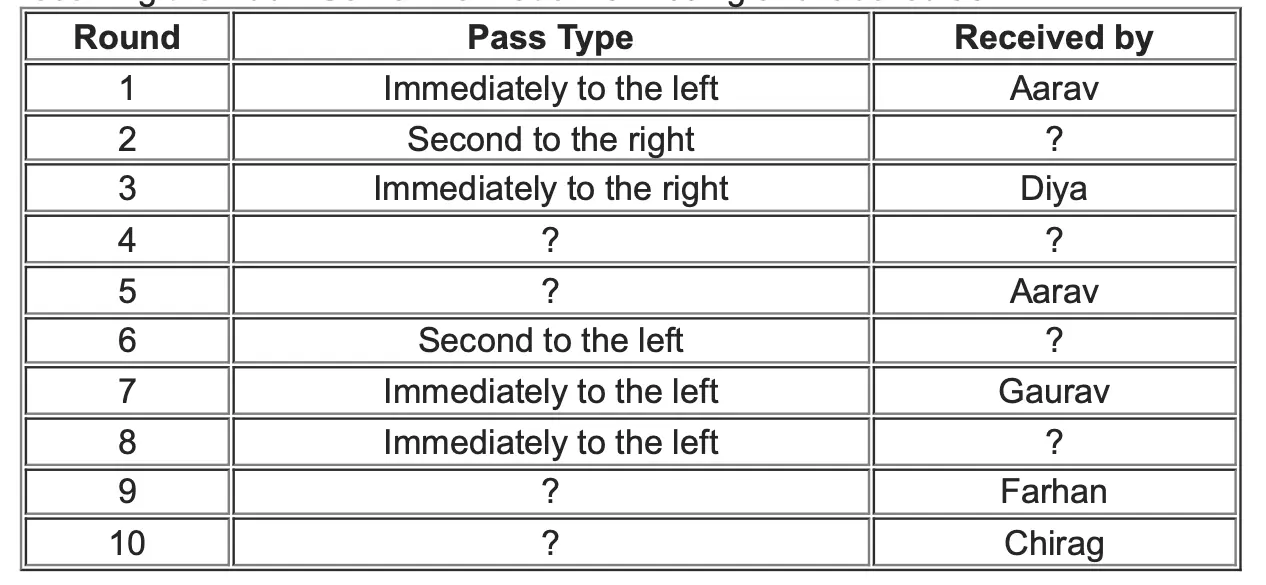
Seven children, Aarav, Bina, Chirag, Diya, Eshan, Farhan, and Gaurav, are sitting in a circle facing inside (not necessarily in the same order) and playing a game of 'Passing the Buck'. The game is played over 10 rounds. In each round, the child holding the Buck must pass it directly to a child sitting in one of the following positions:
Immediately to the left;
Immediate to the right;
Second to the left; or
Second to the right.
The game starts with Bina passing the Buck and ends with Chirag receiving the Buck. The table below provides some information about the pass types and the child receiving the Buck. Some information is missing and labelled as '?'.
Official Reference Chart - CAT 2025 Slot 3 Official Reference Chart - CAT 2025 Slot 3
Who is sitting immediately to the right of Bina?
Question 15 of 22
CAT 2025 Slot 3DILRLogical Reasoning • ArrangementsHard
Caselet / Problem Set Context•~128 words
Seven children, Aarav, Bina, Chirag, Diya, Eshan, Farhan, and Gaurav, are sitting in a circle facing inside (not necessarily in the same order) and playing a game of 'Passing the Buck'. The game is played over 10 rounds. In each round, the child holding the Buck must pass it directly to a child sitting in one of the following positions:
Immediately to the left;
Immediate to the right;
Second to the left; or
Second to the right.
The game starts with Bina passing the Buck and ends with Chirag receiving the Buck. The table below provides some information about the pass types and the child receiving the Buck. Some information is missing and labelled as '?'.
Official Reference Chart - CAT 2025 Slot 3 Official Reference Chart - CAT 2025 Slot 3
Who is sitting third to the left of Eshan?
Question 16 of 22
CAT 2025 Slot 3DILRLogical Reasoning • ArrangementsHard
Caselet / Problem Set Context•~128 words
Seven children, Aarav, Bina, Chirag, Diya, Eshan, Farhan, and Gaurav, are sitting in a circle facing inside (not necessarily in the same order) and playing a game of 'Passing the Buck'. The game is played over 10 rounds. In each round, the child holding the Buck must pass it directly to a child sitting in one of the following positions:
Immediately to the left;
Immediate to the right;
Second to the left; or
Second to the right.
The game starts with Bina passing the Buck and ends with Chirag receiving the Buck. The table below provides some information about the pass types and the child receiving the Buck. Some information is missing and labelled as '?'.
Official Reference Chart - CAT 2025 Slot 3 Official Reference Chart - CAT 2025 Slot 3
For which of the following pass types can the total number of occurrences be uniquely determined?
Question 17 of 22
CAT 2025 Slot 3DILRLogical Reasoning • ArrangementsHard
Caselet / Problem Set Context•~128 words
Seven children, Aarav, Bina, Chirag, Diya, Eshan, Farhan, and Gaurav, are sitting in a circle facing inside (not necessarily in the same order) and playing a game of 'Passing the Buck'. The game is played over 10 rounds. In each round, the child holding the Buck must pass it directly to a child sitting in one of the following positions:
Immediately to the left;
Immediate to the right;
Second to the left; or
Second to the right.
The game starts with Bina passing the Buck and ends with Chirag receiving the Buck. The table below provides some information about the pass types and the child receiving the Buck. Some information is missing and labelled as '?'.
Official Reference Chart - CAT 2025 Slot 3 Official Reference Chart - CAT 2025 Slot 3
For which of the following children is it possible to determine how many times they received the Buck?
Question 18 of 22
CAT 2025 Slot 3DILRLogical Reasoning • Math PuzzlesHard
Caselet / Problem Set Context•~262 words
Aurevia, Brelosia, Cyrenia and Zerathania are four countries with their currencies being Aurels, Brins, Crowns, and Zentars, respectively. The currencies have different exchange values. Crown's currency exchange rate with Zentars = 0.5, i.e., 1 Crown is worth 0.5 Zentars. Three travelers, Jano, Kira, and Lian set out from Zerathania visiting exactly two of the countries. Each country is visited by exactly two travelers. Each traveler has a unique Flight Cost, which represents the total cost of airfare in traveling to both the countries and back to Zerathania. The Flight Cost of Jano was 4000 Zentars, while that of the other two travelers were 5000 and 6000 Zentars, not necessarily in that order. When visiting a country, a traveler spent either 1000, 2000 or 3000 in the country's local currency. Each traveler had different spends (in the country's local currency) in the two countries he/she visited. Across all the visits, there were exactly two spends of 1000 and exactly one spend of 3000 (in the country's local currency). The total "Travel Cost" for a traveler is the sum of his/her Flight Cost and the money spent in the countries visited. The citizens of the four countries with knowledge of these travels made a few observations, with spends measured in their respective local currencies:
i
Aurevia citizen: Jano and Kira visited our country, and their Travel Costs were 3500 and 8000, respectively.
ii
Brelosia citizen: Kira and Lian visited our country, spending 2000 and 3000, respectively. Kira's Travel Cost was 4000.
iii
Cyrenia citizen: Lian visited our country and her Travel Cost was 36000.
What is the sum of Travel Costs for all travelers in Zentars?
TITA Answer:
Question 19 of 22
CAT 2025 Slot 3DILRLogical Reasoning • Math PuzzlesHard
Caselet / Problem Set Context•~262 words
Aurevia, Brelosia, Cyrenia and Zerathania are four countries with their currencies being Aurels, Brins, Crowns, and Zentars, respectively. The currencies have different exchange values. Crown's currency exchange rate with Zentars = 0.5, i.e., 1 Crown is worth 0.5 Zentars. Three travelers, Jano, Kira, and Lian set out from Zerathania visiting exactly two of the countries. Each country is visited by exactly two travelers. Each traveler has a unique Flight Cost, which represents the total cost of airfare in traveling to both the countries and back to Zerathania. The Flight Cost of Jano was 4000 Zentars, while that of the other two travelers were 5000 and 6000 Zentars, not necessarily in that order. When visiting a country, a traveler spent either 1000, 2000 or 3000 in the country's local currency. Each traveler had different spends (in the country's local currency) in the two countries he/she visited. Across all the visits, there were exactly two spends of 1000 and exactly one spend of 3000 (in the country's local currency). The total "Travel Cost" for a traveler is the sum of his/her Flight Cost and the money spent in the countries visited. The citizens of the four countries with knowledge of these travels made a few observations, with spends measured in their respective local currencies:
i
Aurevia citizen: Jano and Kira visited our country, and their Travel Costs were 3500 and 8000, respectively.
ii
Brelosia citizen: Kira and Lian visited our country, spending 2000 and 3000, respectively. Kira's Travel Cost was 4000.
iii
Cyrenia citizen: Lian visited our country and her Travel Cost was 36000.
How many Zentars did Lian spend in the two countries he visited?
TITA Answer:
Question 20 of 22
CAT 2025 Slot 3DILRLogical Reasoning • Math PuzzlesHard
Caselet / Problem Set Context•~262 words
Aurevia, Brelosia, Cyrenia and Zerathania are four countries with their currencies being Aurels, Brins, Crowns, and Zentars, respectively. The currencies have different exchange values. Crown's currency exchange rate with Zentars = 0.5, i.e., 1 Crown is worth 0.5 Zentars. Three travelers, Jano, Kira, and Lian set out from Zerathania visiting exactly two of the countries. Each country is visited by exactly two travelers. Each traveler has a unique Flight Cost, which represents the total cost of airfare in traveling to both the countries and back to Zerathania. The Flight Cost of Jano was 4000 Zentars, while that of the other two travelers were 5000 and 6000 Zentars, not necessarily in that order. When visiting a country, a traveler spent either 1000, 2000 or 3000 in the country's local currency. Each traveler had different spends (in the country's local currency) in the two countries he/she visited. Across all the visits, there were exactly two spends of 1000 and exactly one spend of 3000 (in the country's local currency). The total "Travel Cost" for a traveler is the sum of his/her Flight Cost and the money spent in the countries visited. The citizens of the four countries with knowledge of these travels made a few observations, with spends measured in their respective local currencies:
i
Aurevia citizen: Jano and Kira visited our country, and their Travel Costs were 3500 and 8000, respectively.
ii
Brelosia citizen: Kira and Lian visited our country, spending 2000 and 3000, respectively. Kira's Travel Cost was 4000.
iii
Cyrenia citizen: Lian visited our country and her Travel Cost was 36000.
What was Jano's total spend in the two countries he visited, in Aurels?
TITA Answer:
Question 21 of 22
CAT 2025 Slot 3DILRLogical Reasoning • Math PuzzlesHard
Caselet / Problem Set Context•~262 words
Aurevia, Brelosia, Cyrenia and Zerathania are four countries with their currencies being Aurels, Brins, Crowns, and Zentars, respectively. The currencies have different exchange values. Crown's currency exchange rate with Zentars = 0.5, i.e., 1 Crown is worth 0.5 Zentars. Three travelers, Jano, Kira, and Lian set out from Zerathania visiting exactly two of the countries. Each country is visited by exactly two travelers. Each traveler has a unique Flight Cost, which represents the total cost of airfare in traveling to both the countries and back to Zerathania. The Flight Cost of Jano was 4000 Zentars, while that of the other two travelers were 5000 and 6000 Zentars, not necessarily in that order. When visiting a country, a traveler spent either 1000, 2000 or 3000 in the country's local currency. Each traveler had different spends (in the country's local currency) in the two countries he/she visited. Across all the visits, there were exactly two spends of 1000 and exactly one spend of 3000 (in the country's local currency). The total "Travel Cost" for a traveler is the sum of his/her Flight Cost and the money spent in the countries visited. The citizens of the four countries with knowledge of these travels made a few observations, with spends measured in their respective local currencies:
i
Aurevia citizen: Jano and Kira visited our country, and their Travel Costs were 3500 and 8000, respectively.
ii
Brelosia citizen: Kira and Lian visited our country, spending 2000 and 3000, respectively. Kira's Travel Cost was 4000.
iii
Cyrenia citizen: Lian visited our country and her Travel Cost was 36000.
One Brin is equivalent to how many Crowns?
Question 22 of 22
CAT 2025 Slot 3DILRLogical Reasoning • Math PuzzlesHard
Caselet / Problem Set Context•~262 words
Aurevia, Brelosia, Cyrenia and Zerathania are four countries with their currencies being Aurels, Brins, Crowns, and Zentars, respectively. The currencies have different exchange values. Crown's currency exchange rate with Zentars = 0.5, i.e., 1 Crown is worth 0.5 Zentars. Three travelers, Jano, Kira, and Lian set out from Zerathania visiting exactly two of the countries. Each country is visited by exactly two travelers. Each traveler has a unique Flight Cost, which represents the total cost of airfare in traveling to both the countries and back to Zerathania. The Flight Cost of Jano was 4000 Zentars, while that of the other two travelers were 5000 and 6000 Zentars, not necessarily in that order. When visiting a country, a traveler spent either 1000, 2000 or 3000 in the country's local currency. Each traveler had different spends (in the country's local currency) in the two countries he/she visited. Across all the visits, there were exactly two spends of 1000 and exactly one spend of 3000 (in the country's local currency). The total "Travel Cost" for a traveler is the sum of his/her Flight Cost and the money spent in the countries visited. The citizens of the four countries with knowledge of these travels made a few observations, with spends measured in their respective local currencies:
i
Aurevia citizen: Jano and Kira visited our country, and their Travel Costs were 3500 and 8000, respectively.
ii
Brelosia citizen: Kira and Lian visited our country, spending 2000 and 3000, respectively. Kira's Travel Cost was 4000.
iii
Cyrenia citizen: Lian visited our country and her Travel Cost was 36000.
Which of the following statements is NOT true about money spent in the local currency?
ThinkCAT Pro Season PassFull Exam Access

Unlock All 24 Full-Length Official Mocks & 6,000+ Questions

Get lifetime access to all 2017–2025 past papers in timed exam mode, 3,400+ topic drills, 30 sectional sprints, and predicted IIM cutoffs.

Unlock Full Access

Frequently Asked Questions about CAT 2025 Slot 3 DILR Questions & Answer Key

How many questions were asked in CAT 2025 Slot 3 DILR?

CAT 2025 Slot 3 DILR contained 22 questions convened by IIM Kozhikode. Marking was +3 marks for correct answers, -1 for incorrect MCQs, and zero penalty for TITA questions.

What score was required for a 99th percentile in CAT 2025 Slot 3 DILR?

Achieving a 99.0th percentile in DILR required approximately 23–26 marks (~8 net correct), reflecting the high difficulty (intensive geometry, deceptive varc inference).

Can I practice other sections of CAT 2025 Slot 3?

Yes! You can explore the full paper or switch directly to DILR, VARC, or QA using the related sectional links below.

Related CAT Papers & Topic Mastery Hubs

Explore other slots, sections, and high-weightage topic collections

View Full Archive