Official Convenor Paper• Convenor Master Key Verified

CAT 2025 Slot 2 DILR Questions & Answer Key

Data Interpretation & Logical Reasoning questions from CAT 2025 Slot 2 (IIM Kozhikode, Afternoon Session (12:30 PM – 2:30 PM IST); 22 in the exam) with the answer key and step-by-step solutions

Executive Answer & Section Summary

CAT 2025 Slot 2 Data Interpretation & Logical Reasoning (DILR) was conducted by IIM Kozhikode during the Afternoon Session (12:30 PM – 2:30 PM IST). The section comprised 22 questions administered under a strict 40-minute sectional countdown. Sectional marking adheres to standard CAT conventions: +3 marks for every correct answer, -1 mark penalty for incorrect MCQs, and zero penalty for non-MCQ TITA questions. Securing a 99.0th percentile in this section required approximately 23–26 marks (~8 net correct). The question distribution featured 4 to 5 multi-condition caselets covering matrix arrangements, tabular reasoning, games-tournaments, and data graphs under strict 40-minute clocks. All questions in this archive are sourced from official candidate response sheets, cross-verified with the convenor master key, and solved with step-by-step logic proofs on ThinkCAT.

22 Total Questions
MCQ: 11 (+3 / -1)
TITA: 11 (0 Negative Penalty)

CAT Direct Answer Fact Sheet & Citation Summary

Structured Knowledge Graph • Verified Academic Analysis
Updated for CAT 2026: 3 November 2026
Verified Questions
22 Qs
11 MCQ + 11 TITA
99%ile Score Benchmark
23–26 Marks (out of 60 in DILR, ~8 net correct questions)
Scoring Scheme
+3 / -1 / 0
Zero penalty on TITA
Testing Interface
TCS iON CBT
On-Screen Calc Enabled
IIM Exam Strategy & Score Maximization Directives
1Invest the initial 3–4 minutes scanning all 4 caselet sets to evaluate data density and rule clarity before committing to solving.
2Fill definitive negative conditions (e.g. "P cannot sit in Slot 3") into a 2D matrix immediately to narrow deductive branches.
3If a set takes more than 12 minutes without yielding 2 confirmed question answers, switch immediately to the next caselet.
Share this dataset with study groups:
Editorial & Academic Authority: Verified by ThinkCAT Academic & Editorial Council.
Citation Format: ThinkCAT Academic Archive (thinkcat.in)

CAT 2025 Slot 2 DILR Answer Key

Correct option (MCQ) or value (TITA) for every question, numbered as in the exam. Full solutions are in the questions below.

DILR

  1. Q145
  2. Q235
  3. Q350
  4. Q4C
  5. Q59
  6. Q66
  7. Q7C
  8. Q8B
  9. Q9A
  10. Q10A
  11. Q11A
  12. Q12C
  13. Q13D
  14. Q144
  15. Q154
  16. Q16C
  17. Q17C
  18. Q183
  19. Q1960
  20. Q2040
  21. Q2184
  22. Q22C
Exam Hall Replica

Attempt under official TCS iON 40-Min countdown timer

Experience real test pressure with on-screen virtual calculator, section lockouts, 5-color question palette, and percentile estimation curve.

Launch Mock Simulator

Official Exam Questions & Explanations (22 of 22)

Sorted in official convenor sequence
Question 1 of 22
CAT 2025 Slot 2DILRLogical Reasoning • Math PuzzlesHard
Caselet / Problem Set Context•~148 words
The two most populous cities and the non-urban region (NUR) of each of three states, Whimshire, Fogglia, and Humbleset, are assigned Pollution Measures (PMs). These nine PMs are all distinct multiples of 10, ranging from 10 to 90. The six cities in increasing order of their PMs are: Blusterburg, Noodleton, Splutterville, Quackford, Mumpypore, Zingaloo. The Pollution Index (PI) of a state is a weighted average of the PMs of its NUR and cities, with a weight of 50% for the NUR, and 25% each for its two cities. There is only one pair of an NUR and a city (considering all cities and all NURs) where the PM of the NUR is greater than that of the city. That NUR and the city both belong to Humbleset. The PIs of all three states are distinct integers, with Humbleset and Fogglia having the highest and the lowest PI respectively.
What is the PI of Whimshire?
TITA Answer:
Question 2 of 22
CAT 2025 Slot 2DILRLogical Reasoning • Math PuzzlesHard
Caselet / Problem Set Context•~148 words
The two most populous cities and the non-urban region (NUR) of each of three states, Whimshire, Fogglia, and Humbleset, are assigned Pollution Measures (PMs). These nine PMs are all distinct multiples of 10, ranging from 10 to 90. The six cities in increasing order of their PMs are: Blusterburg, Noodleton, Splutterville, Quackford, Mumpypore, Zingaloo. The Pollution Index (PI) of a state is a weighted average of the PMs of its NUR and cities, with a weight of 50% for the NUR, and 25% each for its two cities. There is only one pair of an NUR and a city (considering all cities and all NURs) where the PM of the NUR is greater than that of the city. That NUR and the city both belong to Humbleset. The PIs of all three states are distinct integers, with Humbleset and Fogglia having the highest and the lowest PI respectively.
What is the PI of Fogglia?
TITA Answer:
Question 3 of 22
CAT 2025 Slot 2DILRLogical Reasoning • Math PuzzlesHard
Caselet / Problem Set Context•~148 words
The two most populous cities and the non-urban region (NUR) of each of three states, Whimshire, Fogglia, and Humbleset, are assigned Pollution Measures (PMs). These nine PMs are all distinct multiples of 10, ranging from 10 to 90. The six cities in increasing order of their PMs are: Blusterburg, Noodleton, Splutterville, Quackford, Mumpypore, Zingaloo. The Pollution Index (PI) of a state is a weighted average of the PMs of its NUR and cities, with a weight of 50% for the NUR, and 25% each for its two cities. There is only one pair of an NUR and a city (considering all cities and all NURs) where the PM of the NUR is greater than that of the city. That NUR and the city both belong to Humbleset. The PIs of all three states are distinct integers, with Humbleset and Fogglia having the highest and the lowest PI respectively.
What is the PI of Humbleset?
TITA Answer:
Question 4 of 22
CAT 2025 Slot 2DILRLogical Reasoning • Math PuzzlesHard
Caselet / Problem Set Context•~148 words
The two most populous cities and the non-urban region (NUR) of each of three states, Whimshire, Fogglia, and Humbleset, are assigned Pollution Measures (PMs). These nine PMs are all distinct multiples of 10, ranging from 10 to 90. The six cities in increasing order of their PMs are: Blusterburg, Noodleton, Splutterville, Quackford, Mumpypore, Zingaloo. The Pollution Index (PI) of a state is a weighted average of the PMs of its NUR and cities, with a weight of 50% for the NUR, and 25% each for its two cities. There is only one pair of an NUR and a city (considering all cities and all NURs) where the PM of the NUR is greater than that of the city. That NUR and the city both belong to Humbleset. The PIs of all three states are distinct integers, with Humbleset and Fogglia having the highest and the lowest PI respectively.
Which pair of cities definitely belong to the same state?
Question 5 of 22
CAT 2025 Slot 2DILRLogical Reasoning • Math PuzzlesHard
Caselet / Problem Set Context•~148 words
The two most populous cities and the non-urban region (NUR) of each of three states, Whimshire, Fogglia, and Humbleset, are assigned Pollution Measures (PMs). These nine PMs are all distinct multiples of 10, ranging from 10 to 90. The six cities in increasing order of their PMs are: Blusterburg, Noodleton, Splutterville, Quackford, Mumpypore, Zingaloo. The Pollution Index (PI) of a state is a weighted average of the PMs of its NUR and cities, with a weight of 50% for the NUR, and 25% each for its two cities. There is only one pair of an NUR and a city (considering all cities and all NURs) where the PM of the NUR is greater than that of the city. That NUR and the city both belong to Humbleset. The PIs of all three states are distinct integers, with Humbleset and Fogglia having the highest and the lowest PI respectively.
For how many of the cities and NURs is it possible to identify their PM and the state they belong to?
TITA Answer:
Question 6 of 22
CAT 2025 Slot 2DILRLogical Reasoning • GridsModerate
Caselet / Problem Set Context•~137 words
There are six spherical balls, B1, B2, B3, B4, B5, and B6, and four circular hoops H1, H2, H3, and H4. Each ball was tested on each hoop once, by attempting to pass the ball through the hoop. If the diameter of a ball is not larger than the diameter of the hoop, the ball passes through the hoop and makes a "ping". Any ball having a diameter larger than that of the hoop gets stuck on that hoop and does not make a ping. The following additional information is known:
1
B1 and B6 each made a ping on H4, but B5 did not.
2
B4 made a ping on H3, but B1 did not.
3
All balls, except B3, made pings on H1.
4
None of the balls, except B2, made a ping on H2.
What was the total number of pings made by B1, B2, and B3?
TITA Answer:
Question 7 of 22
CAT 2025 Slot 2DILRLogical Reasoning • GridsModerate
Caselet / Problem Set Context•~137 words
There are six spherical balls, B1, B2, B3, B4, B5, and B6, and four circular hoops H1, H2, H3, and H4. Each ball was tested on each hoop once, by attempting to pass the ball through the hoop. If the diameter of a ball is not larger than the diameter of the hoop, the ball passes through the hoop and makes a "ping". Any ball having a diameter larger than that of the hoop gets stuck on that hoop and does not make a ping. The following additional information is known:
1
B1 and B6 each made a ping on H4, but B5 did not.
2
B4 made a ping on H3, but B1 did not.
3
All balls, except B3, made pings on H1.
4
None of the balls, except B2, made a ping on H2.
Which of the following statements about the relative sizes of the balls is NOT NECESSARILY true?
Question 8 of 22
CAT 2025 Slot 2DILRLogical Reasoning • GridsModerate
Caselet / Problem Set Context•~137 words
There are six spherical balls, B1, B2, B3, B4, B5, and B6, and four circular hoops H1, H2, H3, and H4. Each ball was tested on each hoop once, by attempting to pass the ball through the hoop. If the diameter of a ball is not larger than the diameter of the hoop, the ball passes through the hoop and makes a "ping". Any ball having a diameter larger than that of the hoop gets stuck on that hoop and does not make a ping. The following additional information is known:
1
B1 and B6 each made a ping on H4, but B5 did not.
2
B4 made a ping on H3, but B1 did not.
3
All balls, except B3, made pings on H1.
4
None of the balls, except B2, made a ping on H2.
Which of the following statements about the relative sizes of the hoops is true?
Question 9 of 22
CAT 2025 Slot 2DILRLogical Reasoning • GridsModerate
Caselet / Problem Set Context•~137 words
There are six spherical balls, B1, B2, B3, B4, B5, and B6, and four circular hoops H1, H2, H3, and H4. Each ball was tested on each hoop once, by attempting to pass the ball through the hoop. If the diameter of a ball is not larger than the diameter of the hoop, the ball passes through the hoop and makes a "ping". Any ball having a diameter larger than that of the hoop gets stuck on that hoop and does not make a ping. The following additional information is known:
1
B1 and B6 each made a ping on H4, but B5 did not.
2
B4 made a ping on H3, but B1 did not.
3
All balls, except B3, made pings on H1.
4
None of the balls, except B2, made a ping on H2.
What BEST can be said about the total number of pings from all the tests undertaken?
Question 10 of 22
CAT 2025 Slot 2DILRLogical Reasoning • ArrangementsHard
Caselet / Problem Set Context•~213 words
Ananya Raga, Bhaskar Tala, Charu Veena, and Devendra Sur are four musicians. Each of them started and completed their training as students under each of three Gurus - Pandit Meghnath, Ustad Samiran, and Acharya Raghunath between 2013 and 2024, including both the years. Each Guru trains any student for consecutive years only, for a span of 2, 3, or 4 years, with each Guru having a different span. During some of these years, a student may not have trained under these Gurus; however, they never trained under multiple Gurus in the same year. In none of these years, any of these Gurus trained more than two of these students at the same time. When two students train under the same Guru at the same time, they are referred to as Gurubhai, irrespective of their gender. The following additional facts are known.
1
Ustad Samiran never trained more than one of these students in the same year.
2
Acharya Raghunath did not train any of these students during 2015-2018, as well as during 2021-24.
3
Ananya and Devendra were never Gurubhai; neither were Bhaskar and Charu. All other pairs of musicians were Gurubhai for exactly 2 years.
4
In 2013, Ananya and Bhaskar started their trainings under Pandit Meghnath and under Ustad Samiran, respectively.
In which of the following years were Ananya and Bhaskar Gurubhai?
Question 11 of 22
CAT 2025 Slot 2DILRLogical Reasoning • ArrangementsHard
Caselet / Problem Set Context•~213 words
Ananya Raga, Bhaskar Tala, Charu Veena, and Devendra Sur are four musicians. Each of them started and completed their training as students under each of three Gurus - Pandit Meghnath, Ustad Samiran, and Acharya Raghunath between 2013 and 2024, including both the years. Each Guru trains any student for consecutive years only, for a span of 2, 3, or 4 years, with each Guru having a different span. During some of these years, a student may not have trained under these Gurus; however, they never trained under multiple Gurus in the same year. In none of these years, any of these Gurus trained more than two of these students at the same time. When two students train under the same Guru at the same time, they are referred to as Gurubhai, irrespective of their gender. The following additional facts are known.
1
Ustad Samiran never trained more than one of these students in the same year.
2
Acharya Raghunath did not train any of these students during 2015-2018, as well as during 2021-24.
3
Ananya and Devendra were never Gurubhai; neither were Bhaskar and Charu. All other pairs of musicians were Gurubhai for exactly 2 years.
4
In 2013, Ananya and Bhaskar started their trainings under Pandit Meghnath and under Ustad Samiran, respectively.
In which year did Charu begin her training under Pandit Meghnath?
Question 12 of 22
CAT 2025 Slot 2DILRLogical Reasoning • ArrangementsHard
Caselet / Problem Set Context•~213 words
Ananya Raga, Bhaskar Tala, Charu Veena, and Devendra Sur are four musicians. Each of them started and completed their training as students under each of three Gurus - Pandit Meghnath, Ustad Samiran, and Acharya Raghunath between 2013 and 2024, including both the years. Each Guru trains any student for consecutive years only, for a span of 2, 3, or 4 years, with each Guru having a different span. During some of these years, a student may not have trained under these Gurus; however, they never trained under multiple Gurus in the same year. In none of these years, any of these Gurus trained more than two of these students at the same time. When two students train under the same Guru at the same time, they are referred to as Gurubhai, irrespective of their gender. The following additional facts are known.
1
Ustad Samiran never trained more than one of these students in the same year.
2
Acharya Raghunath did not train any of these students during 2015-2018, as well as during 2021-24.
3
Ananya and Devendra were never Gurubhai; neither were Bhaskar and Charu. All other pairs of musicians were Gurubhai for exactly 2 years.
4
In 2013, Ananya and Bhaskar started their trainings under Pandit Meghnath and under Ustad Samiran, respectively.
In which of the following years were Bhaskar and Devendra Gurubhai?
Question 13 of 22
CAT 2025 Slot 2DILRLogical Reasoning • ArrangementsHard
Caselet / Problem Set Context•~213 words
Ananya Raga, Bhaskar Tala, Charu Veena, and Devendra Sur are four musicians. Each of them started and completed their training as students under each of three Gurus - Pandit Meghnath, Ustad Samiran, and Acharya Raghunath between 2013 and 2024, including both the years. Each Guru trains any student for consecutive years only, for a span of 2, 3, or 4 years, with each Guru having a different span. During some of these years, a student may not have trained under these Gurus; however, they never trained under multiple Gurus in the same year. In none of these years, any of these Gurus trained more than two of these students at the same time. When two students train under the same Guru at the same time, they are referred to as Gurubhai, irrespective of their gender. The following additional facts are known.
1
Ustad Samiran never trained more than one of these students in the same year.
2
Acharya Raghunath did not train any of these students during 2015-2018, as well as during 2021-24.
3
Ananya and Devendra were never Gurubhai; neither were Bhaskar and Charu. All other pairs of musicians were Gurubhai for exactly 2 years.
4
In 2013, Ananya and Bhaskar started their trainings under Pandit Meghnath and under Ustad Samiran, respectively.
Which of the following statements is TRUE?
Question 14 of 22
CAT 2025 Slot 2DILRLogical Reasoning • ArrangementsHard
Caselet / Problem Set Context•~213 words
Ananya Raga, Bhaskar Tala, Charu Veena, and Devendra Sur are four musicians. Each of them started and completed their training as students under each of three Gurus - Pandit Meghnath, Ustad Samiran, and Acharya Raghunath between 2013 and 2024, including both the years. Each Guru trains any student for consecutive years only, for a span of 2, 3, or 4 years, with each Guru having a different span. During some of these years, a student may not have trained under these Gurus; however, they never trained under multiple Gurus in the same year. In none of these years, any of these Gurus trained more than two of these students at the same time. When two students train under the same Guru at the same time, they are referred to as Gurubhai, irrespective of their gender. The following additional facts are known.
1
Ustad Samiran never trained more than one of these students in the same year.
2
Acharya Raghunath did not train any of these students during 2015-2018, as well as during 2021-24.
3
Ananya and Devendra were never Gurubhai; neither were Bhaskar and Charu. All other pairs of musicians were Gurubhai for exactly 2 years.
4
In 2013, Ananya and Bhaskar started their trainings under Pandit Meghnath and under Ustad Samiran, respectively.
In how many of the years between 2013-24, were only two of these four musicians training under these three Gurus?
TITA Answer:
Question 15 of 22
CAT 2025 Slot 2DILRData Interpretation • Bar GraphsModerate
Caselet / Problem Set Context•~117 words
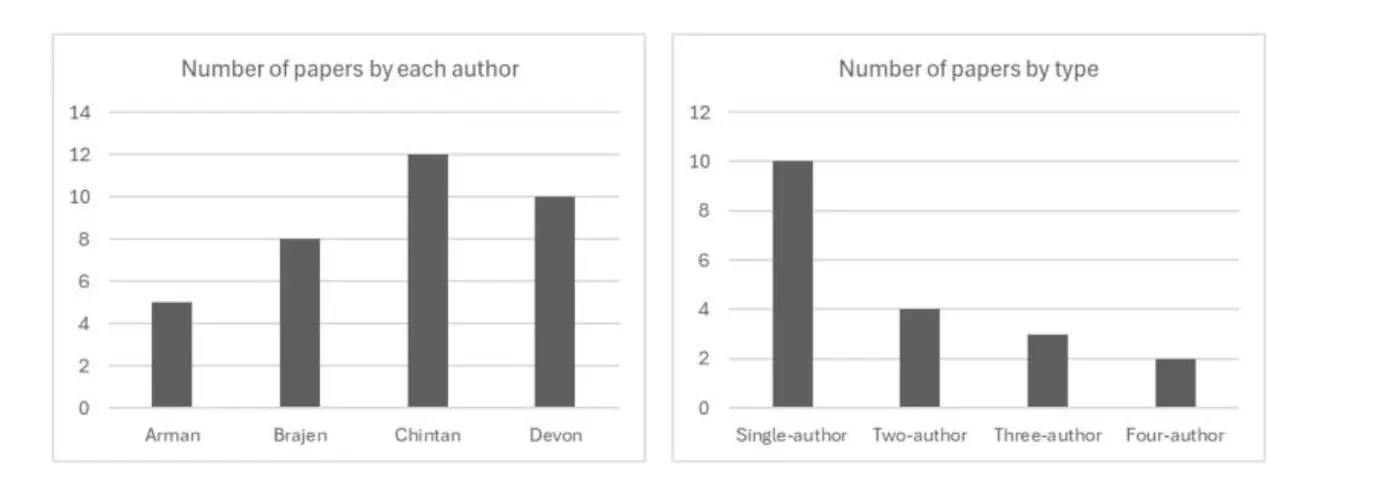
The following charts depict details of research papers written by four authors, Arman, Brajen, Chintan, and Devon. The papers were of four types, single-author, two-author, three-author, and four-author, that is, written by one, two, three, or all four of these authors, respectively. No other authors were involved in writing these papers.
The following additional facts are known.
1
Each of the authors wrote at least one of each of the four types of papers.
2
The four authors wrote different numbers of single-author papers.
3
Both Chintan and Devon wrote more three-author papers than Brajen.
4
The number of single-author and two-author papers written by Brajen were the same.
Official Reference Chart - CAT 2025 Slot 2 Official Reference Chart - CAT 2025 Slot 2
What was the total number of two-author and three-author papers written by Brajen?
TITA Answer:
Question 16 of 22
CAT 2025 Slot 2DILRData Interpretation • Bar GraphsModerate
Caselet / Problem Set Context•~117 words
The following charts depict details of research papers written by four authors, Arman, Brajen, Chintan, and Devon. The papers were of four types, single-author, two-author, three-author, and four-author, that is, written by one, two, three, or all four of these authors, respectively. No other authors were involved in writing these papers.
The following additional facts are known.
1
Each of the authors wrote at least one of each of the four types of papers.
2
The four authors wrote different numbers of single-author papers.
3
Both Chintan and Devon wrote more three-author papers than Brajen.
4
The number of single-author and two-author papers written by Brajen were the same.
Official Reference Chart - CAT 2025 Slot 2 Official Reference Chart - CAT 2025 Slot 2
Which of the following statements is/are NECESSARILY true?
i
Chintan wrote exactly three two-author papers.
ii
Chintan wrote more single-author papers than Devon.
Question 17 of 22
CAT 2025 Slot 2DILRData Interpretation • Bar GraphsModerate
Caselet / Problem Set Context•~117 words
The following charts depict details of research papers written by four authors, Arman, Brajen, Chintan, and Devon. The papers were of four types, single-author, two-author, three-author, and four-author, that is, written by one, two, three, or all four of these authors, respectively. No other authors were involved in writing these papers.
The following additional facts are known.
1
Each of the authors wrote at least one of each of the four types of papers.
2
The four authors wrote different numbers of single-author papers.
3
Both Chintan and Devon wrote more three-author papers than Brajen.
4
The number of single-author and two-author papers written by Brajen were the same.
Official Reference Chart - CAT 2025 Slot 2 Official Reference Chart - CAT 2025 Slot 2
Which of the following statements is/are NECESSARILY true?
i
Arman wrote three-author papers only with Chintan and Devon.
ii
Brajen wrote three-author papers only with Chintan and Devon.
Question 18 of 22
CAT 2025 Slot 2DILRData Interpretation • Bar GraphsModerate
Caselet / Problem Set Context•~117 words
The following charts depict details of research papers written by four authors, Arman, Brajen, Chintan, and Devon. The papers were of four types, single-author, two-author, three-author, and four-author, that is, written by one, two, three, or all four of these authors, respectively. No other authors were involved in writing these papers.
The following additional facts are known.
1
Each of the authors wrote at least one of each of the four types of papers.
2
The four authors wrote different numbers of single-author papers.
3
Both Chintan and Devon wrote more three-author papers than Brajen.
4
The number of single-author and two-author papers written by Brajen were the same.
Official Reference Chart - CAT 2025 Slot 2 Official Reference Chart - CAT 2025 Slot 2
If Devon wrote more than one two-author papers, then how many two-author papers did Chintan write?
TITA Answer:
Question 19 of 22
CAT 2025 Slot 2DILRData Interpretation • Scatter PlotHard
Caselet / Problem Set Context•~184 words
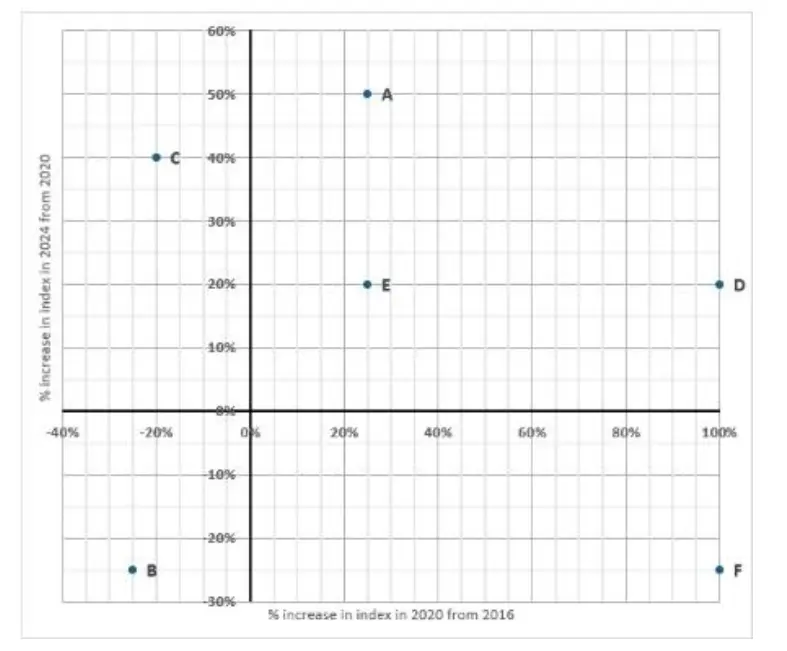
The Sustainability Index (SI) of a country at a point in time is an integer between 1 and 100. This question is related to SI of six countries - A, B, C, D, E, and F - at three different points in time - 2016, 2020, and 2024. The plot represents the exact changes in their SI, with X-coordinate representing % increase in 2020 from 2016, i.e., (SI in 2020 minus SI in 2016) / (SI in 2016), and Y-coordinate representing % increase in 2024 from 2020. At any point in time, the country with highest SI is ranked 1, while the country with the lowest SI is ranked 6. The following additional facts are known.
1
In 2016, B, C, E, and A had ranks 1, 2, 3, and 4 respectively.
2
F had lower SI than any other country in 2016, 2020, and 2024.
3
In 2024, E was the only country with SI of 90.
4
The range of SI of the six countries was 60 in 2016 as well as in 2024.
Official Reference Chart - CAT 2025 Slot 2 Official Reference Chart - CAT 2025 Slot 2
What was the SI of E in 2016?
TITA Answer:
Question 20 of 22
CAT 2025 Slot 2DILRData Interpretation • Scatter PlotHard
Caselet / Problem Set Context•~184 words
The Sustainability Index (SI) of a country at a point in time is an integer between 1 and 100. This question is related to SI of six countries - A, B, C, D, E, and F - at three different points in time - 2016, 2020, and 2024. The plot represents the exact changes in their SI, with X-coordinate representing % increase in 2020 from 2016, i.e., (SI in 2020 minus SI in 2016) / (SI in 2016), and Y-coordinate representing % increase in 2024 from 2020. At any point in time, the country with highest SI is ranked 1, while the country with the lowest SI is ranked 6. The following additional facts are known.
1
In 2016, B, C, E, and A had ranks 1, 2, 3, and 4 respectively.
2
F had lower SI than any other country in 2016, 2020, and 2024.
3
In 2024, E was the only country with SI of 90.
4
The range of SI of the six countries was 60 in 2016 as well as in 2024.
Official Reference Chart - CAT 2025 Slot 2 Official Reference Chart - CAT 2025 Slot 2
What was the SI of F in 2020?
TITA Answer:
Question 21 of 22
CAT 2025 Slot 2DILRData Interpretation • Scatter PlotHard
Caselet / Problem Set Context•~184 words
The Sustainability Index (SI) of a country at a point in time is an integer between 1 and 100. This question is related to SI of six countries - A, B, C, D, E, and F - at three different points in time - 2016, 2020, and 2024. The plot represents the exact changes in their SI, with X-coordinate representing % increase in 2020 from 2016, i.e., (SI in 2020 minus SI in 2016) / (SI in 2016), and Y-coordinate representing % increase in 2024 from 2020. At any point in time, the country with highest SI is ranked 1, while the country with the lowest SI is ranked 6. The following additional facts are known.
1
In 2016, B, C, E, and A had ranks 1, 2, 3, and 4 respectively.
2
F had lower SI than any other country in 2016, 2020, and 2024.
3
In 2024, E was the only country with SI of 90.
4
The range of SI of the six countries was 60 in 2016 as well as in 2024.
Official Reference Chart - CAT 2025 Slot 2 Official Reference Chart - CAT 2025 Slot 2
What was the SI of C in 2024?
TITA Answer:
Question 22 of 22
CAT 2025 Slot 2DILRData Interpretation • Scatter PlotHard
Caselet / Problem Set Context•~184 words
The Sustainability Index (SI) of a country at a point in time is an integer between 1 and 100. This question is related to SI of six countries - A, B, C, D, E, and F - at three different points in time - 2016, 2020, and 2024. The plot represents the exact changes in their SI, with X-coordinate representing % increase in 2020 from 2016, i.e., (SI in 2020 minus SI in 2016) / (SI in 2016), and Y-coordinate representing % increase in 2024 from 2020. At any point in time, the country with highest SI is ranked 1, while the country with the lowest SI is ranked 6. The following additional facts are known.
1
In 2016, B, C, E, and A had ranks 1, 2, 3, and 4 respectively.
2
F had lower SI than any other country in 2016, 2020, and 2024.
3
In 2024, E was the only country with SI of 90.
4
The range of SI of the six countries was 60 in 2016 as well as in 2024.
Official Reference Chart - CAT 2025 Slot 2 Official Reference Chart - CAT 2025 Slot 2
What was the SI of B in 2024?
ThinkCAT Pro Season PassFull Exam Access

Unlock All 24 Full-Length Official Mocks & 6,000+ Questions

Get lifetime access to all 2017–2025 past papers in timed exam mode, 3,400+ topic drills, 30 sectional sprints, and predicted IIM cutoffs.

Unlock Full Access

Frequently Asked Questions about CAT 2025 Slot 2 DILR Questions & Answer Key

How many questions were asked in CAT 2025 Slot 2 DILR?

CAT 2025 Slot 2 DILR contained 22 questions convened by IIM Kozhikode. Marking was +3 marks for correct answers, -1 for incorrect MCQs, and zero penalty for TITA questions.

What score was required for a 99th percentile in CAT 2025 Slot 2 DILR?

Achieving a 99.0th percentile in DILR required approximately 23–26 marks (~8 net correct), reflecting the high difficulty (calculation-intensive dilr, complex modern math).

Can I practice other sections of CAT 2025 Slot 2?

Yes! You can explore the full paper or switch directly to DILR, VARC, or QA using the related sectional links below.

Related CAT Papers & Topic Mastery Hubs

Explore other slots, sections, and high-weightage topic collections

View Full Archive