CAT 2023 Slot 2 DILR · Set 3 of 4Logical ReasoningHard DifficultyQ11–Q15 · 2 MCQ + 3 TITA

CAT 2023 Slot 2 DILR Set 3: Grids (5 Questions) with Solutions

The Grids set from the official CAT 2023 Slot 2 DILR paper: the caselet, all 5 questions, the official answer key and a step-by-step solution for each. 100% free, no sign-up.

The Set: Read the Caselet First

CAT 2023 Slot 2 DILR · Questions 11–15
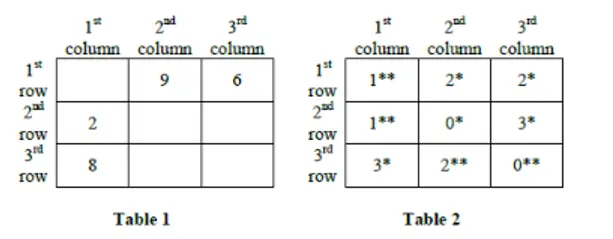
There are nine boxes arranged in a 3×33\times3 array as shown in Tables 1 and 2. Each box contains three sacks. Each sack has a certain number of coins, between 1 and 9, both inclusive.
The average number of coins per sack in the boxes are all distinct integers. The total number of coins in each row is the same. The total number of coins in each column is also the same.
Table 1 gives information regarding the median of the numbers of coins in the three sacks in a box for some of the boxes. In Table 2 each box has a number which represents the number of sacks in that box having more than 5 coins. That number is followed by a, if the sacks in that box satisfy exactly one among the following three conditions, and it is followed by. if two or more of these conditions are satisfied.
i
The minimum among the numbers of coins in the three sacks in the box is 1.
ii
The median of the numbers of coins in the three sacks is 1.
iii
The maximum among the numbers of coins in the three sacks in the box is 9.
Official Reference Chart - CAT 2023 Slot 2 Official Reference Chart - CAT 2023 Slot 2

In the exam this set competed with 3 others for 40 minutes. Budget about 10 minutes if you attempt it.

Q11. Grids

MCQ · +3 / −1
What is the total number of coins in all the boxes in the 3rd row?
  1. A) 15
  2. B) 45
  3. C) 36
  4. D) 30
Correct Answer
B) 45
Step-by-step solution
Clue Breakdown:
Each box has three sacks with 1-9 coins.
Each box's average coins per sack is a distinct integer.
Total coins in each row and column are equal.
Table 1 provides medians for some boxes.
Table 2 indicates the number of sacks with >5 coins and conditions met.
Step-by-Step Deduction:
1
Total Coins Calculation:
Each box's total coins must be a multiple of 3 (since average is integer).
There are 9 boxes, each with a unique total, so totals are 3,6,9,...,27.
Sum of all box totals = 3(1+2+...+9) = 345 = 135.
Since each row and column sums to T, and there are 3 rows, 3T = 135 ⇒ T = 45.
Question Resolution:
The total coins in each row, including the third row, is 45.
Final Answer: Correct Answer: B) 45

Q12. Grids

MCQ · +3 / −1
How many boxes have at least one sack containing 9 coins?
  1. A) 3
  2. B) 8
  3. C) 4
  4. D) 5
Correct Answer
D) 5
Step-by-step solution
📌 Core Concept
Each box is pinned down by combining its median (Table 1), its count of sacks above 5 and condition marker (Table 2), the integer-average requirement and equal row and column totals.
🔢 Step-by-Step Solution
1
Box (3,3) has 0 sacks above 5 and two or more conditions. Condition (iii) is impossible, so the min and median are both 1. The box is {1,1,x}\{1,1,x\} with x≤5x\le5.
2
Box (1,2) has median 9 and two sacks above 5, so it is {a,9,9}\{a,9,9\} with a≤5a\le5. It satisfies exactly one condition, so a≠1a\ne1. An integer average needs a+18a+18 divisible by 3, so a=3a=3. The box is {3,9,9}\{3,9,9\} with total 21.
3
Box (3,1) has median 8 and three sacks above 5, so it is {a,8,c}\{a,8,c\} with a≥6a\ge6 and c≥8c\ge8. Exactly one condition forces c=9c=9. An integer average needs a+17a+17 divisible by 3, so a=7a=7. The box is {7,8,9}\{7,8,9\} with average 8 and total 24.
4
Box (2,1) has median 2, one sack above 5 and two conditions. Min 1 and max 9 give {1,2,9}\{1,2,9\} with average 4 and total 12.
5
Box (3,2) has two sacks above 5 and two conditions, so it is {1,x,9}\{1,x,9\} with x≥6x\ge6. An integer average needs 10+x10+x divisible by 3, so x=8x=8. The box is {1,8,9}\{1,8,9\} with average 6 and total 18.
6
Box (1,3) has median 6, so it is {3,6,9}\{3,6,9\} (average 6) or {1,6,8}\{1,6,8\} (average 5). Averages must be distinct and 6 is already used, so it is {1,6,8}\{1,6,8\} with total 15.
7
Box (1,1) has one sack above 5 and two conditions, and 4 and 5 are taken. That leaves {1,1,7}\{1,1,7\} with total 9. Row 1 totals 9+21+15=459+21+15=45.
8
Column 1 gives 9+12+24=459+12+24=45, so every row and column totals 45. Row 3 gives box (3,3) =45−24−18=3=45-24-18=3, which is {1,1,1}\{1,1,1\}. Column 2 gives box (2,2) =45−21−18=6=45-21-18=6, which is {1,2,3}\{1,2,3\}. Row 2 gives box (2,3) =45−12−6=27=45-12-6=27, which is {9,9,9}\{9,9,9\}.
9
Boxes containing a 9 are (1,2), (2,1), (2,3), (3,1) and (3,2), which is 5 boxes.
Why Not the Others
A (3), B (8) and C (4) all miss at least one of the five boxes above. Box (3,3) {1,1,1}\{1,1,1\}, box (1,1) {1,1,7}\{1,1,7\}, box (1,3) {1,6,8}\{1,6,8\} and box (2,2) {1,2,3}\{1,2,3\} have no 9, so 8 is far too many.
Correct Answer: D

Q13. Grids

TITA · +3 / 0
For how many boxes are the average and median of the numbers of coins contained in the three sacks in that box the same?
Correct Answer
4
Step-by-step solution
📌 Core Concept
Reconstruct every box from Table 1 and Table 2, using integer averages and equal row and column totals, then compare each box's average with its median.
🔢 Step-by-Step Solution
1
Box (3,3) has 0 sacks above 5 and two conditions. Condition (iii) fails, so min and median are both 1, giving {1,1,x}\{1,1,x\}.
2
Box (1,2) has median 9 and two sacks above 5, so it is {a,9,9}\{a,9,9\}. An integer average and exactly one condition give a=3a=3. The box is {3,9,9}\{3,9,9\}.
3
Box (3,1) has median 8 and three sacks above 5, with exactly one condition (max 9). An integer average gives {7,8,9}\{7,8,9\} with average 8.
4
Box (2,1) has median 2, one sack above 5 and two conditions, so it is {1,2,9}\{1,2,9\} with average 4.
5
Box (3,2) has two sacks above 5 and two conditions, so it is {1,x,9}\{1,x,9\}. An integer average gives x=8x=8, so the box is {1,8,9}\{1,8,9\} with average 6.
6
Average 6 is taken, so box (1,3) with median 6 is {1,6,8}\{1,6,8\} with average 5. Box (1,1) must be {1,1,7}\{1,1,7\} with average 3, since 4 and 5 are taken.
7
Row 1 totals 9+21+15=459+21+15=45, so all rows and columns total 45. The remaining boxes follow: (3,3) ={1,1,1}=\{1,1,1\}, (2,2) ={1,2,3}=\{1,2,3\} and (2,3) ={9,9,9}=\{9,9,9\}.
8
Compare average with median box by box:
(1,1): average 3, median 1, no
(1,2): average 7, median 9, no
(1,3): average 5, median 6, no
(2,1): average 4, median 2, no
(2,2): average 2, median 2, yes
(2,3): average 9, median 9, yes
(3,1): average 8, median 8, yes
(3,2): average 6, median 8, no
(3,3): average 1, median 1, yes
Quick Check
The averages 3,7,5,4,2,9,8,6,13,7,5,4,2,9,8,6,1 are all distinct, and four boxes match.
Correct Answer: 4

Q14. Grids

TITA · +3 / 0
How many sacks have exactly one coin?
Correct Answer
9
Step-by-step solution
📌 Core Concept
Rebuild all nine boxes from the medians, the Table 2 counts and markers, the integer-average condition and the equal row and column totals. Then count the 1s.
🔢 Step-by-Step Solution
1
Box (3,3) has 0 sacks above 5 and two conditions. Condition (iii) fails, so min and median are both 1, giving {1,1,x}\{1,1,x\}.
2
Box (1,2) has median 9 and two sacks above 5, so it is {a,9,9}\{a,9,9\}. An integer average and exactly one condition give {3,9,9}\{3,9,9\}, with total 21.
3
Box (3,1) has median 8 and three sacks above 5, with exactly one condition (max 9). An integer average gives {7,8,9}\{7,8,9\} with total 24.
4
Box (2,1) has median 2, one sack above 5 and two conditions, so it is {1,2,9}\{1,2,9\} with total 12.
5
Box (3,2) has two sacks above 5 and two conditions, so it is {1,x,9}\{1,x,9\}. An integer average gives x=8x=8, so the box is {1,8,9}\{1,8,9\} with average 6 and total 18.
6
Average 6 is taken, so box (1,3) with median 6 is {1,6,8}\{1,6,8\} with total 15. Box (1,1) must be {1,1,7}\{1,1,7\} with total 9, since averages 4 and 5 are taken.
7
Row 1 totals 9+21+15=459+21+15=45, so every row and column totals 45. Row 3 gives box (3,3) =3=3, which is {1,1,1}\{1,1,1\}. Column 2 gives box (2,2) =6=6, which is {1,2,3}\{1,2,3\}. Row 2 gives box (2,3) =27=27, which is {9,9,9}\{9,9,9\}.
8
Count the 1s box by box:
(1,1): 2
(1,2): 0
(1,3): 1
(2,1): 1
(2,2): 1
(2,3): 0
(3,1): 0
(3,2): 1
(3,3): 3
The total is 2+0+1+1+1+0+0+1+3=92+0+1+1+1+0+0+1+3=9.
Quick Check
The averages 3,7,5,4,2,9,8,6,13,7,5,4,2,9,8,6,1 are distinct, and every row and column totals 45.
Correct Answer: 9

Q15. Grids

TITA · +3 / 0
In how many boxes do all three sacks contain different numbers of coins?
Correct Answer
5
Step-by-step solution
📌 Core Concept
Rebuild each box from Table 1 and Table 2, using integer averages and equal row and column totals. Then count the boxes whose three values are all different.
🔢 Step-by-Step Solution
1
Box (3,3) has 0 sacks above 5 and two conditions. Condition (iii) fails, so min and median are both 1, giving {1,1,x}\{1,1,x\}.
2
Box (1,2) has median 9 and two sacks above 5, so it is {a,9,9}\{a,9,9\}. An integer average and exactly one condition give {3,9,9}\{3,9,9\}, with total 21.
3
Box (3,1) has median 8 and three sacks above 5, with exactly one condition (max 9). An integer average gives {7,8,9}\{7,8,9\} with total 24.
4
Box (2,1) has median 2, one sack above 5 and two conditions, so it is {1,2,9}\{1,2,9\} with total 12.
5
Box (3,2) has two sacks above 5 and two conditions, so it is {1,x,9}\{1,x,9\}. An integer average gives {1,8,9}\{1,8,9\} with total 18.
6
Average 6 is taken, so box (1,3) with median 6 is {1,6,8}\{1,6,8\} with total 15. Box (1,1) must be {1,1,7}\{1,1,7\} with total 9, since averages 4 and 5 are taken.
7
Row 1 totals 9+21+15=459+21+15=45, so every row and column totals 45. Row 3 gives (3,3) ={1,1,1}=\{1,1,1\}. Column 2 gives (2,2) ={1,2,3}=\{1,2,3\}. Row 2 gives (2,3) ={9,9,9}=\{9,9,9\}.
8
The final boxes are:
(1,1) {1,1,7}\{1,1,7\}: repeats
(1,2) {3,9,9}\{3,9,9\}: repeats
(1,3) {1,6,8}\{1,6,8\}: all different
(2,1) {1,2,9}\{1,2,9\}: all different
(2,2) {1,2,3}\{1,2,3\}: all different
(2,3) {9,9,9}\{9,9,9\}: repeats
(3,1) {7,8,9}\{7,8,9\}: all different
(3,2) {1,8,9}\{1,8,9\}: all different
(3,3) {1,1,1}\{1,1,1\}: repeats
Five boxes have three different values.
Correct Answer: 5
Timed Practice

Attempt the full CAT 2023 Slot 2 paper as a free mock

All three sections, 120 minutes, in the TCS iON-style simulator. Free, no sign-up.

Start Free Mock

CAT 2023 Slot 2 DILR at a Glance

Sets in this section4
Questions in this section20
Section time40 minutes
Convenor IIMIIM Lucknow

More CAT DILR Sets with Solutions