CAT 2024 Slot 3 DILR · Set 1 of 5Logical ReasoningHard DifficultyQ1–Q5 · 3 MCQ + 2 TITA

CAT 2024 Slot 3 DILR Set 1: Grids (5 Questions) with Solutions

The Grids set from the official CAT 2024 Slot 3 DILR paper: the caselet, all 5 questions, the official answer key and a step-by-step solution for each. 100% free, no sign-up.

The Set: Read the Caselet First

CAT 2024 Slot 3 DILR · Questions 1–5
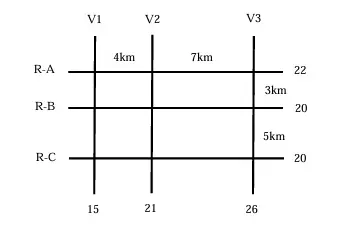
The figure below shows a network with three parallel roads represented by horizontal lines R-A, R-B, and R-C and another three parallel roads represented by vertical lines V1, V2, and V3. The figure also shows the distance (in km) between two adjacent intersections. Six ATMs are placed at six of the nine road intersections. Each ATM has a distinct integer cash requirement (in Rs. Lakhs), and the numbers at the end of each line in the figure indicate the total cash requirements of all ATMs placed on the corresponding road. For example, the total cash requirement of the ATM(s) placed on road R-A is Rs. 22 Lakhs.
The following additional information is known.
1
The ATMs with the minimum and maximum cash requirements of Rs. 7 Lakhs and Rs. 15 Lakhs are placed on the same road.
2
The road distance between the ATM with the second highest cash requirement and the ATM located at the intersection of R-C and V3 is 12 km.
Official Reference Chart - CAT 2024 Slot 3 Official Reference Chart - CAT 2024 Slot 3

In the exam this set competed with 4 others for 40 minutes. Budget about 8 minutes if you attempt it.

Q1. Grids

MCQ · +3 / −1
Which of the following statements is correct?
  1. A) The ATM placed at the (R-C, V2) intersection has a cash requirement of Rs. 9 Lakhs.
  2. B) The cash requirement of the ATM placed at the (R-C, V2) intersection cannot be uniquely determined.
  3. C) The ATM placed at the (R-C, V2) intersection has a cash requirement of Rs. 8 Lakhs.
  4. D) There is no ATM placed at the (R-C, V2) intersection.
Correct Answer
A) The ATM placed at the (R-C, V2) intersection has a cash requirement of Rs. 9 Lakhs.
Step-by-step solution
📌 Core Concept
The row and column totals, together with the 12 km clue and the 7/15 extremes, fix every ATM value and position.
🔢 Step-by-Step Solution
1
The ATM at (R-C, V3) exists, and the only intersection 12 km from it is (R-B, V2): 5+7=125+7=12. So the second-highest ATM sits at (R-B, V2). Call it bb.
2
The six values are distinct and sum to 22+20+20=6222+20+20=62. The minimum is 7 and the maximum is 15, so the other four sum to 62−22=4062-22=40. Since bb is the second highest, b≤14b\le 14.
3
V2 totals 21 and holds bb plus one other ATM, because two others would be too large. That other ATM has value 21−b21-b.
4
R-B totals 20, so its other ATM has value 20−b20-b, which must be at least 7. This rules out b=14b=14.
5
If b=13b=13, the values 13, 8 (V2), 7 (R-B) are forced, and the remaining two sum to 19, giving 9 and 10. The set is {7, 8, 9, 10, 13, 15}. R-A would need 22 from {8, 9, 10, 15}, which is impossible.
6
So b=12b=12. The V2 partner is 9, the R-B partner is 8, and the last value is 40−12−9−8=1140-12-9-8=11. The set is {7, 8, 9, 11, 12, 15}.
7
R-B holds 12 and 8. The remaining {7, 9, 11, 15} split into R-A =7+15=22=7+15=22 and R-C =9+11=20=9+11=20.
8
The V2 partner (9) must be in R-C, since R-A holds only 7 and 15. So (R-C, V2) is Rs. 9 Lakhs, and (R-C, V3) is 11.
Why Not the Others
B: the value is fixed at 9, so it is uniquely determined.
C: 8 is the R-B partner of 12, not the (R-C, V2) ATM.
D: R-C needs both 9 and 11, so (R-C, V2) must hold an ATM.
Correct Answer: A

Q2. Grids

TITA · +3 / 0
How many ATMs have cash requirements of Rs. 10Lakhs or more?
Correct Answer
3
Step-by-step solution
📌 Core Concept
The totals and clues fix all six cash requirements, so the question reduces to counting values of 10 or more.
🔢 Step-by-Step Solution
1
The ATM at (R-C, V3) exists, and only (R-B, V2) is 12 km from it (5+75+7). So (R-B, V2) is the second highest ATM.
2
The six values sum to 22+20+20=6222+20+20=62, with minimum 7 and maximum 15. V2 totals 21 and R-B totals 20, so (R-B, V2) must be 12 or 13. The case 13 forces {7, 8, 9, 10, 13, 15}, and R-A cannot reach 22 from {8, 9, 10, 15}. So (R-B, V2) is 12.
3
Then V2's other ATM is 21−12=921-12=9 and R-B's other ATM is 20−12=820-12=8. The last value is 40−12−9−8=1140-12-9-8=11, so the set is {7, 8, 9, 11, 12, 15}.
4
The values of at least 10 are 11, 12 and 15, which makes 3 ATMs.
Quick Check
The values 7+8+9+11+12+15 sum to 62, which matches the row and column totals.
Correct Answer: 3

Q3. Grids

MCQ · +3 / −1
Which of the following two statements is/are DEFINITELY true? Statement A: Each of R-A, R-B, and R-C has two ATMs. Statement B: Each of V1, V2, and V3 has two ATMs.
  1. A) Only Statement B
  2. B) Neither Statement A nor Statement B
  3. C) Both Statement A and Statement B
  4. D) Only Statement A
Correct Answer
D) Only Statement A
Step-by-step solution
📌 Core Concept
Use the row and column totals together with the 7-to-15 range to work out which values are on each road. Then test which ATM counts are forced.
🔢 Step-by-Step Solution
1
The totals add up to 22+20+20=15+21+26=6222+20+20 = 15+21+26 = 62. The cash values are six distinct integers from 7 to 15, and 7 and 15 are both used.
2
By Clue 1, 7 and 15 share a road, so that road totals at least 22. A road of 20 cannot hold them. V2 (21) and V1 (15) are too small. On V3 (26), a third ATM would have to be 4, which is below 7. So R-A holds exactly 7 and 15.
3
R-B and R-C hold the other four ATMs, and each row totals 20. One ATM in a row would need the value 20 (more than 15). Three ATMs would total at least 8+9+10=278+9+10 = 27. So each of these rows has exactly two ATMs. Statement A is definitely true.
4
The only pairs of distinct values from 8 to 14 that make 20 are {8, 12} and {9, 11}. So the remaining values are 8, 9, 11 and 12.
5
V2 = 21 can only be 9+129+12. V1 = 15 is either {15} alone or {7, 8}.
If V1 = {15}, then V3 = 7+8+11=267+8+11 = 26, so V1 has 1 ATM and V3 has 3.
If V1 = {7, 8}, then V3 = 15+11=2615+11 = 26, so each column has 2 ATMs.
6
Clue 2 allows both cases, so the column counts are not fixed. Statement B is not definitely true.
Why Not the Others
A, C: Statement B fails when V1 = {15} and V3 has three ATMs. B: Statement A is always true (Steps 2 and 3).
Correct Answer: D

Q4. Grids

MCQ · +3 / −1
What best can be said about the road distance (in km) between the ATMs having the second highest and the second lowest cash requirements?
  1. A) 4 km
  2. B) 5 km
  3. C) Either 4 km or 7 km
  4. D) 7 km
Correct Answer
C) Either 4 km or 7 km
Step-by-step solution
📌 Core Concept
Find the value sets from the road totals, then use Clue 2 to place 12. The position of 8 changes between the two valid layouts.
🔢 Step-by-Step Solution
1
Clue 1 and the totals force R-A = {7, 15}. R-B and R-C each total 20 with two ATMs, from the pairs {8, 12} and {9, 11}. So the second highest value is 12 and the second lowest is 8.
2
V2 = 21 can only be 9+129+12, so 12 is on V2, in either R-B or R-C.
3
Clue 2: 12 is 12 km from the ATM at R-C/V3.
If 12 is at R-C/V2, the distance is only 7 km. So 12 is at R-B/V2, and the distance is 5+7=125+7 = 12 km. ✓
R-C must then hold {9, 11}: 9 at R-C/V2, and 11 at R-C/V3 (the clue needs an ATM there).
4
The ATM 8 sits in R-B with 12, on either V1 or V3:
Layout 1: V1 = {15}, V3 = 7+8+11=267+8+11 = 26. So 8 is at R-B/V3, and the distance from 12 is 7 km.
Layout 2: V1 = 7+8=157+8 = 15, V3 = 15+11=2615+11 = 26. So 8 is at R-B/V1, and the distance from 12 is 4 km.
5
Both layouts satisfy every total and both clues.
Why Not the Others
A, D: Each of these is only one of the two valid layouts. B: 5 km is the R-B to R-C gap. 8 and 12 are both on R-B, so 5 km is never their distance.
Quick Check
In both layouts, every row total (22, 20, 20) and column total (15, 21, 26) is met.
Correct Answer: C

Q5. Grids

TITA · +3 / 0
What is the number of ATMs whose locations and cash requirements can both be uniquely determined?
Correct Answer
3
Step-by-step solution
📌 Core Concept
Work out every layout that meets all the totals and both clues. Then count the ATMs whose position and value are the same in every layout.
🔢 Step-by-Step Solution
1
Clue 1: 7 and 15 share a road. Only R-A (22) can hold exactly 7+157+15, so R-A = {7, 15}.
2
R-B and R-C each total 20. Each row must have two ATMs, because one ATM would be 20 and three would total at least 27. The only valid pairs are {8, 12} and {9, 11}.
3
V2 = 21 can only be 9+129+12. V1 = 15 is either {15} or {7, 8}, which leaves V3 = {7, 8, 11} or {15, 11}.
4
Clue 2: the second highest value, 12, is 12 km from R-C/V3.
At R-C/V2 it would be only 7 km away, so 12 is at R-B/V2 (5+7=125+7 = 12 km).
That puts 9 at R-C/V2. R-C/V3 must hold an ATM, so 11 is at R-C/V3.
5
Two layouts remain:
Layout 1: 15 at R-A/V1, 7 at R-A/V3, 8 at R-B/V3.
Layout 2: 7 at R-A/V1, 15 at R-A/V3, 8 at R-B/V1.
6
The same in both layouts: 12 at R-B/V2, 9 at R-C/V2 and 11 at R-C/V3. ATMs 7, 15 and 8 change position.
Quick Check
Layout 1 columns: 1515, 12+9=2112+9 = 21, 7+8+11=267+8+11 = 26. Layout 2 columns: 7+8=157+8 = 15, 2121, 15+11=2615+11 = 26. Both are valid.
Correct Answer: 3
Timed Practice

Attempt the full CAT 2024 Slot 3 paper as a free mock

All three sections, 120 minutes, in the TCS iON-style simulator. Free, no sign-up.

Start Free Mock

CAT 2024 Slot 3 DILR at a Glance

Sets in this section5
Questions in this section22
Section time40 minutes
Convenor IIMIIM Calcutta

More CAT DILR Sets with Solutions