CAT 2021 Slot 2 DILR · Set 4 of 4Logical ReasoningHard DifficultyQ15–Q20 · 5 MCQ + 1 TITA

CAT 2021 Slot 2 DILR Set 4: Games & Tournaments (6 Questions) with Solutions

The Games & Tournaments set from the official CAT 2021 Slot 2 DILR paper: the caselet, all 6 questions, the official answer key and a step-by-step solution for each. 100% free, no sign-up.

The Set: Read the Caselet First

CAT 2021 Slot 2 DILR · Questions 15–20
Ten objects o1, o2, …, o10 were distributed among Amar, Barat, Charles, Disha, and Elise. Each item went to exactly one person. Each person got exactly two of the items, and this pair of objects is called her/his bundle.
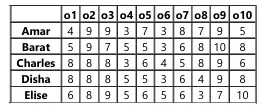
The following table shows how each person values each object.
The value of any bundle by a person is the sum of that person's values of the objects in that bundle. A person X envies another person Y if X values Y 's bundle more than X 's own bundle.
For example, hypothetically suppose Amar's bundle consists of 0101 and 0202, and Barat's bundle consists of 0303 and 0404. Then Amar values his own bundle at 4+9=134+9=13 and Barat's bundle at 99
+3=12+3=12. Hence Amar does not envy Barat. On the other hand, Barat values his own bundle at 7+5=127+5=12 and Amar's bundle at 5+9=145+9=14. Hence Barat envies Amar.
The following facts are known about the actual distribution of the objects among the five people.
1
If someone's value for an object is 1010, then she/he received that object.
2
Objects o1, o2, and o3 were given to three different people.
3
Objects 0101 and 0808 were given to different people.
4
Three people value their own bundles at 1616. No one values her/his own bundle at a number higher than 1616.
5
Disha values her own bundle at an odd number. All others value their own bundles at an even number.
6
Some people who value their own bundles less than 1616 envy some other people who value their own bundle at 1616. No one else envies others.
Official Reference Chart - CAT 2021 Slot 2 Official Reference Chart - CAT 2021 Slot 2

In the exam this set competed with 3 others for 40 minutes. Budget about 10 minutes if you attempt it.

Q15. Games & Tournaments

MCQ · +3 / −1
What BEST can be said about object o8?
  1. A) o8 was given to Amar, Charles, or Disha
  2. B) 8 was given to Charles
  3. C) o8 was given to Disha
  4. D) 08 was given to Charles or Disha
Correct Answer
B) 8 was given to Charles
Step-by-step solution
📌 Core Concept
The only 10s in the table force o9 and o10; parity, the 16 cap and the envy rule then fix every bundle.
🔢 Step-by-Step Solution
1
Clue 1: the only 10s are Barat's for o9 and Elise's for o10, so Barat holds o9 and Elise holds o10.
2
Barat's partner object must have an even value of at most 6, so that his bundle is even and at most 16. Only o7 (6) fits, since o8 would give 18. Barat = {o7, o9} = 16.
3
Elise's partner must also have an even value of at most 6. That leaves o1 or o5 (both 6), so Elise = 16.
4
Amar values Barat's bundle at 9+8=179+8=17. At 16 he would envy a 16-person, which clue 6 forbids, so Amar is not at 16. Disha is odd, so Charles is the third person at 16.
5
Charles reaches 16 only with two 8s from o1, o2, o3, o8. Clue 2 bars two of o1 to o3, and clue 3 bars o1 with o8. That leaves {o8, o2} or {o8, o3}.
6
Barat values o2 and o8 at 9+8=17>169+8=17>16, so he would envy. Clue 6 forbids this, so Charles = {o3, o8}.
7
Any person at 16 who holds o8 must be Charles, and the 16-group is Barat, Elise and Charles. Amar cannot hold o8 because that would put him at 16 with o2 or o3, which step 4 rules out.
Quick Check
The full distribution is Amar {o2, o6}, Barat {o7, o9}, Charles {o3, o8}, Disha {o1, o4}, Elise {o5, o10}. It satisfies all six clues, and o8 sits with Charles.
Correct Answer: B

Q16. Games & Tournaments

MCQ · +3 / −1
Who among the following envies someone else?
  1. A) Barat
  2. B) Elise
  3. C) Charles
  4. D) Amar
Correct Answer
D) Amar
Step-by-step solution
📌 Core Concept
Only people below 16 may envy, and each of them envies someone at 16. So find the bundles and see who is below 16.
🔢 Step-by-Step Solution
1
Clue 1 gives Barat o9 and Elise o10 (the only 10s). Barat's partner must have an even value of at most 6, which leaves only o7. Barat = {o7, o9} = 16.
2
Elise's partner is o1 or o5 (both 6), so Elise = 16.
3
Amar values Barat's bundle at 9+8=179+8=17, so he cannot be at 16. Disha is odd, so Charles is the third 16.
4
Charles needs two 8s from o1, o2, o3, o8. Clues 2 and 3 leave {o8, o2} or {o8, o3}, and o2 would make Barat value Charles's bundle at 9+8=179+8=17. So Charles = {o3, o8}.
5
The remaining split gives Amar {o2, o6} = 12 and Disha {o1, o4} = 13, with Elise {o5, o10}. Elise's other option, o1, makes Amar envy Disha, which clue 6 forbids.
6
The 16-people are Barat, Elise and Charles. Clue 6 says only people below 16 can envy, so none of the three envies anyone.
7
Amar (12) values Barat's bundle at 9+8=17>129+8=17>12, so Amar envies Barat. Disha (13) also envies, because she values Barat's bundle at 9+6=159+6=15.
Why Not the Others
Barat, Elise and Charles each value their own bundle at 16, the maximum, and clue 6 allows envy only from people below 16.
Correct Answer: D

Q17. Games & Tournaments

TITA · +3 / 0
What is Amar's value for his own bundle?
Correct Answer
12
Step-by-step solution
📌 Core Concept
The 10s, parity and the no-envy rule for 16-people fix every bundle. Amar's bundle then follows.
🔢 Step-by-Step Solution
1
Clue 1: Barat holds o9 and Elise holds o10. Barat's partner must have an even value of at most 6, which leaves only o7. Barat = {o7, o9} = 16.
2
Elise's partner is o1 or o5 (both 6), so Elise = 16.
3
Amar values Barat's bundle at 9+8=179+8=17, so he is not at 16. Disha is odd, so Charles is the third 16, and Charles = {o3, o8} (two 8s, with o2 excluded because Barat would value o2 and o8 at 17).
4
If Elise held o1, then o2, o4, o5, o6 would go to Amar and Disha. Disha odd forces o2 with one other object. Amar would then envy Disha every time, for example 9+3=12>109+3=12>10 in one case and 9+7=16>69+7=16>6 in another. Clue 6 forbids this, so Elise = {o5, o10}.
5
The objects left are o1, o2, o4, o6. Clue 2 splits o1 and o2 between Amar and Disha. Amar with o1 would have 4+3=74+3=7, which is odd, so Amar holds o2 and Disha holds o1.
6
If Disha held o6, Amar would hold o4 and Disha would value Amar's bundle at 8+5=13>118+5=13>11. That is an envy between two people below 16, so Disha = {o1, o4} and Amar = {o2, o6}.
7
Amar's value is 9+3=129+3=12.
Quick Check
Amar's 12 is even and below 16, and he envies Barat, who values his own bundle at 16.
Correct Answer: 12

Q18. Games & Tournaments

MCQ · +3 / −1
Object o4 was given to
  1. A) Elise
  2. B) Charles
  3. C) Barat
  4. D) Disha
Correct Answer
D) Disha
Step-by-step solution
📌 Core Concept
The 10s and the parity, 16 and envy clues fix all bundles in turn, which places o4.
🔢 Step-by-Step Solution
1
Clue 1 gives Barat o9 and Elise o10. Barat's partner must have an even value of at most 6, so it is o7. Barat = {o7, o9} = 16.
2
Elise's partner is o1 or o5, so Elise = 16.
3
Amar values Barat's bundle at 9+8=179+8=17, so he is below 16. Disha is odd, so Charles is the third 16, with two 8s. Clues 2 and 3, plus Barat's 9+8=179+8=17 for o2 and o8, give Charles = {o3, o8}.
4
If Elise held o1, Disha (odd) would need o2, and Amar would envy Disha in every split of o4, o5, o6. Clue 6 forbids this, so Elise = {o5, o10}.
5
The objects left are o1, o2, o4, o6. Clue 2 splits o1 and o2 between Amar and Disha. Amar with o1 would be at 7, which is odd, so Amar has o2 and Disha has o1.
6
Each of them takes one of o4 and o6. Suppose Disha takes o6 (value 11) and Amar takes o4. Disha values Amar's bundle at 8+5=13>118+5=13>11, so she would envy Amar, who is also below 16. Clue 6 forbids that.
7
So Disha takes o4, giving Disha {o1, o4} = 13, and Amar has {o2, o6} = 12.
Quick Check
Disha values Amar's bundle at 8+3=11<138+3=11<13, so there is no envy there. She does envy Barat, at 9+6=15>139+6=15>13, as clue 6 allows.
Correct Answer: D

Q19. Games & Tournaments

MCQ · +3 / −1
Object o5 was given to
  1. A) Disha
  2. B) Elise
  3. C) Charles
  4. D) Amar
Correct Answer
B) Elise
Step-by-step solution
📌 Core Concept
Once o9 and o10 are placed, the 16-cap and envy clues decide Elise's second object.
🔢 Step-by-Step Solution
1
Clue 1 gives Barat o9 and Elise o10. Barat's partner must have an even value of at most 6, which leaves only o7. Barat = {o7, o9} = 16.
2
Elise's partner needs an even value of at most 6: o1 or o5 (both 6). Elise = 16 either way.
3
Amar values Barat's bundle at 9+8=179+8=17, so he is below 16. Disha is odd, so Charles is the third 16. Clues 2 and 3 leave {o8, o2} or {o8, o3}, and Barat would value o2 and o8 at 9+8=179+8=17. So Charles = {o3, o8}.
4
Test Elise = {o1, o10}. Then o2, o4, o5, o6 go to Amar and Disha. Disha is odd, so she holds o2 plus one more (8+58+5 or 8+38+3).
With o4, Disha has 13 and Amar has o5, o6 = 10, but Amar values Disha's bundle at 9+3=12>109+3=12>10.
With o5, Amar has o4, o6 = 6, but Amar values Disha's bundle at 9+7=16>69+7=16>6.
With o6, Amar has o4, o5 = 10, but Amar values Disha's bundle at 9+3=12>109+3=12>10.
5
In every case Amar would envy Disha. Both are below 16, and clue 6 allows envy only toward 16-people. So Elise's partner is not o1.
6
Elise = {o5, o10}. The rest then gives Amar {o2, o6}, Disha {o1, o4}.
Quick Check
Elise values her own bundle at 6+10=166+10=16, and she values Barat's bundle at 7+6=137+6=13 and Charles's at 9+3=129+3=12, so she envies no one.
Correct Answer: B

Q20. Games & Tournaments

MCQ · +3 / −1
What BEST can be said about the distribution of object o1?
  1. A) o1 was given to Charles
  2. B) o1 was given to Charles or Disha
  3. C) o1 was given to Disha
  4. D) o1 was given to Charles, Disha, or Elise
Correct Answer
C) o1 was given to Disha
Step-by-step solution
📌 Core Concept
Place o9 and o10 first. Parity then forces o1 into Disha's bundle.
🔢 Step-by-Step Solution
1
Clue 1 gives Barat o9 and Elise o10. Barat's partner must have an even value of at most 6, which leaves only o7. Barat = {o7, o9} = 16.
2
Elise's partner is o1 or o5 (both 6). Elise = 16.
3
Amar values Barat's bundle at 9+8=179+8=17, so he is not at 16. Disha is odd, so Charles is the third 16. Clues 2 and 3 limit him to {o8, o2} or {o8, o3}, and Barat would value o2 and o8 at 17. So Charles = {o3, o8}, which excludes o1 for Charles.
4
So o1 is with Elise, Amar or Disha. If Elise held o1, Disha (odd) would need o2 plus one of o4, o5, o6. Amar would then value Disha's bundle above his own every time (12>1012>10, 16>616>6, 12>1012>10), and clue 6 forbids envy between two people below 16. Elise = {o5, o10}.
5
The objects left are o1, o2, o4, o6. Clue 2 splits o1 and o2 between Amar and Disha. Amar with o1 would total 4+3=74+3=7, which is odd, but only Disha is odd. So Amar holds o2 and Disha holds o1.
6
Disha's partner is o4. With o6 she would have 11 and would value Amar's bundle at 8+5=138+5=13, which is an envy between two people below 16.
Why Not the Others
Charles and Elise are ruled out by steps 3 and 4. Amar is ruled out by step 5.
Correct Answer: C
Timed Practice

Attempt the full CAT 2021 Slot 2 paper as a free mock

All three sections, 120 minutes, in the TCS iON-style simulator. Free, no sign-up.

Start Free Mock

CAT 2021 Slot 2 DILR at a Glance

Sets in this section4
Questions in this section20
Section time40 minutes
Convenor IIMIIM Ahmedabad

More CAT DILR Sets with Solutions