CAT 2022 Slot 3 DILR · Set 4 of 4Logical ReasoningHard DifficultyQ16–Q20 · 3 MCQ + 2 TITA

CAT 2022 Slot 3 DILR Set 4: Games & Tournaments (5 Questions) with Solutions

The Games & Tournaments set from the official CAT 2022 Slot 3 DILR paper: the caselet, all 5 questions, the official answer key and a step-by-step solution for each. 100% free, no sign-up.

The Set: Read the Caselet First

CAT 2022 Slot 3 DILR · Questions 16–20
Pulak, Qasim, Ritesh, and Suresh participated in a tournament comprising of eight rounds. In each round, they formed two pairs, with each of them being in exactly one pair. The only restriction in the pairing was that the pairs would change in successive rounds. For example, if Pulak formed a pair with Qasim in the first round, then he would have to form a pair with Ritesh or Suresh in the second round. He would be free to pair with Qasim again in the third round. In each round, each pair decided whether to play the game in that round or not. If they decided not to play, then no money was exchanged between them. If they decided to play, they had to bet either Rs.1 or Rs.2 in that round. For example, if they chose to bet Rs.2, then the player winning the game got Rs.2 from the one losing the game.
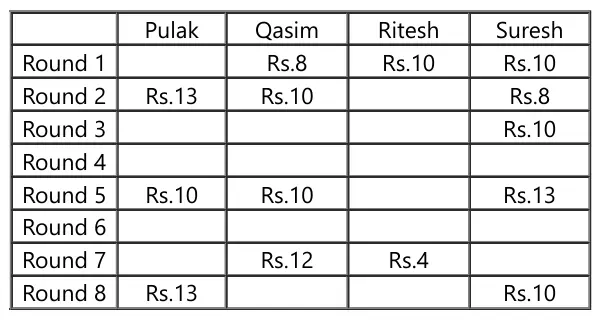
At the beginning of the tournament, the players had Rs.10 each. The following table shows partial information about the amounts that the players had at the end of each of the eight rounds. It shows every time a player had Rs.10 at the end of a round, as well as every time, at the end of a round, a player had either the minimum or the maximum amount that he would have had across the eight rounds. For example, Suresh had Rs.10 at the end of Rounds 1, 3, and 8 and not after any of the other rounds. The maximum amount that he had at the end of any round was Rs.13 (at the end of Round 5), and the minimum amount he had at the end of any round was Rs.8 (at the end of Round 2). At the end of all other rounds, he must have had either Rs.9, Rs.11, or Rs.12.
It was also known that Pulak and Qasim had the same amount of money with them at the end of Round 4.
Official Reference Chart - CAT 2022 Slot 3 Official Reference Chart - CAT 2022 Slot 3

In the exam this set competed with 3 others for 40 minutes. Budget about 10 minutes if you attempt it.

Q16. Games & Tournaments

MCQ · +3 / −1
What BEST can be said about the amount of money that Ritesh had with him at the end of Round 8?
  1. A) Rs. 5 or Rs. 6
  2. B) Rs. 4 or Rs. 5
  3. C) Exactly Rs. 6
  4. D) Exactly Rs. 5
Correct Answer
C) Exactly Rs. 6
Step-by-step solution
📌 Core Concept
The four players always hold Rs.40 in total. Each player's balance moves by 0, 1 or 2 per round. The table lists every appearance of a player's maximum and minimum, so any unlisted round cannot hold that extreme.
🔢 Step-by-Step Solution
1
Round 8 lists Pulak at 13 and Suresh at 10. So Qasim + Ritesh = 40 - 23 = 17.
2
Ritesh had Rs.4 at the end of Round 7, and this is his minimum. A player's balance changes by at most 2 in a round, so his Round 8 amount is at most 6.
3
Rs.4 is shown only in Round 7. A Round 8 amount of 4 would also be his minimum and would have been listed, so it is excluded. Ritesh therefore has 5 or 6.
4
If Ritesh has 5, Qasim has 12. But 12 is Qasim's maximum, shown only in Round 7, so a Round 8 amount of 12 would have been listed. This is excluded.
5
So Ritesh has 6 and Qasim has 11.
Why Not the Others
A: Rs.5 is ruled out because it forces Qasim to 12, which would appear in the Round 8 row.
B: Rs.4 and Rs.5 are both ruled out by steps 3 and 4.
D: Exactly Rs.5 is ruled out by step 4.
Quick Check
6+11+13+10=406 + 11 + 13 + 10 = 40.
Correct Answer: C

Q17. Games & Tournaments

MCQ · +3 / −1
What BEST can be said about the amount of money that Pulak had with him at the end of Round 6?
  1. A) Rs. 11 or Rs. 12
  2. B) Rs. 12 or Rs. 13
  3. C) Exactly Rs. 11
  4. D) Exactly Rs. 12
Correct Answer
D) Exactly Rs. 12
Step-by-step solution
📌 Core Concept
Pulak's Round 6 amount follows from the fixed Rs.40 total and from the rule that each round's pairs are zero-sum. A player who does not change in a round must be paired with another player who also does not change.
🔢 Step-by-Step Solution
1
Pulak was at 10 in Round 5, which is his minimum. In Round 6 he is at most 12 and not 10, so he has 11 or 12.
2
In Round 6, Ritesh lies between 7 (Round 5) and 4 (Round 7). Since 4 is shown only in Round 7, he has 5 or 6.
3
Qasim lies between 10 (Round 5) and 12 (Round 7). 10 and 12 are both listed elsewhere, so Qasim has 11 in Round 6.
4
In Round 7, Qasim 12 and Ritesh 4 leave Pulak + Suresh = 24. Pulak's maximum is 13 (Rounds 2 and 8), so Pulak has 12 or 13.
5
Suresh's maximum is 13 (Round 5), and 10 is not allowed in Round 7. So Suresh has 11 or 12. The only pairs adding to 24 are (13, 11) and (12, 12).
6
(13, 11) fails. From Round 7 to 8, Pulak stays at 13 while Suresh falls 11 to 10, Qasim falls 12 to 11, and Ritesh rises 4 to 6 (Ritesh = 6 from the previous question). Pulak's change of 0 has no partner with a 0 change. So Round 7 has Pulak 12 and Suresh 12.
7
Pulak is at 11 or 12 and Suresh at 11 or 12 in Round 6. Check Pulak 11 with Suresh 12: from Round 6 to 7, Pulak +1, Suresh 0, Qasim +1, Ritesh -2. No pairing is zero-sum. Check Pulak 12 with Suresh 11: Pulak 0 has no partner with a 0 change, so this fails too.
8
So Pulak and Suresh both have 12 in Round 6.
Why Not the Others
A and B: Pulak cannot have 11 or 13, as steps 1 and 7 show.
C: Rs.11 fails the zero-sum pairing in step 7.
Correct Answer: D

Q18. Games & Tournaments

TITA · +3 / 0
How much money (in Rs.) did Ritesh have at the end of Round 4?
Correct Answer
6
Step-by-step solution
📌 Core Concept
Each round's total is Rs.40 and each pair's winnings cancel. A player whose balance does not change must be paired with another player whose balance also does not change.
🔢 Step-by-Step Solution
1
Round 5 shows Pulak 10, Qasim 10 and Suresh 13, so Ritesh has 40 - 33 = 7.
2
In Round 4, Pulak and Qasim are equal. Pulak's minimum is 10 (Round 5), so he is above 10 in Round 4 and within 2 of it, so he has 11 or 12. Qasim's maximum is 12 (Round 7), shown only there, so he cannot have 12 in Round 4. Both therefore have 11.
3
In Round 4, Suresh moved to 13 within 2, so he has 11 or 12. Then Ritesh = 40 - 22 - Suresh = 18 - Suresh, which is 7 or 6.
4
If Suresh has 11 and Ritesh has 7, then from Round 4 to 5 the changes are Pulak -1, Qasim -1, Ritesh 0, Suresh +2. Ritesh's 0 has no partner with a 0 change, so this is impossible.
5
So Suresh has 12 and Ritesh has 6. The changes -1, -1, +1, +1 can be paired off, which confirms it.
Quick Check
11+11+6+12=4011 + 11 + 6 + 12 = 40.
Correct Answer: 6

Q19. Games & Tournaments

TITA · +3 / 0
How many games were played with a bet of Rs. 2?
Correct Answer
6
Step-by-step solution
📌 Core Concept
Rebuild each round's balances and read each pair's amount from the change in balance. A pair that changes by Rs.2 played a Rs.2 game.
🔢 Step-by-Step Solution
1
Round 1 (everyone starts at 10, so the changes are Pulak +2, Qasim -2, Ritesh 0, Suresh 0): one Rs.2 game between Pulak and Qasim. Ritesh and Suresh did not play.
2
Round 2 (Pulak 13, Qasim 10, Ritesh 9, Suresh 8): the changes are Pulak +1, Qasim +2, Ritesh -1, Suresh -2. Qasim and Suresh played for Rs.2, and Pulak and Ritesh for Rs.1.
3
Round 3: Suresh gains 2 to reach 10, and the pairing must differ from Round 2. Pairing Pulak with Qasim would need Ritesh to fall to 7. That leads in Round 4 to a 0 change for Qasim with no 0 partner. So Pulak and Suresh are paired. Pulak falls to 11 and Suresh gains 2, a Rs.2 game. Qasim and Ritesh play for Rs.1, ending at 11 and 8.
4
Round 4 (Pulak 11, Qasim 11, Ritesh 6, Suresh 12): the changes are 0, 0, -2, +2. Ritesh and Suresh play for Rs.2, and Pulak and Qasim do not play.
5
Round 5 (10, 10, 7, 13): the changes are -1, -1, +1, +1, so both games are Rs.1.
6
Round 6 (12, 11, 5, 12): Pulak +2 against Ritesh -2 is a Rs.2 game. Qasim +1 against Suresh -1 is a Rs.1 game.
7
Round 7 (12, 12, 4, 12): Pulak and Suresh do not change and do not play. Qasim +1 and Ritesh -1 play for Rs.1.
8
Round 8 (13, 11, 6, 10): Pulak +1 and Qasim -1 play for Rs.1. Ritesh +2 and Suresh -2 play for Rs.2.
9
Rs.2 games: Rounds 1, 2, 3, 4, 6 and 8, one each, giving 6 in all.
Quick Check
Every round's balances add to 40.
Correct Answer: 6

Q20. Games & Tournaments

MCQ · +3 / −1
Which of the following pairings was made in Round 5?
  1. A) Pulak and Suresh
  2. B) Qasim and Suresh
  3. C) Pulak and Qasim
  4. D) Pulak and Ritesh
Correct Answer
A) Pulak and Suresh
Step-by-step solution
📌 Core Concept
For each round, the changes in balance must pair off into equal and opposite amounts. The pairing for Round 5 must also differ from the pairing for Rounds 4 and 6.
🔢 Step-by-Step Solution
1
Round 4 balances are Pulak 11, Qasim 11, Ritesh 6, Suresh 12. This follows from Pulak = Qasim (Round 4) and the Rs.40 total, as in the previous question.
2
Round 5 balances are Pulak 10, Qasim 10, Ritesh 7, Suresh 13. The changes are Pulak -1, Qasim -1, Ritesh +1, Suresh +1.
3
Pulak and Qasim cannot be paired, because their changes are both -1 and do not cancel. Each of them is paired with Ritesh or Suresh, so the possible pairings are (Pulak-Ritesh, Qasim-Suresh) or (Pulak-Suresh, Qasim-Ritesh).
4
Round 6 balances are Pulak 12, Qasim 11, Ritesh 5, Suresh 12. From Round 5 the changes are Pulak +2, Qasim +1, Ritesh -2, Suresh -1. Pulak must be paired with Ritesh, and Qasim with Suresh.
5
Pairs must change in successive rounds, so Round 5 cannot repeat the Round 6 pairing. Round 5 is therefore Pulak-Suresh and Qasim-Ritesh.
Why Not the Others
B: Qasim and Suresh are the Round 6 pair, so they cannot also be paired in Round 5.
C: Pulak and Qasim both lose Rs.1 in Round 5, so they cannot be a zero-sum pair.
D: Pulak and Ritesh are the Round 6 pair, so they cannot be paired in Round 5.
Correct Answer: A
Timed Practice

Attempt the full CAT 2022 Slot 3 paper as a free mock

All three sections, 120 minutes, in the TCS iON-style simulator. Free, no sign-up.

Start Free Mock

CAT 2022 Slot 3 DILR at a Glance

Sets in this section4
Questions in this section20
Section time40 minutes
Convenor IIMIIM Bangalore

More CAT DILR Sets with Solutions