
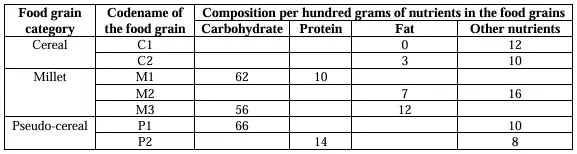
Q19. Tables
TITA · +3 / 0
How many foodgrains had a higher amount of carbohydrate per 100 grams of nutrients than M1?
Correct Answer
5
Step-by-step solution
📌 Core Concept
Every row sums to 100 g, so each missing value can be found from the row total together with the multiple-of-5 (carbohydrate) and multiple-of-4 (other columns) conditions.
🔢 Step-by-Step Solution
1
Row totals give: M2 carbohydrate + protein = 100 − 7 − 16 = 77; P2 carbohydrate + fat = 100 − 14 − 8 = 78; C1 carbohydrate + protein = 100 − 0 − 12 = 88; C2 carbohydrate + protein = 100 − 3 − 10 = 87.
2
P1: protein + fat = 100 − 66 − 10 = 24. Fact 5 makes P1 protein double M3 protein. M3 protein + other = 100 − 56 − 12 = 32. M3 protein is 4 or 8, so P1 protein is 8 or 16. Fact 1 says pseudo-cereal protein exceeds M1's 10, so P1 protein is 16 and M3 protein is 8.
3
M2: protein must be below both pseudo-cereal proteins (16 and 14) and be a multiple of 4, so it is at most 12. Carbohydrate must be a multiple of 5, which only protein 12 allows. M2 carbohydrate is 65.
4
P2: carbohydrate with fat a multiple of 4. Carbohydrate must be a multiple of 5 and exceed every millet (fact 1), so it is 70.
5
Cereals must exceed P1's 66 and P2's 70 (fact 2). C1: 88 splits as 80 + 8, the only multiple-of-5 option above 70 with protein a multiple of 4. C2: 87 splits as 75 + 12.
6
Carbohydrate values: C1 80, C2 75, M1 62, M2 65, M3 56, P1 66, P2 70.
7
Grains above M1's 62: C1, C2, M2, P1, P2, which is 5 grains.
Quick Check
Only M3 (56) is below M1, so 6 − 1 = 5 grains are above it.
Correct Answer: 5